

The Q1 2026 median house price in Liverpool sits around $1.27 million, while two-bedroom units are regularly clearing above $700,000, so the right dwelling type matters more than the headline number. A buyer who compares every Liverpool listing against the house median is likely to miss the true opportunities and the genuine risks.
Liverpool is no longer a market that can be judged with one suburb-wide figure. Houses, two-bedroom apartments and three-bedroom units attract different buyers, carry different costs and respond differently when borrowing capacity tightens. The practical question behind a search for property for sale in Liverpool NSW is not, “What does Liverpool cost?” It's, “Which type of property suits my budget, purpose and tolerance for ongoing costs?”
Table of Contents
- What the Liverpool NSW Market Looks Like Right Now
- Who Lives in Liverpool and Why It Matters for Buyers
- Houses vs Units in Liverpool NSW Compared
- Why Sales Are Slowing but Well-Priced Homes Still Compete
- Recent Liverpool Sales That Show How the Market Really Works
- How the Liverpool Dwelling Pipeline Shapes Supply and Value
- Affordability, Yields and the Investor Question
- Practical Next Steps for Buyers and Sellers in Liverpool NSW
What the Liverpool NSW Market Looks Like Right Now
The latest market reading shows a sharp divide between dwelling types. PRD recorded a Q1 2026 median of $1,270,000 for houses and $598,750 for units, while its Liverpool market update recorded 13.4% year-on-year house price growth and a house yield of 3.0%. Those figures describe very different propositions. A house offers land and family space, but it demands substantially more capital. A unit may be easier to enter, but strata obligations and building quality can determine whether the apparent discount is genuine. PRD's Liverpool market update provides the detailed market context behind those figures.
Two-bedroom apartments are particularly important because selected sales and current listings have pushed beyond the mid-$700,000 range. Domain's Liverpool data includes multiple two-bedroom apartment sales in the mid-$500,000s and a live two-bedroom listing at $760,000, confirming that location, condition, parking and building quality can move a unit well beyond a basic suburb median. Domain's Liverpool sold and live apartment data is useful for checking that spread, although buyers should always distinguish an asking price from an achieved result.
Liverpool Property Market at a Glance
| Metric | Q1 2026 Position | Practical Meaning |
|---|---|---|
| House median | $1,270,000 | Detached homes carry a major land and space premium |
| Unit median | $598,750 | Units provide a lower capital entry point, but quality varies sharply |
| House sales | 390 transactions, down 28.6% year-on-year | Buyers are more selective, so pricing accuracy matters |
| Unit sales | 260 transactions, down 15.3% year-on-year | Unit demand remains active, but not every apartment is equally liquid |
| Vacancy rate | 1.1% in March 2026 | Rental competition remains tight for suitable stock |
The broader Sydney context also matters when judging affordability, lending conditions and suburb-level price movements. Buyers who want a wider explanation of how Sydney property prices changed can use that overview alongside Liverpool-specific comparable sales.
For sellers, the lesson is direct. A strong campaign can't rescue an unrealistic price guide. The homes that compete are presented properly, supported by relevant comparable sales and positioned for the buyer group most likely to act.
Who Lives in Liverpool and Why It Matters for Buyers
Liverpool's demand comes from a broad local population rather than one narrow buyer profile. The ABS 2021 Census QuickStats records 233,446 residents for the Liverpool local area, with a median weekly household income of $1,819, median monthly mortgage repayments of $2,200 and median weekly rent of $400. These figures show both the depth of the housing market and the pressure facing households deciding whether to rent, buy or move between dwelling types. The data is available through the Liverpool suburb profile based on ABS Census information.
That population supports several overlapping markets:
- Family purchasers often prioritise land, bedroom count, schools and practical parking, but the house median places borrowing capacity under pressure.
- First-home buyers commonly compare smaller apartments against the cost of continuing to rent, with deposit size and mortgage serviceability shaping their shortlist.
- Investors look for reliable tenant demand, but gross rent doesn't reveal the impact of strata levies, insurance, maintenance, management and finance costs.
- Professionals and downsizers may accept less land in exchange for central access, secure parking, lift access and reduced upkeep.
The local income figures explain why Liverpool has distinct price segmentation. A household may be able to manage regular housing costs while still being unable to compete comfortably for a median-priced house. That doesn't eliminate demand. It redirects demand towards smaller units, shared purchasing arrangements, older homes requiring work and properties in nearby suburbs.
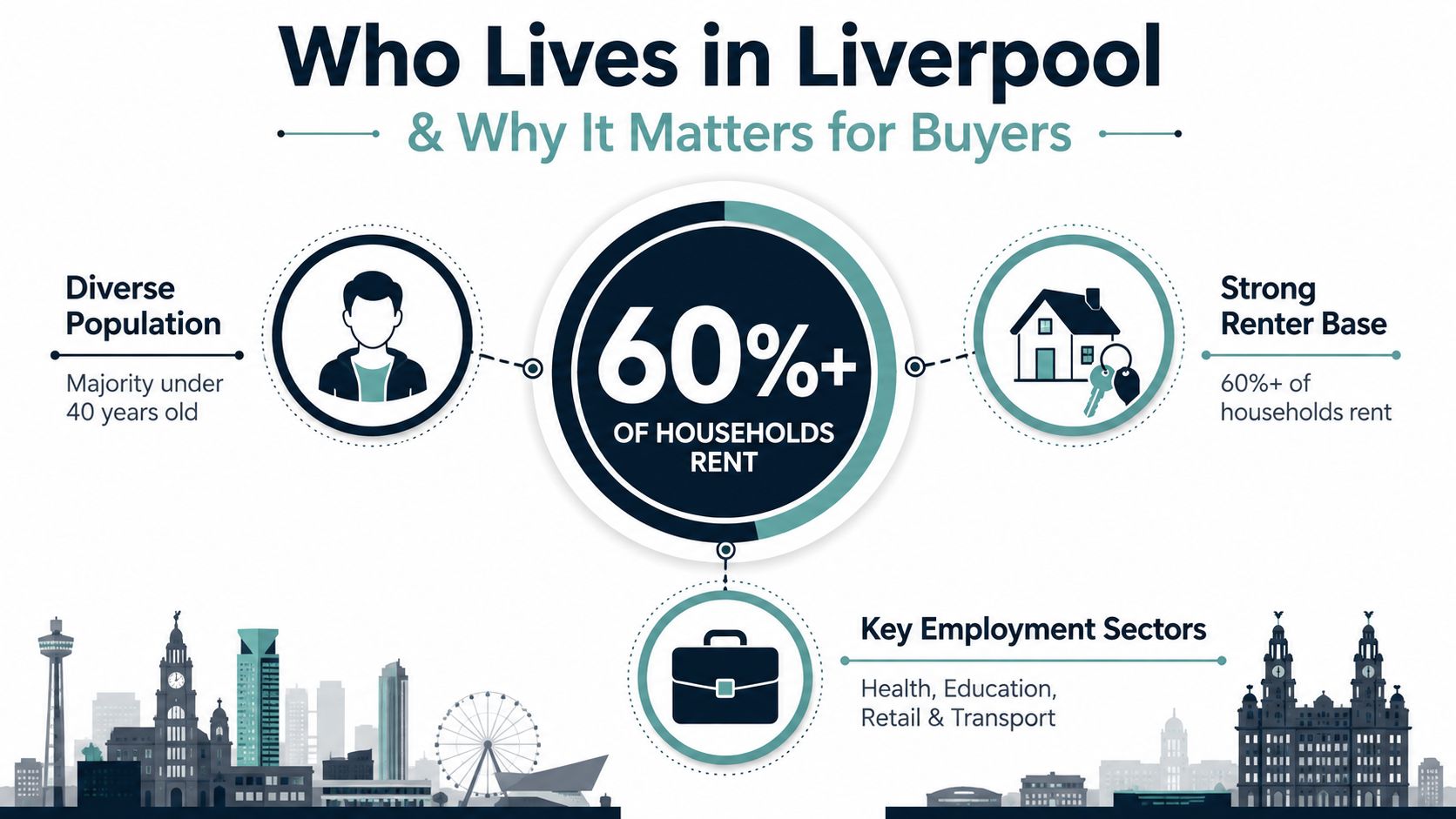
Rental evidence reinforces the difference between dwelling types. SQM Research listed weekly rents of $680.39 for three-bedroom houses, $577.34 for all units and $537.50 for two-bedroom units in Liverpool. Those figures help investors compare income potential, but they don't replace a net cash-flow assessment. A unit with a high levy schedule can produce less usable income than the advertised rent suggests.
Sellers should identify the strongest audience before preparing the campaign. A three-bedroom unit needs a different presentation from a compact CBD apartment, and a family house should lead with usable living space rather than generic claims about convenience.
Houses vs Units in Liverpool NSW Compared
Liverpool buyers are choosing between three distinct products, not just “house or apartment”. A detached house near the current median offers land, privacy and family accommodation. A two-bedroom unit provides a more accessible route into the suburb but can face competition from newer developments. A three-bedroom unit sits between those options and has recently shown the most interesting resilience.
Independent reporting for 2025 recorded a median house sale price of about $1.2 million from 121 sales, compared with a median unit sale price of about $510,000 from 823 sales. House values were reported as up 14.8% against 2024, while units rose 3%. The transaction gap is significant. 823 unit sales versus 121 house sales indicates that apartment and unit stock represents a much larger part of Liverpool's trading activity. The Liverpool local area analysis adds useful context about the suburb's housing profile and population.
Which Dwelling Type Fits the Buyer
| Property Type | Typical Price Position | Main Advantage | Main Trade-Off |
|---|---|---|---|
| House | Around $1.27 million in Q1 2026 | Land, privacy and family space | Higher entry cost and a smaller eligible buyer pool |
| Two-bedroom unit | Selected properties above $700,000 | Central access and lower maintenance than a house | Strata costs, shared building risk and limited bedroom space |
| Three-bedroom unit | $623,000 median, with 65 days on market | More usable accommodation without house upkeep | Larger floor plans can carry higher purchase and strata costs |
LSRE's suburb profile recorded two-bedroom units at a $476,000 median with 63 days on market, compared with three-bedroom units at a $623,000 median with 65 days on market. The similar selling periods matter. Buyers aren't automatically rejecting the larger unit premium when the layout works, the complex is well maintained and the property presents as a genuine alternative to a house. The LSRE Liverpool profile sets out those bedroom-specific comparisons.
Gross yield can favour units because the purchase price is lower, but strata fees narrow that advantage quickly. Houses may offer stronger long-term land exposure, while three-bedroom units can suit buyers seeking a balance between income, usable space and maintenance.
Use comparable sales that match bedroom count, parking, building age, floor position, condition and street location. Comparing a modern three-bedroom unit with an older two-bedroom apartment may help with budgeting, but it isn't a defensible valuation method.
Practical rule: Value the property against its closest competitors, not against the cheapest dwelling in the suburb.
Why Sales Are Slowing but Well-Priced Homes Still Compete
Falling transaction volume doesn't mean every Liverpool property is struggling. PRD recorded 390 house sales in Q1 2026, down 28.6% year-on-year, and 260 unit sales, down 15.3%. At the same time, Liverpool's vacancy rate was 1.1% in March 2026, below the Liverpool LGA long-run average of 1.2% and comparable with Sydney Metro's 1.1%. The Gregory Agency market report brings those sales and rental indicators together.
The split tells us buyers remain present but are refusing to pay without evidence. A well-presented apartment with a sensible price guide can still attract inspections because buyers understand what it offers and can compare it against achieved results. A dated property with a high guide, weak natural light or an awkward layout may receive attention online but lose momentum once purchasers inspect it.
What the Indicators Are Saying
| Indicator | Q1 2026 Reading | What It Means |
|---|---|---|
| House sales | 390 transactions | The higher price point is narrowing buyer participation |
| Year-on-year house sales change | Down 28.6% | Sellers need realistic campaign positioning |
| Unit sales | 260 transactions | Apartments remain active, but quality separates outcomes |
| Year-on-year unit sales change | Down 15.3% | Buyers are comparing buildings and costs more carefully |
| Vacancy | 1.1% | Rental demand remains tight for suitable properties |
| House price | $1,270,000 | Detached stock still commands a substantial premium |
The mistake is to interpret a slower market as a reason to make a panic offer, or as permission for a seller to price from an old peak. Buyers can negotiate where a listing has been exposed without a clear result, but they still need to act decisively when a property is correctly priced and effectively differentiated.
Sellers should treat the first campaign period as a test of positioning. If enquiry is weak, the cause may be price, presentation, poor photography or an unclear target audience. Waiting for the market to “catch up” often creates a stale listing that later buyers use as a negotiation tool.
Recent Liverpool Sales That Show How the Market Really Works
The clearest recent evidence comes from the difference between unit formats. PRD reported that Liverpool's median unit price was $585,000 in Q1 2025, with annual growth of 8.9%, and later recorded a median of $565,000 in Q3 2025, with annual growth of 5.6%. Unit sales moved from 306 in Q1 2025 to 352 in Q3 2025, a pattern PRD associated with undersupply and price resilience. PRD's second-half 2025 Liverpool update is a useful reference for that change over the year.
That data needs to be read carefully. A median can rise because the mix of properties sold changes, not because every apartment has achieved the same result. The practical comparison is between similar buildings and similar floor plans.
Why Three Bedrooms Are Holding Attention
The three-bedroom unit market has been more resilient than many buyers expected. The reason is straightforward. A well-designed three-bedroom unit can accommodate a family, a professional working from home or an investor targeting a broader tenant pool, while avoiding the maintenance burden of a detached house.
Selected two-bedroom properties have also demonstrated that buyers will pay above the broad unit median when the apartment offers a strong combination of location, parking, size and presentation. Current Domain data shows a two-bedroom Liverpool property listed at $760,000, while sold listings include multiple two-bedroom apartments in the mid-$500,000s. That spread shows why a buyer must inspect the individual building rather than assume every two-bedroom unit belongs in the same price bracket.
A three-bedroom unit should be assessed for genuine usability. A nominal third bedroom without natural light, adequate ventilation or practical furniture space may not justify the premium. Conversely, a quiet apartment with secure parking, a functional kitchen and a well-run strata scheme can attract both owner-occupiers and investors.
The pattern is consistent across the market. Presentation, pricing discipline and dwelling type matter more than a generic claim that Liverpool is rising. A seller with a renovated, well-positioned unit can compete strongly. A seller with a tired property and an ambitious guide may struggle even when local demand remains sound.
How the Liverpool Dwelling Pipeline Shapes Supply and Value
Liverpool's future housing supply is large enough to change the competition between neighbourhoods and dwelling types. A NSW parliamentary submission citing Department of Planning and Environment forecasts stated that Liverpool LGA would need 116,150 dwellings by 2036. It also recorded 6,586 dwellings delivered between 2011 and 2016, with a further 8,050 forecast for 2016 to 2021, while the South West Growth Area was projected to reach 27,800 new dwellings at final build-out. The investment property analysis of Liverpool's dwelling pipeline provides the source context for those projections.
These figures don't mean every Liverpool property faces the same supply risk. New apartment stock competes most directly with other apartments offering similar layouts, facilities and access. A detached house in an established street competes within a much narrower pool because a new development may not provide equivalent land, mature amenity or established streetscape.
Read the Pipeline by Product
| Dwelling Type | Pipeline Pressure | Value Outlook |
|---|---|---|
| Small new apartments | Higher where several projects offer similar layouts | Buyers should negotiate hard and inspect building quality |
| Two-bedroom units | Variable, depending on building location and competing stock | Stronger where parking, light and access distinguish the property |
| Three-bedroom units | More limited relative to family-sized demand | Resilience can improve when the layout genuinely replaces a house |
| Established houses | Lower direct competition from new apartment supply | Land and established amenity can support scarcity value |
Buyers considering growth-area stock should compare the completed product against future competing supply, not just the display suite. Check the apartment's position within the building, anticipated neighbouring construction and the costs attached to shared facilities.
Sellers need to identify the exact alternatives a purchaser will see. A new apartment is competing with other new apartments. An established house with a strong land component, usable rooms and access to existing services may have fewer direct substitutes.
For a more detailed discussion of approval trends and buyer implications, see what building in Liverpool NSW approval trends mean for buyers. The central point is simple. Supply creates risk where properties are interchangeable, but it doesn't automatically weaken scarce, differentiated stock.
Affordability, Yields and the Investor Question
Liverpool's affordability gap is too large for investors to ignore. Median household income is around $80,496, with estimated buying affordability of roughly $489,000 to $520,000, while recent 2026 market updates place the median Liverpool house price between $1.27 million and $1.35 million. The Liverpool affordability and market analysis explains why many searches for property for sale in Liverpool NSW become a question of dwelling type, deposit and borrowing capacity.
A concrete borrowing comparison makes the gap clearer. A $600,000 unit requires a materially smaller deposit and loan than a house priced around $1.27 million. On an $80,496 household income, the unit may fit a household's borrowing plan, subject to existing debts, interest rates and lender assessment. The house requires far more capital and exposes the buyer to substantially higher repayments, even where land offers stronger long-term appeal.
The investor's first decision is therefore purpose. A three-bedroom unit can deserve close attention because it may provide family-sized accommodation without the entry cost of a detached house. That resilience matters when buyers need space but cannot reach house pricing. A two-bedroom unit may suit an income-focused strategy, provided the building's ongoing costs do not consume the apparent advantage.
Compare the Strategy, Not Just the Property
Investors should calculate net yield from actual figures. Confirm the rent, building levies, sinking-fund contributions, insurance, repairs, council charges and management fees before relying on an advertised gross return. The strata report and property-specific rental appraisal matter more than a broad suburb comparison.
A cash-flow buyer should test the complete expense schedule and vacancy assumptions. A growth-focused buyer may accept lower immediate income for land exposure, but must service the debt through weaker periods. An owner-occupier should separate the lifestyle value of additional rooms, parking or location from the investment calculation.
Three-bedroom units sit between those strategies. They can attract households seeking space, while avoiding the full capital requirement of a house. Their performance still depends on layout, parking, building condition, strata costs and competing stock.
For current rental options, Liverpool rental properties can help establish the type of accommodation tenants are being offered. Investors should then obtain independent finance, tax and building advice.
The disciplined question is: Can this property meet your purpose without relying on an optimistic resale story?
Practical Next Steps for Buyers and Sellers in Liverpool NSW
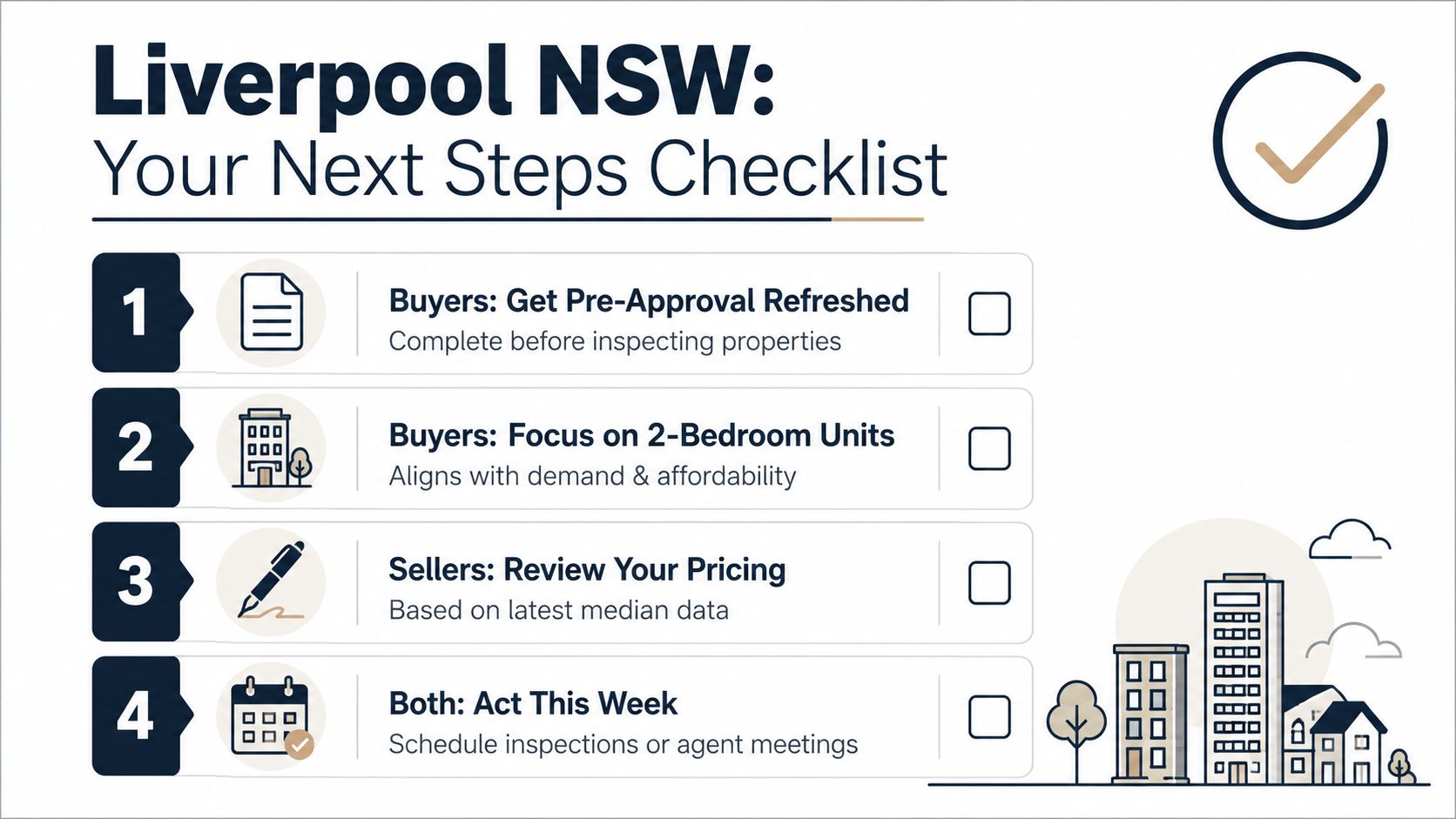
Buyers should turn the market evidence into a short operating checklist:
- Refresh finance approval before inspecting. The house median and local affordability gap make borrowing capacity a decision point, not an administrative detail.
- Choose the dwelling type first. If income matters most, compare two-bedroom units and their complete strata budgets. If land and long-term accommodation matter most, assess established houses without assuming the median is achievable for every household.
- Order independent due diligence. For any purchase above $1 million, arrange building and pest advice before committing, and obtain the strata report for an apartment.
- Compare achieved sales, not guides. Use matching bedroom count, parking, building age and condition. Domain's sold data is a useful starting point, but it shouldn't replace local valuation judgement.
Sellers need an equally deliberate process:
- Set the guide from current comparables. Falling Q1 2026 transaction volumes mean buyers are less forgiving of ambitious pricing.
- Present the property for its strongest audience. A three-bedroom unit should show usable accommodation, while a house should make its land and family advantages clear.
- Prepare the campaign before launch. Professional photography, accurate floor plans, clean styling and organised documents reduce avoidable objections.
- Use more than portal exposure. A database campaign can identify active buyers before the first inspection. If you're weighing presentation options, this Virtual Tour Easy real estate guide explains how three-dimensional tours can help remote and time-poor purchasers assess a property.
Whether you're selling, buying or comparing agents, compare real estate agents in Liverpool by looking at communication, campaign design, local evidence and who will handle the negotiations. Gregory Property Agents provides sales, buyer advisory and property management services across Liverpool and surrounding South-West Sydney, with direct agent involvement and data-backed pricing.
Gregory Property Agents can help you assess the right Liverpool dwelling type, prepare a defensible price position and negotiate with the current buyer pool in mind. Visit Gregory Property Agents to arrange a property discussion, market appraisal or buyer consultation before you act.