
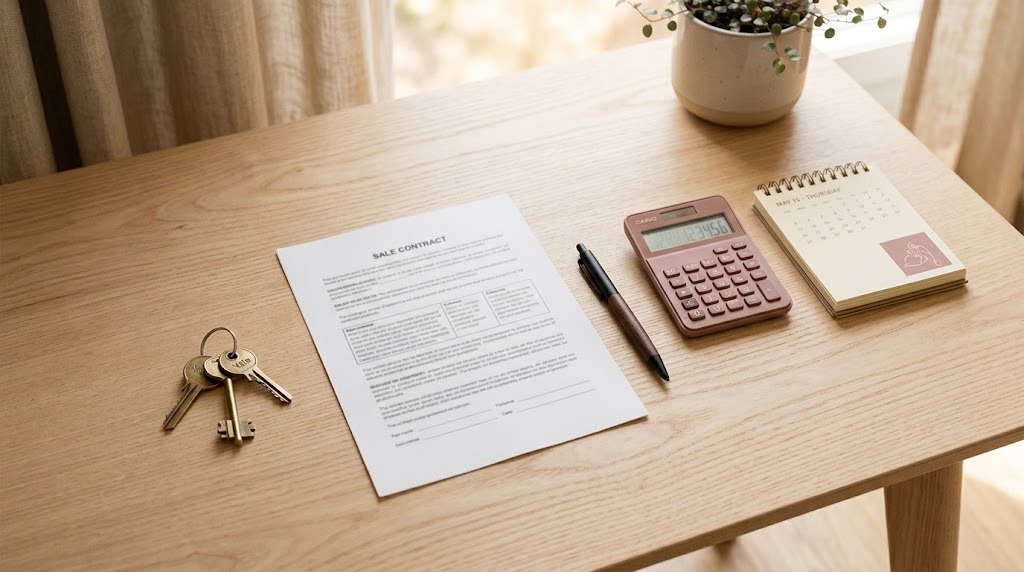
Selling a house in Green Valley follows a set New South Wales process: an appraisal, a signed agency agreement, a contract for sale prepared by a solicitor or conveyancer, a marketing campaign, exchange of contracts, then settlement, which NSW Fair Trading says typically happens about six weeks after exchange. The costs to plan for are agent commission, marketing, conveyancing, clearing your mortgage and getting the house ready, plus capital gains tax in some cases.
If you bought here twenty or thirty years ago, parts of this will look unfamiliar. Contracts are mostly exchanged electronically now, settlement happens online, and since January 2025 every Australian resident seller needs a tax document most long-term owners have never heard of.
Here’s how it runs, in order.
How do you sell a house in Green Valley NSW?
You get your home appraised, sign an agency agreement with a licensed agent, have a solicitor or conveyancer prepare the contract for sale, then market the home by auction or private treaty. Once contracts are exchanged with a buyer, settlement usually follows about six weeks later, when the money transfers and you hand over the keys.
Step 1: Find out what your home is worth
The median house price in Green Valley is $1.2 million, up 3.9% over the past 12 months on 108 sales (Cotality data via propertyvalue.com.au, checked October 2026). Recent verified sales run from $1,262,500 for a four-bedroom home on 701 m² in July 2026 to $1,920,000 for a five-bedroom home on 782 m² in April 2026 (Pricefinder and NSW Valuer General data).
Where your home lands in that spread depends on land size, layout, condition and recent nearby sales. We cover it properly in what your Green Valley home is worth, and you can book a free property appraisal at any time.
Step 2: Choose an agent and read the agency agreement properly
An agent can’t market your home until you’ve both signed an agency agreement. It’s a legally binding contract, and NSW Fair Trading says it must state:
- the services provided, and the fees or commission you will pay
- when and how the agent is paid (for example, from the buyer’s deposit)
- the agent’s estimated selling price, where a range can’t have a top figure more than 10% above the bottom
- whether the agent can do things like exchange contracts for you.
Commission is negotiable, as Fair Trading points out. Compare what you’re signing up for, not just the percentage. Flat rate or tiered? (Fair Trading warns price-based tiers can cost significantly more.) What marketing is included? How long is the term, and how do you end it?
The price estimate deserves the same scrutiny. Under NSW underquoting rules, the agent must give you evidence for their estimate and can’t advertise or quote below it. A big number is easy to say. Ask to see the sales behind it.
The agreement itself has a one-business-day cooling-off period, ending at 5pm the next business day (Saturday counts; public holidays don’t). Changing agents? End the old agreement in writing first, or both may charge you commission.
Step 3: Have the contract for sale ready before you advertise
The contract must be prepared before the home is advertised, and NSW Fair Trading says a solicitor or conveyancer should prepare it. You need one anyway, because every NSW settlement now runs through the eConveyancing system.
The contract must include the title search with the registered plan and any dealings such as easements, a drainage diagram, a current section 10.7 zoning certificate from Liverpool City Council, and a statement of the buyer’s cooling-off rights. A swimming or spa pool adds a certificate of compliance, a recent occupation certificate with proof of registration, or a certificate of non-compliance.
Miss a required document and the buyer may be entitled to rescind within 14 days of exchange.
Two more items belong here.
Your ATO clearance certificate. Since 1 January 2025, the ATO requires every Australian resident selling property to have a clearance certificate and give it to the buyer at or before settlement. Without one, the buyer must withhold 15% of the price and pay it to the ATO. On a $1.2 million sale, that is $180,000 not paid to you at settlement. Apply as soon as you decide to sell.
Land tax, if it applies to you. If your landholdings are over the threshold, Fair Trading says outstanding land tax must be cleared before the property can be sold.
Added a granny flat, enclosed a patio or put up a big shed over the years? Tell your conveyancer now, not when a buyer’s solicitor asks.
Step 4: Prepare and present the home
Spend less than you think. Buyers look hard at the block, the floor plan and the bones of the house, so fix what they’ll notice in the first five minutes: a dripping tap, a door that sticks, a tired front garden.
Then clear out. Buyers need to picture their own things in your rooms. A full renovation before selling rarely pays its way, and it delays the day you can list.
Step 5: Auction or private treaty?
With private treaty, you set a price and buyers make offers. NSW Fair Trading notes you get more control and time to consider offers. The risk is pricing: too high and it may not sell, too low and you leave money behind.
At auction, you give your agent a written reserve price before bidding starts. Pass it and the home sells at the fall of the hammer, with the deposit (usually 10%) paid on the spot. Fall short and the property is passed in, and you negotiate with bidders.
No method suits every street. We lean towards auction when we expect several ready buyers to compete, and private treaty when the buyer pool is narrower or the home needs explaining. BJ will tell you which he’d choose for your property, and why.
Step 6: Marketing and open homes
A typical campaign combines professional photos, a floor plan, online listings, a signboard, open homes and private inspections, with cost and length agreed up front.
What sellers underestimate is price feedback. If offers show the estimate is no longer reasonable, the agent must revise it and tell you in writing. Better to have that conversation early.
Step 7: Offers, negotiation and exchange
Price is only one part of an offer. Look at the deposit, settlement date, cooling-off and conditions too. A slightly lower offer with clean terms can be the stronger one.
Nobody is bound until signed copies of the contract are exchanged, which these days is usually done electronically. The buyer pays a deposit of 10% unless a lower amount is agreed. During cooling-off they can pay just 0.25% at exchange and the rest before cooling-off ends, according to NSW Fair Trading.
In a private treaty sale, the buyer usually has five business days after exchange to withdraw, forfeiting 0.25% of the price if they do. They can waive it with a certificate from their lawyer or conveyancer, or it can be shortened or extended by negotiation. You, the seller, get no cooling-off. Neither does an auction buyer, even if a passed-in property sells later that day.
Step 8: The settlement period
NSW Fair Trading says settlement typically occurs six weeks after exchange, though a different timeframe can be negotiated, which helps if you need time to buy or move.
Your conveyancer handles the legal side. Your jobs: call your lender early about the mortgage discharge and any fees or break costs (especially on a fixed rate), book removalists, and keep the home in the condition it was sold in.
Transfer duty is not your cost. Revenue NSW says it is paid by the purchaser, and sellers do not pay it.
Step 9: Settlement day and handing over the keys
Settlement happens online between conveyancers and lenders; you don’t attend. Funds clear your mortgage, commission is paid as your agency agreement sets out, and the balance comes to you. Once it’s confirmed, the keys go to the buyer.
What does selling a house in Green Valley cost?
We won’t quote averages, because most of these depend on your choices and circumstances. Here’s what each covers and what moves it.
| Cost | What it covers | What affects it |
| Agent commission | The agent’s fee for selling, usually payable only on sale | Negotiated with the agent. Flat rate or tiered structure, what is included, when it is payable |
| Marketing | Photos, floor plan, online listings, signboard, inspections | Campaign size and length, listing level; check whether it is payable if the home does not sell |
| Auctioneer’s fee | Running the auction, if you choose that method | Must be stated in the agency agreement if you are paying it |
| Conveyancing and legal | Contract preparation, searches and certificates, settlement | Complexity of the title, a pool, past additions to the property |
| Mortgage discharge | Clearing your loan at settlement | Your lender’s fees; break costs on a fixed-rate loan |
| Presentation and repairs | Cleaning, gardening, minor repairs, painting, styling | Condition of the home and how much you choose to do |
| Capital gains tax | Tax on a capital gain, if any | Your main residence is generally exempt; renting it out or other income use can change that. Ask an accountant |
| Land tax | Any outstanding land tax | Only applies if your landholdings exceed the threshold |
| Moving | Removalists and any storage | Distance, volume, timing |
On capital gains tax, the ATO says your main residence is generally exempt. The ATO has also flagged CGT changes announced in the 2026–27 Federal Budget, so confirm your position with an accountant.
Not on the list: stamp duty. That’s the buyer’s.
How long does it take to sell a house in NSW?
Only two stages have timeframes set by the rules. Everything else depends on your home, your price and the market.
| Stage | Timeframe | What drives it |
| Appraisal and choosing an agent | Your pace | How many agents you compare |
| Agency agreement | 1 business day cooling-off (unless waived) | Set by NSW rules |
| Contract for sale and clearance certificate | Varies | How quickly certificates and searches come back; any pool or title issues |
| Preparing the home | Varies | Repairs, clean-out, styling |
| Campaign to exchange | Varies most | Price, presentation, competing listings, buyer demand |
| Buyer cooling-off | 5 business days (private treaty); none at auction | Can be waived, reduced or extended |
| Settlement | Typically 6 weeks after exchange | Negotiable between buyer and seller |
Nobody can promise you the stretch from launch to exchange. Pricing and preparation are what you control, so that’s where we put the effort before a home goes live.
What affects how quickly a Green Valley home sells?
Price, first. A home priced in line with recent sales gets inspected; one priced on hope gets scrolled past.
Then presentation, the block and condition. A five-bedroom home on 782 m² draws a different buyer from a compact three-bedroom, and each buyer pool moves at its own speed. Competition matters too: when similar homes list in the same weeks, buyers compare. Holiday periods change who’s around to inspect.
Selling in a special situation
Selling for someone who has passed away? Our guide to selling a deceased estate in Green Valley and Busby covers probate and executor steps.
Selling because of a separation? Read selling the family home during separation or divorce in NSW.
How does BJ Gregory handle a Green Valley sale?
Gregory Property Agents is an independent, boutique agency based in Green Valley. BJ Gregory is a second-generation agent with over 20 years across Green Valley, Liverpool, Fairfield and South-West Sydney, and a Class 1 licensed real estate agent (NSW Licence #20435105).
The practical difference: BJ personally handles the first conversation, the appraisal and the campaign, so you deal with the person who priced your home from start to finish. Read more about how we sell homes, or about working with a real estate agent in Green Valley.
Frequently asked questions
How much does it cost to sell a house in NSW?
It depends on agent commission, marketing, conveyancing, any mortgage discharge or break costs, and what you spend preparing the home. Commission is negotiable, so compare agency agreements line by line. Sellers don’t pay transfer duty (stamp duty).
How long does settlement take in NSW?
NSW Fair Trading says settlement typically occurs six weeks after contracts are exchanged, although buyer and seller can negotiate a different timeframe. Settlement is completed electronically through the eConveyancing system.
Do sellers pay stamp duty in NSW?
No. Revenue NSW says transfer duty, previously called stamp duty, is paid by the purchaser, and sellers do not pay it.
Is there a cooling-off period when selling a house in NSW?
Not for the seller. In a private treaty sale the buyer usually has five business days after exchange to withdraw, forfeiting 0.25% of the price if they do. There is no cooling-off period at auction.
Do I need a clearance certificate to sell my house?
Yes, if you are an Australian resident for tax purposes. Since 1 January 2025 the ATO requires a clearance certificate on all property sales, given to the buyer at or before settlement. Without one, the buyer must withhold 15% of the sale price and pay it to the ATO.
Ready to talk about your sale?
Start with a free property appraisal. BJ will walk through your home, show you the sales behind his estimate and lay out the steps and costs for your property, with no obligation to list. Call 0422 333 333, email bj@gregory.agency, or get in touch online.
<div class=”gpa-author-box”>
<img class=”gpa-author-photo” src=”https://www.gregory.agency/wp-content/uploads/2026/05/bj_photo.png” alt=”BJ Gregory, real estate agent in Green Valley NSW”>
<div>
<p class=”gpa-author-name”>BJ Gregory</p>
<p class=”gpa-author-role”>Director | Licence #20435105 | Gregory Property Agents</p>
<p class=”gpa-author-bio”>A second-generation agent based in Green Valley in the Liverpool LGA, BJ Gregory has spent over 20 years working across the streets, schools and communities of Green Valley, Liverpool, Fairfield and South-West Sydney. BJ brings personal commitment and local insight that only comes from genuinely living and working in the local market.</p>
<p class=”gpa-author-ticks”><span>✓ 20+ Years Experience</span><span>✓ Licensed Agent NSW</span><span>✓ 2nd Generation Agent</span></p>
<p class=”gpa-author-cta-text”>Thinking of selling in Green Valley? BJ will walk you through every step, with no obligation.</p>
<a class=”gpa-author-btn” href=”https://www.gregory.agency/free-appraisal/”>Book BJ Direct</a>
</div>
</div>
<script type=”application/ld+json”>
{
“@context”: “https://schema.org”,
“@type”: “FAQPage”,
“mainEntity”: [
{
“@type”: “Question”,
“name”: “How much does it cost to sell a house in NSW?”,
“acceptedAnswer”: {
“@type”: “Answer”,
“text”: “It depends on agent commission, marketing, conveyancing, any mortgage discharge or break costs, and what you spend preparing the home. Commission is negotiable, so compare agency agreements line by line. Sellers don’t pay transfer duty (stamp duty).”
}
},
{
“@type”: “Question”,
“name”: “How long does settlement take in NSW?”,
“acceptedAnswer”: {
“@type”: “Answer”,
“text”: “NSW Fair Trading says settlement typically occurs six weeks after contracts are exchanged, although buyer and seller can negotiate a different timeframe. Settlement is completed electronically through the eConveyancing system.”
}
},
{
“@type”: “Question”,
“name”: “Do sellers pay stamp duty in NSW?”,
“acceptedAnswer”: {
“@type”: “Answer”,
“text”: “No. Revenue NSW says transfer duty, previously called stamp duty, is paid by the purchaser, and sellers do not pay it.”
}
},
{
“@type”: “Question”,
“name”: “Is there a cooling-off period when selling a house in NSW?”,
“acceptedAnswer”: {
“@type”: “Answer”,
“text”: “Not for the seller. In a private treaty sale the buyer usually has five business days after exchange to withdraw, forfeiting 0.25% of the price if they do. There is no cooling-off period at auction.”
}
},
{
“@type”: “Question”,
“name”: “Do I need a clearance certificate to sell my house?”,
“acceptedAnswer”: {
“@type”: “Answer”,
“text”: “Yes, if you are an Australian resident for tax purposes. Since 1 January 2025 the ATO requires a clearance certificate on all property sales, given to the buyer at or before settlement. Without one, the buyer must withhold 15% of the sale price and pay it to the ATO.”
}
}
]
}
</script>