
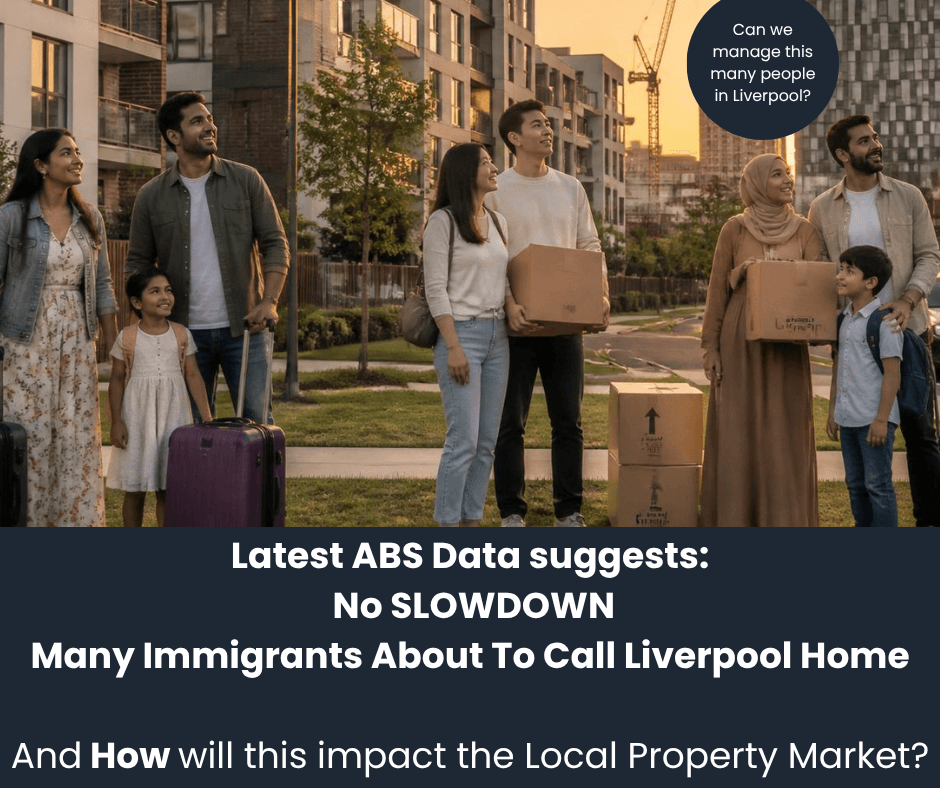

More Overseas Arrivals Set to Call Liverpool Home
New ABS data shows sustained migration surge could reshape Western Sydney’s property landscape
Fresh migration statistics released by the Australian Bureau of Statistics released on the 14th of July paint a picture of sustained population growth that could have significant implications for Liverpool and the broader Western Sydney region over the coming year.
The Numbers Tell a Story
According to the ABS Overseas Arrivals and Departures data for May 2026, Australia continues to experience strong inbound migration across multiple categories.
Permanent Migration Remains Robust
The data shows permanent arrivals have been consistently running at approximately 11,000 to 14,000 people per month throughout the 2025-26 financial year. In the 12 months from June 2025 to May 2026, Australia welcomed:
- 142,900 permanent arrivals
- 147,030 long-term residents returning
- 768,280 long-term visitors (people intending to stay 12 months or more)
Combined, that’s over 1.05 million people arriving in Australia for permanent or long-term stays in just 12 months.
What the Data Is Potentially Saying
When you look at these figures in the context of Sydney’s housing affordability crisis and infrastructure development patterns, what the data is potentially saying here is that lots and lots more people from overseas are going to be calling Liverpool home.
Why Liverpool?
The math is straightforward. New arrivals to Australia need somewhere to live, and they need it quickly. With Sydney’s median house price sitting above $1.5 million, and rental vacancy rates at historic lows across the metropolitan area, new migrants are increasingly looking to outer suburbs that offer:
- Relative affordability – Liverpool’s median house price of approximately $1m represents genuine accessibility for first-time buyers and new arrivals
- Established communities – Existing diaspora networks from India, China, the Middle East, and Pacific nations create natural settlement patterns
- Employment opportunities – The Western Sydney Airport precinct and Liverpool CBD are emerging as major employment hubs
- Infrastructure investment – Projects like the Fifteenth Avenue upgrade signal government commitment to the region’s growth
The Long-term Visitor Surge
Particularly notable in the ABS data is the spike in long-term visitor arrivals. These are people on student visas, working holiday visas, and other temporary arrangements that require stays of 12 months or longer.
The January and February 2026 figures show dramatic increases:
- January 2026: 113,160 long-term visitors
- February 2026: 124,210 long-term visitors
These cohorts need rental accommodation immediately upon arrival, and with Western Sydney University’s Liverpool campus continuing to expand, the city is well-positioned to capture a significant share of this demand.
Implications for the Local Community
Housing Market Pressure
What the data is potentially saying is that demand pressure on Liverpool’s housing market—both sales and rentals—is likely to intensify over the next 12 to 18 months.
When over a million people arrive in Australia annually for long-term stays, and Sydney remains the primary destination, the ripple effects inevitably reach suburbs like Liverpool where housing remains within reach of new arrivals and first-home buyers.
Rental Market Tightening
The long-term visitor data suggests rental markets across Western Sydney could tighten significantly. International students and temporary visa holders typically rent rather than buy, and they need accommodation close to universities, transport hubs, and employment centres—all of which Liverpool provides.
Local landlords may see improved rental yields, but the flip side is that existing renters could face increased competition and upward pressure on rents.
Infrastructure Urgency
The migration data also underscores why infrastructure debates—like the recent Governance Committee discussion about the Fifteenth Avenue upgrade—matter so much.
If Liverpool is going to absorb its share of Australia’s migration intake, the city needs infrastructure that can support a growing population. Transport corridors, public transit, schools, healthcare facilities, and community services all need to scale accordingly.
The Bigger Picture
Australia’s migration program is a deliberate policy choice designed to support economic growth, address skills shortages, and maintain the nation’s demographic balance. The ABS data confirms that policy is being implemented at scale.
For Liverpool, what the data is potentially saying is that the city is entering a period of sustained population growth driven by international migration. This isn’t speculative demand or investor-driven price inflation—it’s fundamental demand from people who need a place to live, work, and build their lives.
Whether that growth translates into opportunity or pressure depends largely on how well local and state governments plan for it, how quickly infrastructure can be delivered, and how the community responds to its changing demographics.
What Happens Next?
The ABS will continue to release monthly overseas arrivals and departures data, providing an ongoing window into migration trends. The June 2026 data, due for release in August, will offer further confirmation of whether the patterns observed through May are continuing.
For Liverpool residents, property owners, and community leaders, the message from the data is clear: plan for growth, because it’s already happening.
Data Source: Australian Bureau of Statistics, Overseas Arrivals and Departures, Australia, May 2026. Available at: https://www.abs.gov.au/statistics/industry/tourism-and-transport/overseas-arrivals-and-departures-australia/may-2026