
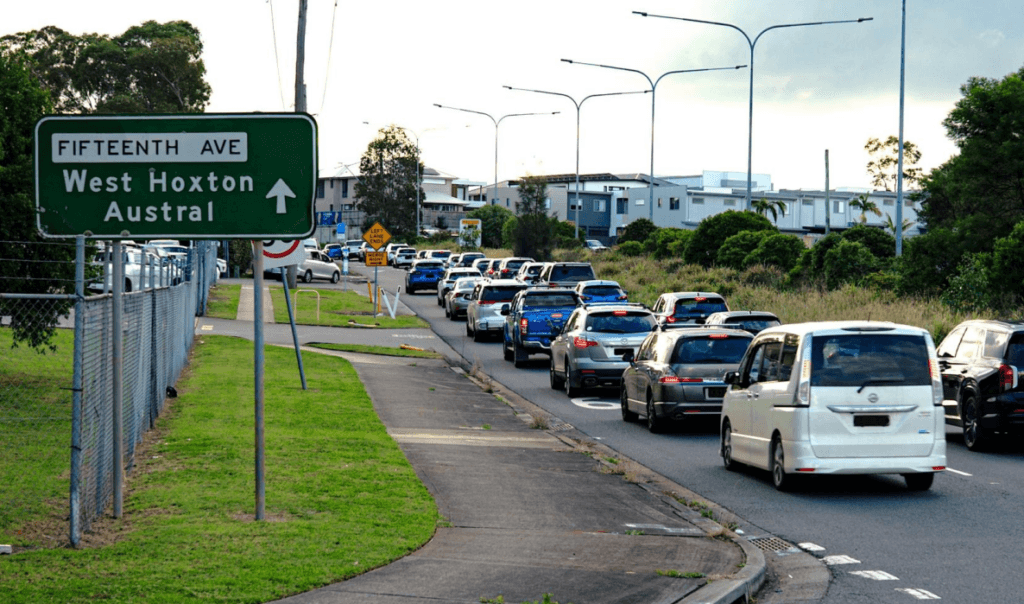
Fifteenth Avenue: Liverpool’s Future or a Missed Opportunity?
The air inside Liverpool City Council chambers will be thick with tension tonight. As Councillors prepare for this evening’s Ordinary Meeting, all eyes are fixed on one issue that has become the defining debate of the city’s growth: the Fifteenth Avenue Upgrade.
For months, the Fifteenth Avenue corridor has been a political battleground. It is the vital artery meant to connect the heart of Liverpool to the burgeoning Western Sydney International (Nancy-Bird Walton) Airport and the Bradfield City Centre. But as Transport for NSW (TfNSW) pushes forward with its “Stage 1” design, a growing chorus of planners and local advocates are asking a pointed question: Are we building a city, or are we just building a bigger road?
The TfNSW Vision vs. The “Transit Boulevard”
TfNSW’s current proposal is, by all accounts, a standard arterial road upgrade. It features two lanes in each direction, a design speed of 80 km/h, and a promise that a dedicated transitway will come later—in a “Stage 2” that currently lacks funding and land reservation.
Liverpool Council, however, is singing a different tune. They are advocating for a “Transit Boulevard”—a design that prioritizes people over pavement. Their proposal calls for a 70 km/h speed zone, three lanes in each direction, and, crucially, dedicated public transport lanes integrated from day one.
The difference in speed—dropping from 80 km/h to 70 km/h—is more than just a number. It is a fundamental shift in urban character. An 80 km/h arterial road acts as a concrete wall, severing neighborhoods and making the “active transport” paths feel like an afterthought. A 70 km/h boulevard, by contrast, is a place where high-density housing and vibrant local businesses can actually thrive.
The Airport Link: A Game Changer
The logic behind Council’s push for a dedicated transitway is increasingly difficult to ignore. A rail connection to the airport is the “holy grail” for Liverpool, but a high-frequency transit link is the immediate necessity.
Imagine a corridor where passengers can move from the airport to the Liverpool CBD with ease, luggage in tow, without ever touching a steering wheel. Imagine a workforce that can commute from the suburbs to the Aerotropolis on a dedicated, rapid-bus spine that bypasses the gridlock of a standard four-lane road. This isn’t just about moving cars; it’s about creating a car-free, efficient, and productive economic zone. If we build a standard four-lane road now, we are essentially killing the possibility of that rapid transit link for a generation.
A Question of Trust
To be fair, Liverpool Council’s track record on infrastructure advocacy hasn’t always been a straight line. Residents have been burned by past promises and shifting priorities, and skepticism toward the Council’s “alternative designs” is a natural response to years of local political volatility. Trust is a scarce commodity in Liverpool’s town planning circles.
Yet, even the most hardened cynics are beginning to look at the Council’s Transit Boulevard proposal and think: They might actually be on to something. Well Council certainly seem to think so.
The math is simple: TfNSW is solving the traffic problem of 2026. Council is trying to build the infrastructure for 2050.
What to Watch Tonight
As Councillors head into this evening’s meeting, the debate will likely center on whether to accept the TfNSW design as a “bird in the hand,” or to dig in their heels and demand a design that matches the scale of Liverpool’s ambitions.
If Council chooses to endorse their alternative design, it will be a high-stakes gamble. It risks delaying a much-needed project, but it also offers a vision of a city that is connected, dense, and sustainable.
In the high-stakes game of city-shaping, the difference between a road and a boulevard is the difference between a city that just functions, and a city that truly lives. Tonight, Liverpool decides which path it wants to take.