

Liverpool's vacancy rate is 1.1%, with median asking rents of $700.84 a week for houses and $577.34 for units. That combination makes rental properties in Liverpool NSW a landlord-leaning market, but the strongest results still depend on the street, property type, presentation and the agent's response time.
Liverpool isn't one uniform rental market. A unit near the station serves a different tenant from a family house in Hinchinbrook, while an apartment in Edmondson Park competes on transport, parking and building quality rather than backyard space. The spreadsheet tells you vacancy is tight. The local inspection tells you why some homes attract immediate applications and others sit despite the suburb's strong demand.
Table of Contents
- The Liverpool NSW Rental Market at a Glance
- Why Renting Is Structural in Liverpool LGA
- Houses Versus Units for Rentals in Liverpool NSW
- Where Tenants Are Looking Right Now
- Liverpool CBD and Edmondson Park as Standout Pockets
- What Landlords and Buyers Should Watch in 2026
- Practical Next Steps for Tenants, Owners and Investors
The Liverpool NSW Rental Market at a Glance
Liverpool's rental market recorded a 1.1% vacancy rate in Liverpool and 1.2% across Liverpool LGA in March 2026, compared with the approximately 3% level associated with a balanced market, according to PRD's Liverpool Market Update (PRD Liverpool Market Update). That is a tight result. Well-presented homes can attract applications quickly, while tenants usually need their documents, references and timing organised before an inspection.
Asking rents show a clear property-type split. SQM Research recorded median weekly asking rents of $700.84 for houses and $577.34 for units in the week ending 12 October 2025 (SQM Research Liverpool rental data). A house generally competes on bedrooms, outdoor space and access to schools. A unit is judged more heavily on station proximity, parking, building condition and travel time.
Liverpool NSW rental market snapshot
| Metric | Liverpool LGA | Sydney Metro |
|---|---|---|
| Vacancy rate | 1.2% | Broader comparison required |
| House median weekly asking rent | $700.84 | Not provided |
| Unit median weekly asking rent | $577.34 | Not provided |
Leasing activity supports the same reading. PRD reported that houses rented increased 11.7% year on year to 886 houses in Q1 2025, with the suburb's vacancy rate at 1.0% in March 2025. Owners still need to price accurately and respond promptly. A strong suburb does not rescue poor presentation, an awkward floor plan or a slow follow-up process.
Street profile remains decisive. Station-adjacent homes and well-connected apartment pockets tend to generate faster enquiry, while family houses retain a space premium. The Liverpool value suburb guide provides a useful starting point for comparing transport, property type and entry price before inspecting. From an agent's perspective, the spreadsheet shows tight conditions, but inspections reveal which homes convert that demand into signed leases.
Why Renting Is Structural in Liverpool LGA
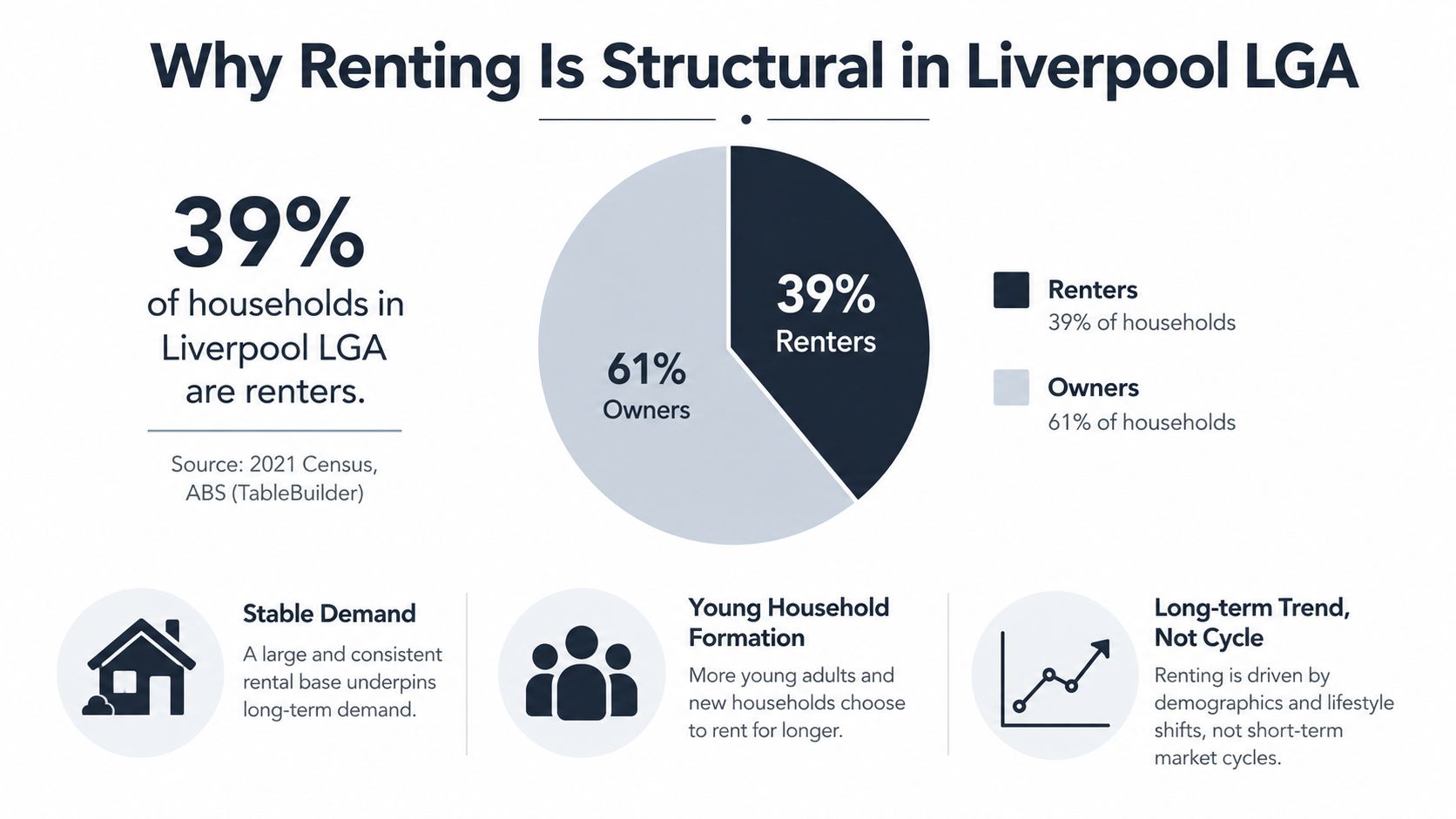
Liverpool's rental base is too large to treat as a temporary response to interest rates or a short-lived supply shock. The 2021 Census recorded 24,377 occupied privately rented dwellings, representing 35.2% of all occupied private dwellings in Liverpool, compared with 32.6% in New South Wales and 30.6% across Australia (Liverpool rental tenure data). In plain terms, roughly one in three households lived in rented accommodation.
That figure is lower than the 39% sometimes repeated in market commentary, so I'd use the Census measure when making a property decision. It shows a substantial, established tenant pool, not a niche group waiting to buy immediately.
What keeps renters in the market
Households move through Liverpool for work, education, health services, family reasons and affordability. Some may eventually buy, but the timing isn't controlled by a landlord's preferred investment horizon. A renter can remain in the pool because the gap between a weekly rent and a purchase repayment, deposit requirement or suitable home is still too wide.
Liverpool's housing mix reinforces that demand. Established family streets provide detached homes, while the CBD and newer growth areas provide apartments for smaller households. Those two segments don't compete directly, which helps sustain demand across both houses and units.
Practical rule: Treat Liverpool's tenant demand as a permanent operating condition, not a temporary bonus. Your vacancy allowance should still be realistic because a strong suburb won't rescue an overpriced or poorly presented property.
The latest market update also shows why tight conditions can coexist with more investor stock. PRD recorded vacancy at 1.1% in Liverpool and 1.2% across the LGA in March 2026, still far below the approximately 3% balanced-market benchmark (PRD's Liverpool vacancy update). More listings don't automatically create balance when tenant demand absorbs them quickly.
Houses Versus Units for Rentals in Liverpool NSW
The tenant profile should drive the house-versus-unit decision, not the advertised yield alone. Houses suit families seeking bedrooms, outdoor space and parking. Units attract singles, couples, smaller households and workers who will exchange floor area for transport access and lower maintenance.
The verified figures support a clear price difference. Liverpool's $700.84 house median is above the $577.34 unit median. PRD reported a 3.0% house rental yield in March 2025, then recorded 3.0% for Liverpool houses in March 2026, compared with the 2.6% Liverpool LGA average and 2.8% Sydney Metro figure, as noted in PRD's Liverpool market update, cited earlier in this article.
Houses vs units rental performance
| Metric | House, 3-bed | Unit, 2-bed |
|---|---|---|
| Median weekly asking rent | $700.84 | $577.34 |
| Verified rental yield reference | 3.0% house yield | Unit yield not provided in the verified data |
| Typical tenant | Families and larger households | Singles, couples and smaller households |
| Main leasing advantage | Space, privacy and parking | Transport access and lower maintenance |
A house may produce a lower gross return on the purchase price than a unit while still offering steadier leasing demand. Families usually have fewer suitable alternatives. Practical parking, usable living space and an outdoor area can keep a house competitive, even when a cheaper apartment is available.
Units perform best when location does the work. A clean two-bedroom apartment near Liverpool station, shops or services can lease quickly because tenants reduce travel time and car dependence. The building still matters. A tired walk-up with poor light, limited parking or unresolved strata issues will not perform like a modern, well-managed apartment nearby.
Street profile often decides the result. Quiet access, functional layouts and easy parking help houses compete. For units, secure entry, natural light, lift access where relevant and reasonable strata presentation can matter more than a small difference in advertised rent.
The trade-off investors often miss
A higher yield does not automatically mean lower risk. PRD's later update noted that vacancy had risen modestly as investors returned to the market, while Liverpool house yields remained above broader benchmarks. That combination matters because several similar apartments can compete for the same tenant group.
Compare net cash flow after strata, management, maintenance, insurance, council rates and realistic vacancy. SQM's Liverpool rent data, cited earlier, can help frame asking-rent conditions, but the final test is property-specific. Check whether the numbers still work if leasing takes longer or the advertised rent is not achieved.
Where Tenants Are Looking Right Now
Transport is the clearest common denominator. Renters are increasingly conscious of the cost of driving, and properties within practical walking distance of a station or frequent bus route attract attention because the saving is felt every week. That doesn't make every station-side apartment a good rental. It means access must be genuine, safe and convenient at the time the tenant travels.
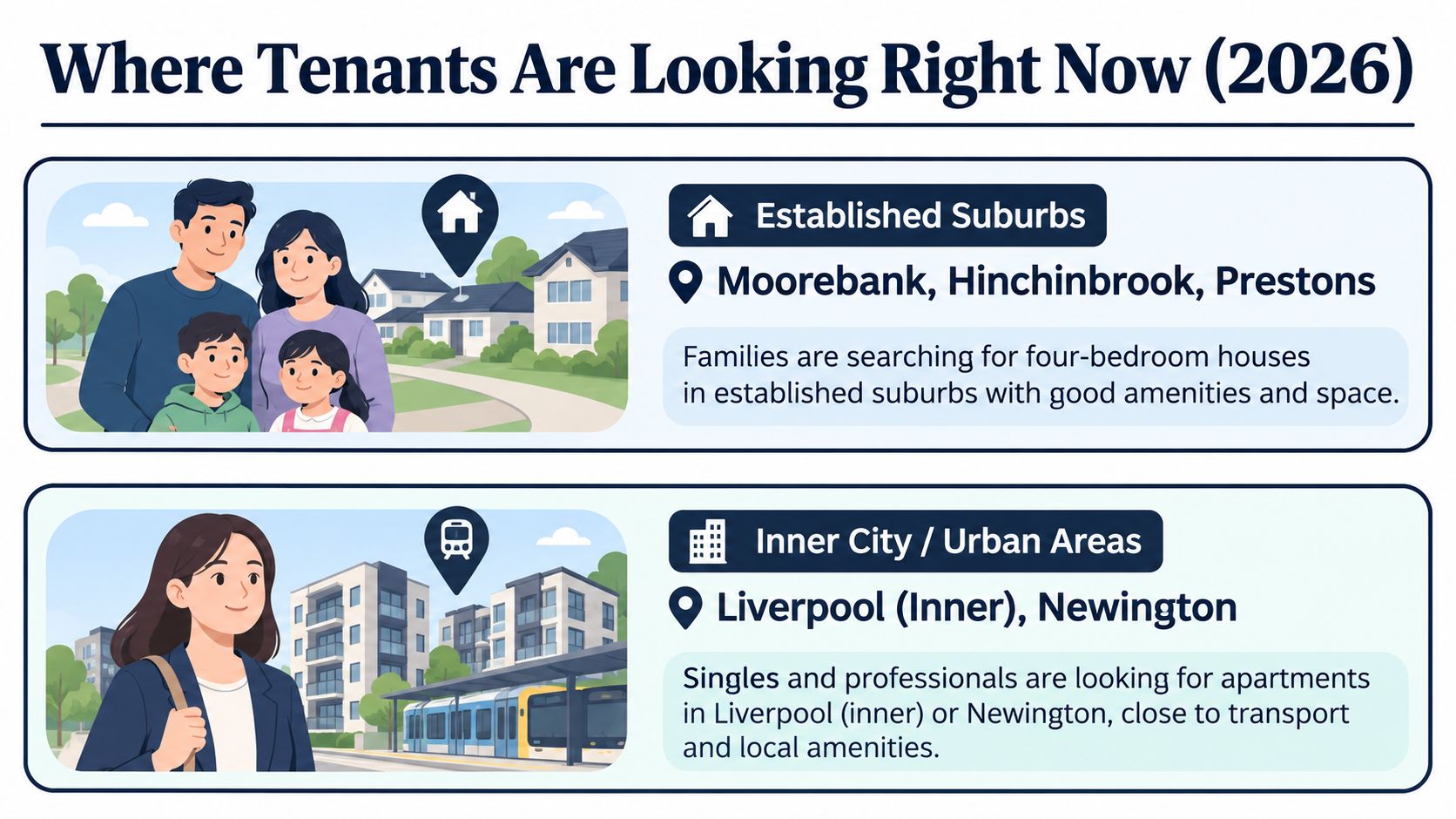
Family renters often search established areas such as Moorebank, Hinchinbrook and Prestons for larger homes with usable living areas and better separation between bedrooms. Professionals and smaller households look more closely at Liverpool CBD, Warwick Farm and other transit-oriented corridors. The tenant's job location can matter more than a suburb label.
How renters improve their odds
Start before the listing appears. Set alerts on Domain and Realestate.com.au, keep your documents organised and contact the agent as soon as a suitable property goes live. Waiting for a midweek replay can mean the strongest applicants have already inspected and applied.
Bring a complete file:
- Income evidence: Have recent payslips ready and make sure the figures are consistent with the application.
- Rental history: Include a current rent ledger where available, plus landlord or agent references.
- Identity documents: Keep the standard identification material easy to upload.
- Employment confirmation: A clear employer reference can answer questions before the agent needs to ask.
Properties on busy corridors such as Camden Valley Way may suit tenants who value access, but noise, parking and turning movements need to be checked in person. Older walk-ups near the hospital can linger when they lack lift access, storage, parking or modern finishes. Those trade-offs matter more than a listing's polished photos.
Liverpool can also draw applicants who travel long distances for work. A prepared agent who can show a property at 7 pm when requested is more likely to capture those tenants than one who only offers narrow inspection windows. For workers commuting for up to two hours, an evening inspection isn't a luxury. It may be the only practical opportunity.
The South-West Sydney employment and airport overview provides useful context for renters and owners thinking about employment-linked demand. The on-ground rule remains simple: register early, inspect promptly and apply with a complete file.
Liverpool CBD and Edmondson Park as Standout Pockets
Liverpool CBD and Edmondson Park attract different renter profiles, yet both reward practical access. CBD tenants often prioritise the station, hospital, shops, services and riverfront amenities within an easy trip. Edmondson Park appeals to renters seeking newer apartments, town-centre convenience and a more recent growth setting.
The Light Horse Park Revitalisation Project will be delivered in three stages and is expected to be completed by early 2027, according to the Light Horse Park project overview. Council documents list upgraded landscaping, tree planting, a playground, water play, outdoor gym areas, picnic shelters, walking paths, improved lighting and Georges River foreshore works. Those works include viewing platforms, a jetty and a floating pontoon, as outlined in the Liverpool City Council Light Horse Park redevelopment.
The CBD renewal effect
The foreshore proposal also includes a 7 km cycle and pedestrian path network, new bridge crossings and a continuous foreshore connection from Haigh Park to Light Horse Park, according to Georges River foreshore planning information. These remain proposed improvements rather than completed amenities, so buyers should not price the entire future benefit into today's purchase. They do help explain the appeal of well-positioned apartments to renters who want transport, services and lifestyle access.
Edmondson Park needs a more selective inspection. Newer buildings with workable layouts, secure parking and a genuine walk to transport can lease well. Older apartments farther from the station may need sharper pricing, particularly where facilities and storage are limited. The town-centre branding alone does not justify a premium.
Liverpool CBD and Edmondson Park apartment snapshot
| Suburb | 2-bed weekly rent | Days on market | Vacancy |
|---|---|---|---|
| Liverpool CBD | Market-dependent | Market-dependent | Liverpool 1.1% |
| Edmondson Park | Market-dependent | Market-dependent | Liverpool LGA 1.2% |
The available verified material does not support treating the frequently quoted $480 to $560 CBD range, $620 Edmondson Park rent or sub-14-day leasing claim as current benchmarks. Compare each apartment's achievable rent with live comparable listings, then factor in strata costs, building quality, parking, noise and transport access. That street-level check matters more than a suburb label or a polished development brochure.
What Landlords and Buyers Should Watch in 2026
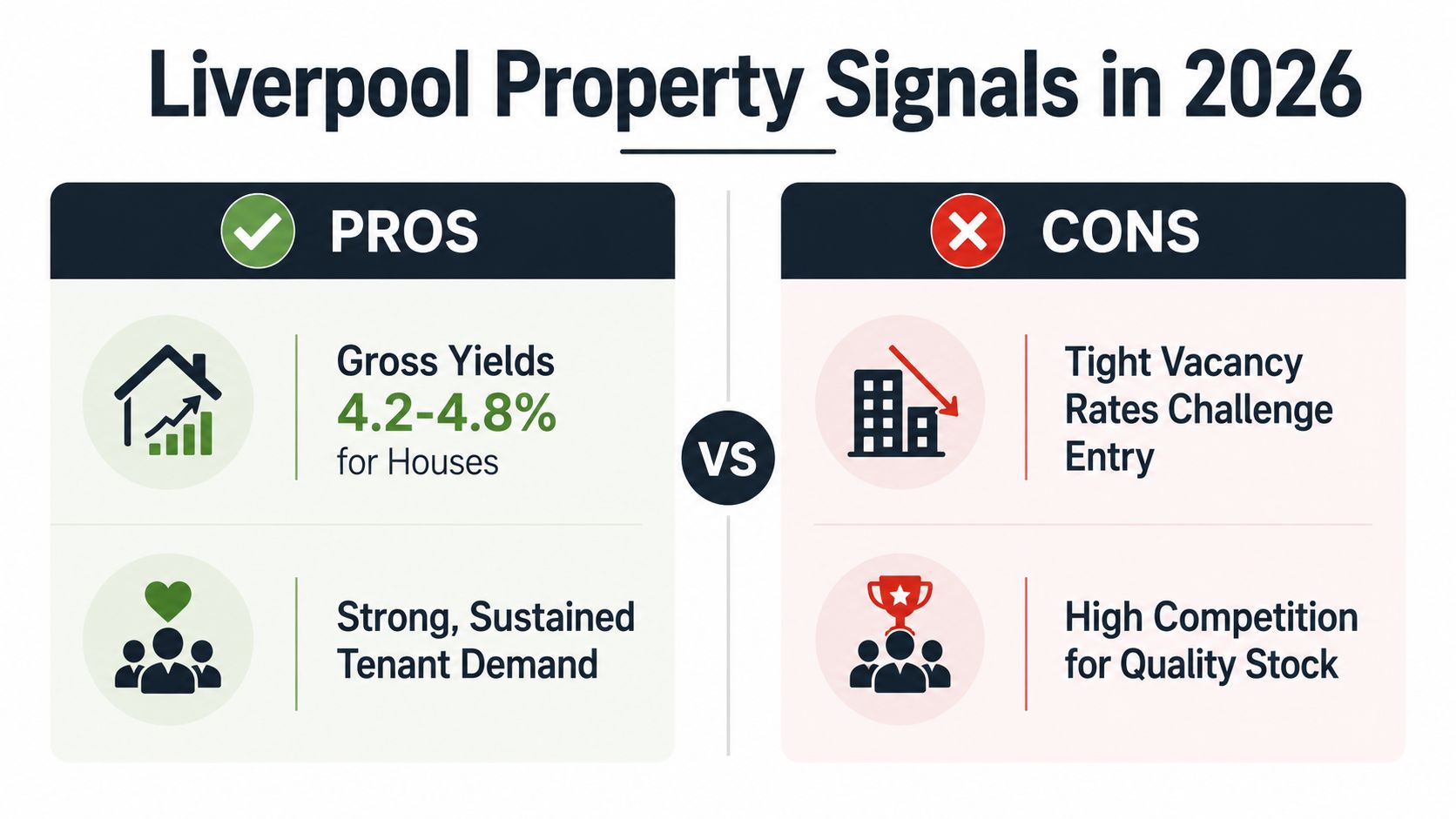
Liverpool's house rental yield was 3.0% in March 2026, compared with 2.6% across the LGA and 2.8% in Sydney Metro, according to the PRD figures cited earlier. Vacancy had also risen modestly as investors returned. The practical warning is clear: a strong headline yield does not remove competition from comparable new apartments.
The upside and the exposure
Liverpool offers an established tenant base, services and infrastructure investment. Lower-entry units may also produce a stronger rent-to-price relationship than many inner-ring Sydney alternatives. Market commentary has placed the unit median around $480,000, with an estimated gross yield near 5.0% in early 2026 (Liverpool rental market analysis). Treat those figures as indicative commentary, not verified benchmarks for every building or suburb.
The risks require property-level checking:
- Supply concentration: Several similar apartments completing nearby can force landlords to compete on rent, presentation and incentives.
- Building quality: Strata levies, defects, sinking-fund adequacy and maintenance history can reduce the net return quickly.
- Tenant concentration: A home suited to several tenant groups is more defensive than one reliant on a single employer or narrow renter profile.
- Yield interpretation: Gross yield excludes ownership costs. It is a screening measure, not a cash-flow result.
Run a stress test before buying. Use realistic rent, then subtract management, strata, insurance, rates, maintenance and an allowance for vacancy. Test repayments at a higher mortgage rate rather than assuming current borrowing costs will remain unchanged.
Set rent against competing properties, especially where several similar units share one building. This guide to pricing units for occupancy is a useful reference when choosing between a higher asking rent and faster tenant uptake. The target is a rent that attracts suitable applicants while protecting income from avoidable vacancy.
Investor's test: If the property only works at the top asking rent, perfect occupancy and no unexpected strata cost, the deal does not work. Rework the assumptions before committing to the purchase.
Practical Next Steps for Tenants, Owners and Investors
The right next move depends on your role. Tenants need speed and complete documents. Owners need a defensible rent assessment and a leasing plan. Investors need assumptions that allow for ordinary vacancy and ownership costs, rather than relying on an attractive listing headline.
Tenants
Prepare your application before inspecting. Keep income evidence, rental history, references and identification in one organised file. Ask the agent about inspection times, parking, noise and the actual walking route to transport.
A quieter inspection can expose problems hidden during a busy Saturday open. Visit on a weekday morning if possible, listen for traffic and building noise, check common areas, and use the trip-planning tools on Realestate.com.au to test the station or bus journey from the property.
Ask whether an evening inspection is possible if work makes daytime attendance difficult. Agencies handling high volumes of enquiries may also use structured rental inquiry use cases to record questions and inspection requests while staff are showing properties.
Owners
Price against comparable homes, not the rent remembered from the market peak. As noted earlier, SQM Research's Liverpool figures provide a useful market benchmark, but a property can sit above or below that level based on bedrooms, parking, condition, location and building quality.
Presentation determines whether enquiry becomes an application. Repair obvious defects, photograph rooms accurately, make inspection access easy and respond promptly to suitable applicants. If a property attracts enquiries but loses applicants at inspection, examine its presentation, layout, noise and asking rent.
Owners reviewing their budget can use this guide to calculate monthly rent from the weekly figure. Keep that calculation separate from net return, because management, repairs, rates, insurance and strata reduce the amount received.
Investors
Run three versions of the deal:
- Base case: Use comparable achievable rent, ordinary management costs and a vacancy allowance.
- Pressure case: Reduce achievable rent, allow a longer leasing period and test a higher mortgage repayment.
- Improvement case: Include only upgrades with a clear reason to believe tenants will pay more or lease faster.
Early-2026 market commentary cited Liverpool houses at around $580 per week, units around $460 per week and an estimated unit gross yield near 5.0%. Treat those figures as general context, not a substitute for property-level appraisal. Compare the purchase price, rent evidence and recurring costs before making an offer.
A practical investor check is simple: calculate gross yield from the achievable rent, then subtract management, strata, insurance, rates, maintenance and an allowance for vacancy. Test repayments at a higher mortgage rate, and check whether the result still works if leasing takes longer than expected.
Gregory Property Agents provides rental appraisals, tenant sourcing, property management, maintenance coordination and a 24/7 owner portal for landlords across Liverpool and surrounding South-West Sydney. Visit Gregory Property Agents to discuss the property, street profile and leasing strategy before listing or buying.
1 Comment
Comments are closed.