

A landlord in Liverpool can set a weekly rent in minutes, then spend weeks paying for that decision. The common mistake is to look at one nearby listing, copy the figure, and divide or multiply it without checking the calendar-month equivalent, comparable properties, vacancy conditions, or the return the property needs to produce.
The calculation itself is straightforward. Setting the right rent is the difficult part, because the number must satisfy both sides of the transaction. Investors need acceptable income, while tenants compare your property with every similar home they can inspect in Liverpool, Fairfield, Cabramatta, Casula, Warwick Farm and surrounding suburbs.
Table of Contents
- Why Getting Monthly Rent Right Matters
- The Australian Formula for Calendar Monthly Rent
- Using Comparable Market Data to Set Your Starting Rent
- Testing Your Rent Against Gross Rental Yield Targets
- Adjusting Rent for Property Condition and Renovations
- Balancing Market Demand with Investor Return Goals
Why Getting Monthly Rent Right Matters
A Liverpool landlord lists a three-bedroom townhouse at $620 per week after seeing a similar nearby property advertised at that figure. The home is well presented, yet it remains vacant while comparable homes lease quickly. The owner loses rent, continues paying holding costs and may later pay for re-advertising, possibly with a reduction that better analysis could have avoided.
This outcome is common in practical property management. A property can present well and still sit outside the tenant search that matters. In Fairfield and Cabramatta, renters often compare several similar homes before inspecting, so a modest weekly difference can determine whether a listing stays within an applicant's budget. An ambitious figure on an investor's spreadsheet can remove the property from the shortlist.
Practical rule: A higher advertised rent helps only when the property remains within the range tenants are actively considering.
Vacancy is part of the rent calculation
Weekly rent is only one part of the income decision. Allow for possible vacancy, preparation and advertising costs, as well as the risk that a high asking figure attracts applicants expecting features the property does not offer.
An extra amount per week can work in a tight market, but local evidence must support it. Liverpool rental information shows different benchmarks by property type. One source reports a $620 median weekly house rent and a 2.5% vacancy rate, while another reports $600 for houses and $580 for townhouses. The difference shows why a generic suburb figure can mislead investors (Liverpool rental market data).
Vacancy changes the effective result. A slightly lower rent that secures a suitable tenant may produce better annual income than a higher figure followed by an empty period and another marketing campaign. That trade-off matters particularly where tenants can compare homes across Liverpool, Fairfield, Cabramatta, Casula, Warwick Farm and nearby suburbs.
Accurate conversion also supports budgeting. Mortgage repayments, council rates, insurance and maintenance are commonly reviewed monthly, while NSW tenancy agreements may use weekly or fortnightly payment cycles. Keep the accounting conversion separate from the legal payment frequency so expected income is not confused with the timing of tenant payments.
A repeatable process beats instinct
Good rent setting is not a one-off guess. Compare leased properties, current supply, condition, location and tenant demand, then test the result against the investor's return requirements. Revisit the calculation at lease renewal, after meaningful improvements and when local stock conditions change.
Renovations add another judgement call. Fresh paint or improved presentation may help a home compete, but the added rent must justify the work and remain acceptable to tenants. Spending to chase a higher figure can weaken returns if the improvement produces little extra income or extends the vacancy period.
The practical objective is clear: achieve the strongest sustainable rent, not the highest number an owner hopes to see. Correct pricing attracts a more suitable tenant pool, supports cash flow and reduces the re-advertising cycle that erodes income.
The Australian Formula for Calendar Monthly Rent
In Australia, the precise way to convert weekly rent into a calendar-month amount is to convert the weekly figure into a daily rate, apply the annual calendar, then divide by the number of months. Consumer Affairs Victoria describes the method as weekly rent multiplied by 365, then divided by 7, then multiplied by 12 divided by 365, which is equivalent to multiplying the weekly rent by 52 and dividing by 12 (Consumer Affairs Victoria rent calculator).
The working formula is:
Calendar monthly rent = weekly rent × 52 ÷ 12
The alternative shortcut, weekly rent multiplied by 4, doesn't produce a true calendar-month figure. Calendar months don't contain exactly four weeks, so the shortcut ignores the additional days that occur across the year. For lease drafting and budgeting, that difference matters.
Worked example for Liverpool
For a Liverpool three-bedroom house renting at $580 per week:
- $580 × 52 = $30,160 annual rent
- $30,160 ÷ 12 = $2,513.33 per calendar month
The four-week shortcut would produce $2,320 per month. That figure doesn't represent the annual rent divided evenly across the calendar year, so it shouldn't be used when documenting a calendar monthly obligation.
A newer townhouse in Prestons at $720 per week follows the same process:
- $720 × 52 = $37,440 annual rent
- $37,440 ÷ 12 = $3,120 per calendar month
The contractual payment cycle can still be weekly, fortnightly or another interval agreed in the tenancy agreement. NSW guidance allows landlords and agents to request rent up to two weeks in advance, but no more, and tenants must pay on or before the agreed date (NSW rent calculator guidance). The calendar-month figure is therefore often an accounting conversion, not a replacement for the payment frequency written into the agreement.
| Weekly Rent | Correct Monthly (×52÷12) | Shortcut (×4) | Annual Shortfall |
|---|---|---|---|
| $500 | $2,166.67 | $2,000 | $2,000 |
| $580 | $2,513.33 | $2,320 | $2,320 |
| $720 | $3,120 | $2,880 | $2,880 |
The table shows why a four-week calculation creates an annual understatement equal to four weeks of rent. Property managers should use the same formula in lease schedules, owner statements and investment forecasts, while checking that the tenancy agreement states the agreed periodic rent clearly.
Using Comparable Market Data to Set Your Starting Rent
A tenant comparing a three-bedroom home in Liverpool will judge it against the alternatives available that week, not against an investor's preferred return. Set the starting rent from properties a tenant can inspect, then test whether the figure is supported by recent leasing activity. Domain and realestate.com.au can show asking and, where available, leased evidence. Local agency records and NSW Fair Trading rental information add useful context.
Match the comparison carefully:
- Property type: Compare houses with houses, townhouses with townhouses and units with units.
- Bedroom and bathroom count: A three-bedroom home should not be benchmarked against a two-bedroom dwelling just because both are nearby.
- Location: Separate Liverpool CBD from the Warwick Farm station catchment. Miller may attract a different tenant profile and offer different transport access.
- Condition and inclusions: Record kitchen quality, air conditioning, parking, outdoor space, storage and presentation.
- Availability: Count comparable properties available now. An old listing is not the same competitor as a property newly advertised this week.
A Comparative Market Analysis should produce a defensible range from current or recent transactions. Supply then determines how firmly you can hold the upper end. A two-bedroom unit with 90 units available to rent faces a different pricing problem from a three-bedroom home with only two comparable options. Testing a slightly higher starting rent may be reasonable in the second case, provided the property offers features tenants can see and value.
Read Liverpool data as a range
Liverpool figures vary by property type and source. Earlier data cited in this article gives a $620 median weekly rent for houses and a 2.5% vacancy rate, while another set places houses at $600 and townhouses at $580. The practical lesson is to treat suburb figures as an opening reference, not as the final rent for a particular home.
Active asking rents need the same caution. An advertised figure shows what an owner wants, not necessarily what a tenant agreed to pay. If a listing remains online for an extended period, its unchanged price may indicate that tenants are rejecting the property, even when the original number looked attractive.
For a property-specific assessment, use Liverpool property appraisal guidance and compare the suggested range with live competition. Check land size, parking, air conditioning, renovation quality and transport access. A newer build may command more than older stock near the hospital. A well-maintained older home with secure parking can still outperform a newer but poorly configured alternative. That is the return trade-off: a higher rent is useful only if the condition and location support it without extending vacancy.
| Suburb | Median Weekly Rent (3-Bed House) | Vacancy Rate | Typical Property Age |
|---|---|---|---|
| Liverpool | $600 to $620 | 2.5% | Mixed |
| Cabramatta | Not stated | Not stated | Mixed |
| Fairfield | Not stated | Not stated | Mixed |
Keep unavailable entries unavailable. Estimates would create false precision. Record the date, property type, condition, advertised rent and, where known, achieved rent for each comparable. That file gives the landlord a defensible starting point and makes later rent reviews easier.
Testing Your Rent Against Gross Rental Yield Targets
Comparable rents show what tenants may accept. Gross rental yield tests whether that income fits the investor's strategy. The standard formula is:
Gross yield = (weekly rent × 52) ÷ property price × 100
Use this as a decision test, not as permission to set an unsupported asking rent. A yield target may expose a gap between an investor's return requirement and what tenants in South-West Sydney are demonstrating through current competition.
Liverpool yield test
Assume a Liverpool property is valued at $720,000 and the investor wants a 4.5% gross yield. The required annual rent is:
- $720,000 × 4.5% = $32,400 annual rent
- $32,400 ÷ 12 = $2,700 required monthly rent
- $32,400 ÷ 52 = approximately $623.08 weekly rent
The weekly requirement sits close to the Liverpool house range of $600 to $620 per week reported earlier. The conversion above applies the calendar-month formula to those previously cited weekly figures. It does not prove that a particular Liverpool home can achieve $623.08. Condition, parking, transport access, renovation quality and nearby competition still determine whether tenants will accept that rent.
If comparable homes offer better presentation or more practical features, the target may be too high for immediate leasing. Holding out for the yield can then create vacancy, reducing the income the investor was trying to protect.
Cabramatta yield test
For a Cabramatta unit valued at $650,000, a 5.0% gross yield requires:
- $650,000 × 5.0% = $32,500 annual rent
- $32,500 ÷ 12 = approximately $2,708.33 required monthly rent
- $32,500 ÷ 52 = approximately $625 weekly rent
That figure is a financial target, not evidence of tenant willingness to pay. A unit competing against substantial nearby stock may need a lower asking rent to avoid vacancy. A scarce, well-presented property close to transport may support a stronger result, provided the local tenant pool confirms it.
| Suburb | Property Value | Target Yield | Required Monthly Rent | Median Market Rent | Gap |
|---|---|---|---|---|---|
| Liverpool | $720,000 | 4.5% | $2,700 | $2,600 to $2,686.67 | $13.33 to $100 |
| Cabramatta | $650,000 | 5.0% | $2,708.33 | Not stated | Not stated |
The Liverpool table converts the earlier reported $600 to $620 weekly house rents into calendar monthly equivalents. The weekly evidence was sourced earlier, while the monthly figures are calculations using the Australian formula.
Use yield as a floor test rather than a ceiling. If the target exceeds credible comparable rents, the investor has several choices: accept a lower yield, improve the property, reduce vacancy exposure or reassess the purchase price. A property yield analysis tool can test different rent and value combinations, but it cannot replace a leasing assessment based on actual tenant demand.
NSW conditions reinforce the trade-off. One source reports a 3.2% gross long-term rental yield for the state, based on a $1.10 million median three-bedroom house. The same linked market discussion reports a 1.1% to 1.6% vacancy rate for Sydney and identifies 3% vacancy as balanced (NSW rental market conditions). Tighter conditions may support a carefully tested premium, but they do not justify pricing beyond the property's condition and the alternatives tenants can inspect.
Adjusting Rent for Property Condition and Renovations
A three-bedroom house in Fairfield doesn't earn the same rent just because it has three bedrooms. Tenants notice the kitchen, bathroom, appliances, flooring, storage, air conditioning and signs of deferred maintenance before they think about an investor's mortgage or target return.
A renovation example makes the point clearly. A poorly constructed kitchen can hold back a rent review even when the rest of the property remains serviceable. In one local property example, the owner replaced a failing kitchen with a flat-pack kitchen and new appliances after the existing tenant chose not to accept a rent increase tied to the old condition. Once the property was re-advertised, the new tenant accepted an additional $80 per week, a result that reflected stronger presentation and functionality rather than a spreadsheet adjustment.
Spend where tenants feel the difference
Australian renovation guidance places a typical kitchen renovation at about A$15,000 to A$25,000, with potential value added of about A$25,000 to A$40,000 and possible rental support of A$40 to A$80 per week (Australian kitchen renovation guidance). These figures are broad, so the property manager still needs to assess whether the local tenant pool values the proposed finish.
The strongest improvements usually solve a daily problem:
- Kitchen functionality: Reliable appliances, practical storage and durable surfaces can improve both inspection appeal and tenant satisfaction.
- Cooling and comfort: Split-system air conditioning can matter greatly during inspections and throughout a tenancy.
- Secure parking: In many South-West Sydney streets, a lock-up garage or secure off-street space separates otherwise similar properties.
- Bathroom condition: Clean, functional fixtures support the overall impression of a well-maintained home.
Cosmetic painting alone may improve presentation without changing the rent ceiling. It can be worthwhile when the property looks tired, but it shouldn't be treated as equivalent to replacing failed appliances or repairing a poorly functioning kitchen.
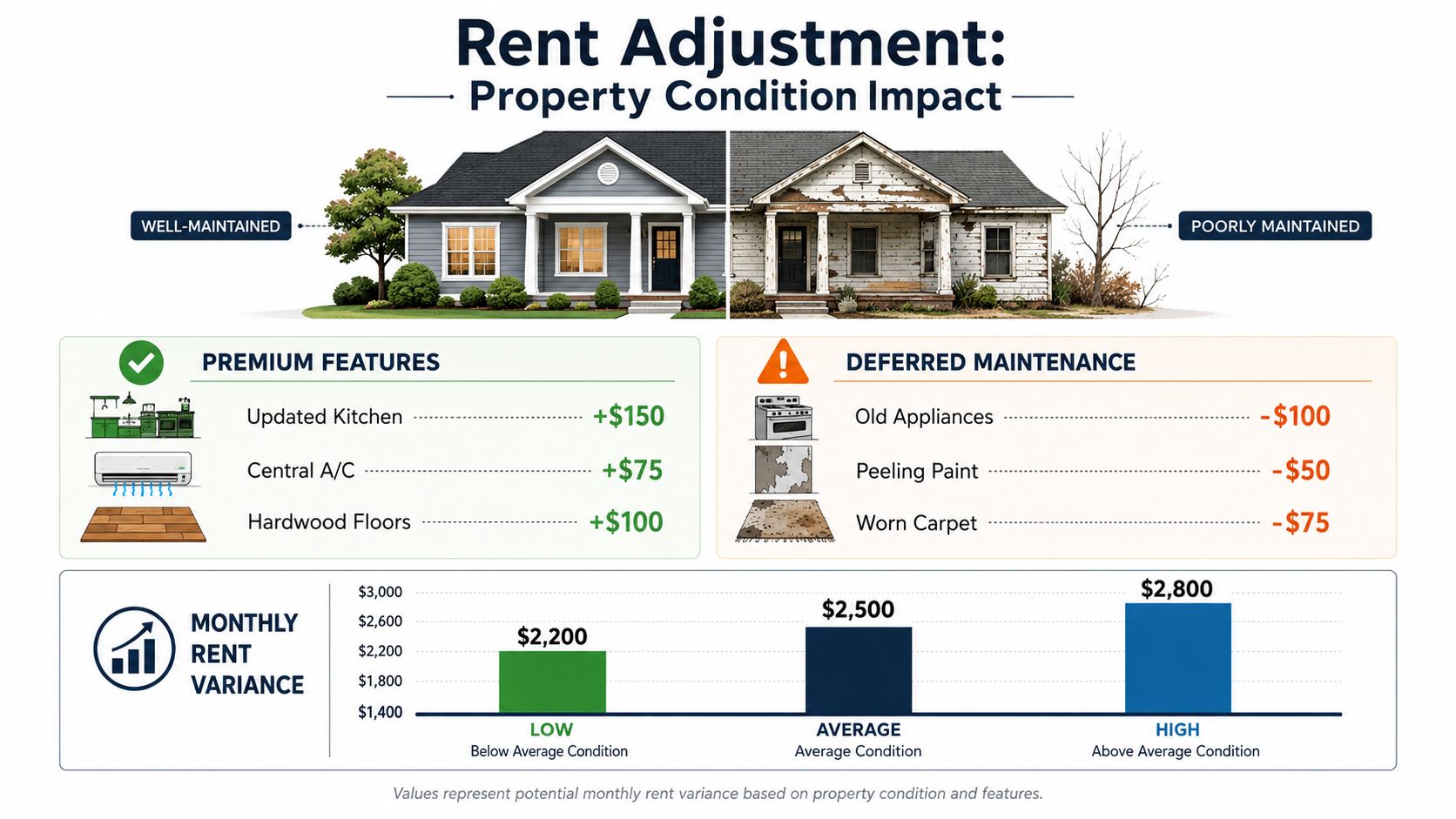
Before setting a premium, inspect the property as a tenant would. Check whether doors, blinds, flooring, appliances, ventilation and outdoor areas support the proposed rent. A structured rental inspection checklist helps identify defects that can undermine a price recommendation.
Renovation also has a relationship cost. A tenant may tolerate an older kitchen when the rent reflects it, but may resist an increase if the owner hasn't improved the feature being used to justify the increase. Sometimes the better commercial decision is to complete the work at turnover, then launch the property at a stronger, defensible rent.
Balancing Market Demand with Investor Return Goals
Rent setting is a negotiation between the investor's spreadsheet and the tenant's alternatives. The most reliable approach combines three tests, market range, return requirement and property-specific adjustment, then gives greater weight to the evidence that reflects what renters are doing now.
Establish the decision range
Start with comparable leased properties and current competing stock. Separate houses, townhouses and units, then adjust for transport access, parking, land, condition and inclusions. A property with limited direct competition can be tested toward the upper end of the range, while a home surrounded by near-identical listings needs sharper positioning.
Next, calculate the investor's required return. If the required rent sits above comparable outcomes, don't force the market to solve the problem. Decide whether the owner can accept a lower yield, improve the property, wait for a better demand window or revisit the investment assumptions.
Finally, apply the condition and location adjustment. Edmondson Park and Austral may attract different tenant priorities from established Liverpool or Fairfield streets, and the available stock can shift the pricing conversation. Seasonal demand also changes the quality and volume of enquiry, so a price that works at one point in the leasing cycle may need a different launch strategy later.
Good pricing is ambitious enough to test demand, but realistic enough to generate inspections from qualified tenants.
A landlord may reasonably test $20 or $30 above market in a high-demand situation, provided the property remains within the range tenants recognise as credible. The danger is allowing ambition to become greed. Once the listing falls outside common search filters, the owner may receive fewer suitable enquiries and lose more through vacancy than the premium could have produced.
Choose the cost of certainty
Suppose reducing rent by $15 per week prevents a four-week vacancy. The annual income sacrifice is $780, while four weeks of lost rent at the higher price can exceed that amount depending on the original rent. That comparison should be calculated before rejecting a modest adjustment. A reliable tenant who stays, pays on time and cares for the property may create better long-term value than a short tenancy secured at the maximum advertised figure.
The same reasoning applies when comparing property choices. Renters seeking value may find stronger negotiating opportunities in suburbs with a large supply of similar units, including Liverpool's two-bedroom unit market. Owners should recognise that competition can limit pricing power even when the wider Sydney market feels tight.
For broader ownership decisions, a neutral guide to renting or selling can help frame whether holding the property remains preferable to selling, particularly when the achievable rent no longer supports the owner's objectives. For local context, review the Fairfield property market report alongside current comparable evidence.
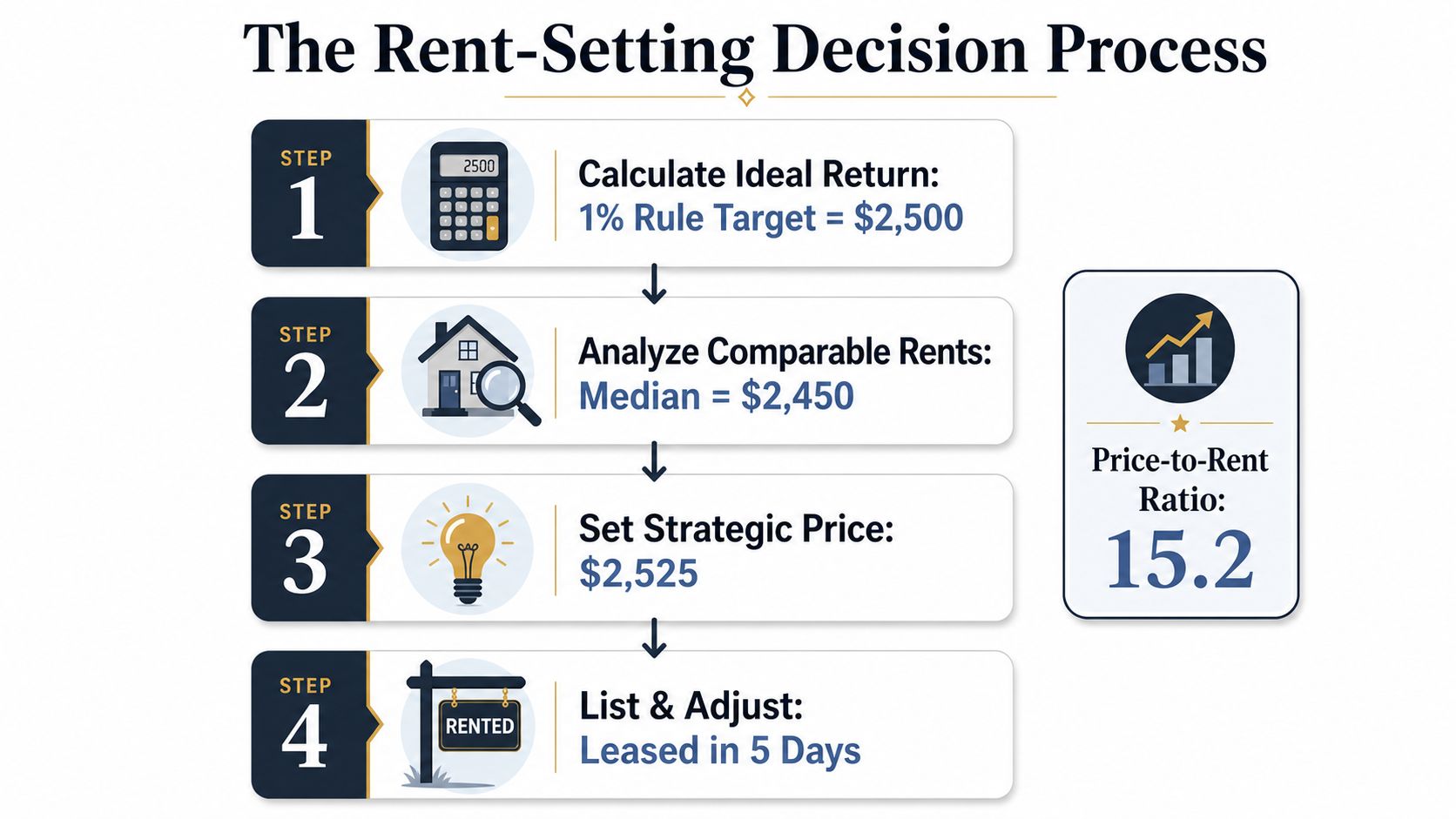
Use the following sequence every time:
- Calculate the calendar month: Convert the agreed weekly rent using the annual formula.
- Check the market range: Compare recent leased evidence and current competition.
- Stress-test the yield: Confirm whether the proposed rent supports the investment plan.
- Set and monitor the launch price: Test a defensible figure, track enquiry quality and adjust before vacancy becomes expensive.
The best monthly rent isn't the highest figure written into an advertisement. It's the amount that reflects the property's real condition, attracts the right tenant pool and supports a return the owner can live with.
Gregory Property Agents provides data-backed rent reviews, tenant sourcing, inspections, maintenance coordination and transparent owner reporting across Liverpool, Fairfield and South-West Sydney. Visit Gregory Property Agents to arrange a property management discussion and establish a monthly rent figure based on current comparable evidence, property condition and your investment goals.
1 Comment
Comments are closed.