
Sydney sales commissions aren't fixed by law. They're negotiable, typically 1.8% to 2.5% of the sale price, with an average around 2.1%, and your total selling cost is usually commission plus marketing.
You might be sitting at the kitchen table in Liverpool with two proposals in front of you. One agent has quoted a lower percentage, while another has recommended a broader campaign with professional photography, major property portals, signage and direct buyer follow-up. The cheaper percentage looks attractive until you ask what the complete campaign will cost.
That's the part many South-West Sydney sellers miss. A real estate agent quote usually has two cost layers: the commission paid when the property sells, and campaign expenses that may be charged separately. A small difference in the commission rate can become thousands of dollars at Sydney price points, but cutting marketing can also reduce the buyer reach and negotiation pressure that help produce a strong result.
This guide breaks down real estate agent fees in Sydney in plain language, then applies the maths to Liverpool and Fairfield examples. You'll see how the fee models work, what should appear in writing, and how to negotiate value without asking an agent to remove the work your sale needs. If presentation is part of your campaign discussion, resources such as virtual staging for agents can also help you consider how an empty or dated room will appear in online marketing.
Table of Contents
- Introduction What Sydney Sellers Actually Pay in 2026
- How Real Estate Agent Fees Work in New South Wales
- The Three Common Fee Models Sydney Agents Use
- What Your Fee Covers and What Costs Extra
- Real Cost Examples for Liverpool and Fairfield Listings
- How to Negotiate Fees Without Losing Service Quality
- Choosing the Right Agent and Next Steps for Your Sale
Introduction What Sydney Sellers Actually Pay in 2026
A Fairfield seller may receive quotes of 1.8%, 2.1% and 2.5%. The percentages look easy to compare, but the underlying service can differ. One proposal may include photography, portal advertising, signage, buyer-database follow-up and negotiation support. Another may charge some of those items separately.
NSW Government guidance confirms that residential agent fees are not set by a compulsory schedule and can be negotiated. The agency agreement should make the remuneration, calculation method and expenses clear (NSW Government guidance on using a real estate agent).
Why the percentage can mislead
At a $1.45 million sale price, commission rates of 1.8% to 2.5% produce roughly $26,100 to $36,250 inclusive of GST, before separately charged campaign items (Sydney 2026 fee guide). The commonly cited Sydney average is near 2.1%, although the agreed rate depends on the agent, property and service package (Sydney agent commission guidance).
That commission is only one side of the cost stack. Marketing may add photography, online listings, signage, brochures, copywriting, social promotion and administration. A lower rate can come with a larger upfront campaign bill. A higher rate may include more of that work, though the agreement must confirm exactly what is covered.
The comparison works like checking a building quote. The headline labour rate matters, but the final bill also depends on materials and what the contractor does. Selling costs follow the same pattern: commission plus campaign expenses, then GST treatment and any agreed extras.
Kitchen-table rule: Compare the all-in amount, the sale-price assumptions, GST treatment, marketing inclusions and service responsibilities before choosing a rate.
The useful question is, “What will I pay, and what work will that buy?” That gives Liverpool and Fairfield sellers a clearer basis for weighing buyer reach, negotiation effort and fee savings. For presentation discussions, virtual staging for agents can help show how an empty or dated room may appear in online marketing.
How Real Estate Agent Fees Work in New South Wales
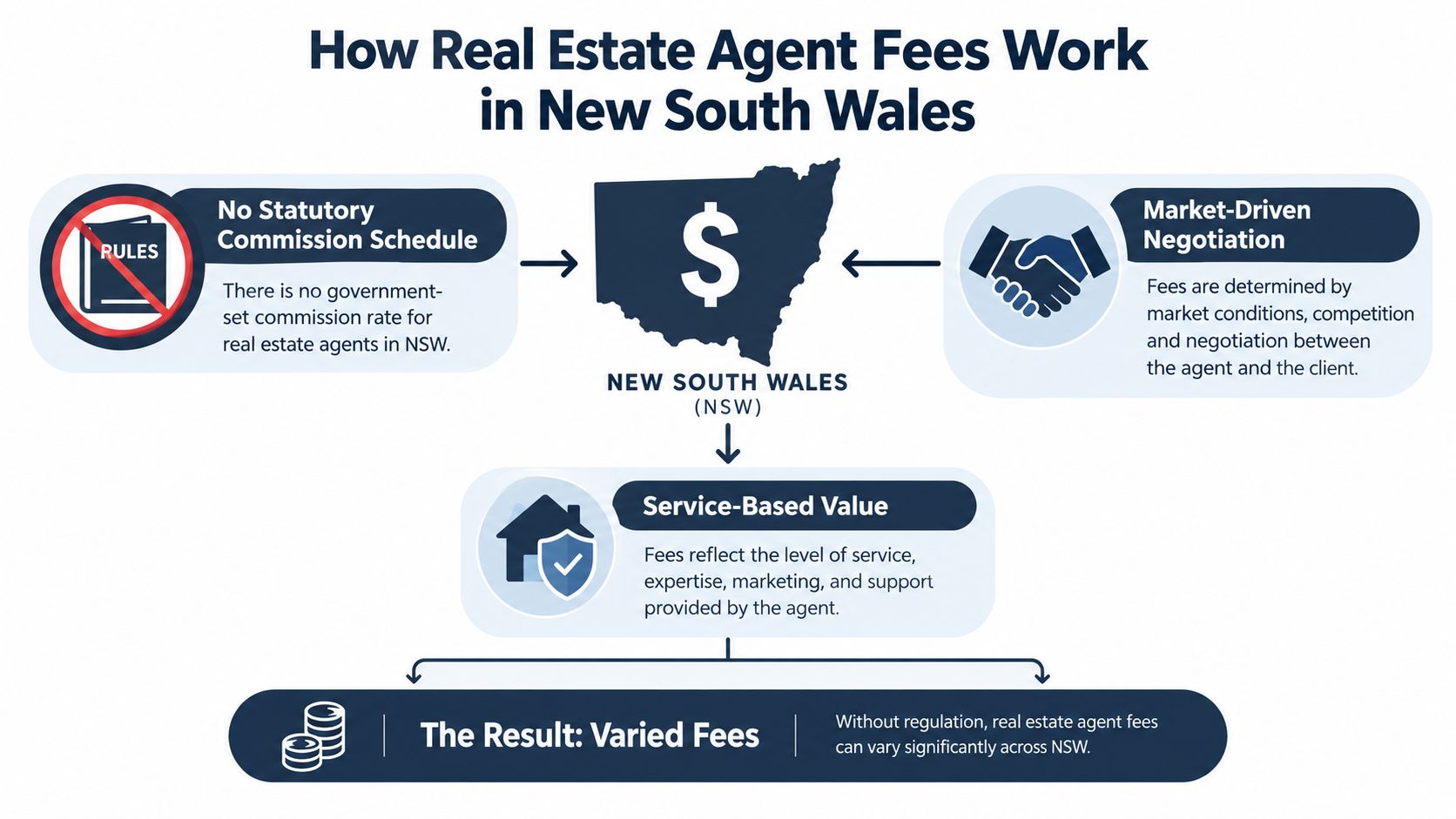
A Liverpool seller may receive two proposals for the same home, yet the totals can differ because the agents have priced their work differently. NSW residential sales do not follow one compulsory commission rate. The seller and agent agree on the remuneration, calculation method and expenses in the agency agreement, so the percentage is only the starting point.
The arrangement works like hiring a specialist for a substantial renovation. One contractor may charge a percentage of the finished project, another a fixed price, and another a base fee with an additional amount tied to the result. In each case, the quote needs to show the work included, the materials covered and the charges for changes. Property sales follow the same logic.
The percentage model in simple terms
With percentage commission, the agreed rate is applied to the final sale price. A higher sale produces a higher dollar commission, while a lower sale produces a lower one, subject to the wording of the agreement. The rate therefore needs to be read alongside the campaign budget, GST treatment and service scope.
This arrangement connects the agent's remuneration to the sale price, but it does not promise a particular result. Before signing, check the agency period, exclusivity provisions, payment trigger, whether the rate is inclusive of GST, marketing costs and any additional fees. These details determine the two-part cost stack: commission and campaign expenses.
Why documentation matters
NSW's NCAT guidance on agent commissions and fees explains that disputes can concern commissions, fees or expenses charged by licensed agents. A written agreement and records of instructions, invoices and approvals can help if the parties later disagree about what was payable.
Before photography or advertising starts, ask for the commercial terms in writing. A useful proposal should identify:
- The commission formula: Confirm whether the rate applies to the full sale price and whether GST is included.
- The payment point: Check when the fee becomes payable and what happens if the agency agreement ends.
- The campaign scope: List each advertising and preparation item instead of relying on “full marketing”.
- Extra administration: Ask about auction, settlement, withdrawal or other charges.
- Responsibility: Identify who will conduct inspections, follow up buyers and negotiate offers.
Compare the agency's workflow and communication tools as well as its fee. Bounti Labs for real estate agents is relevant when reviewing how an agency organises its operating processes. Those systems do not replace the fee agreement, but they can affect how consistently the promised work is delivered.
The Three Common Fee Models Sydney Agents Use
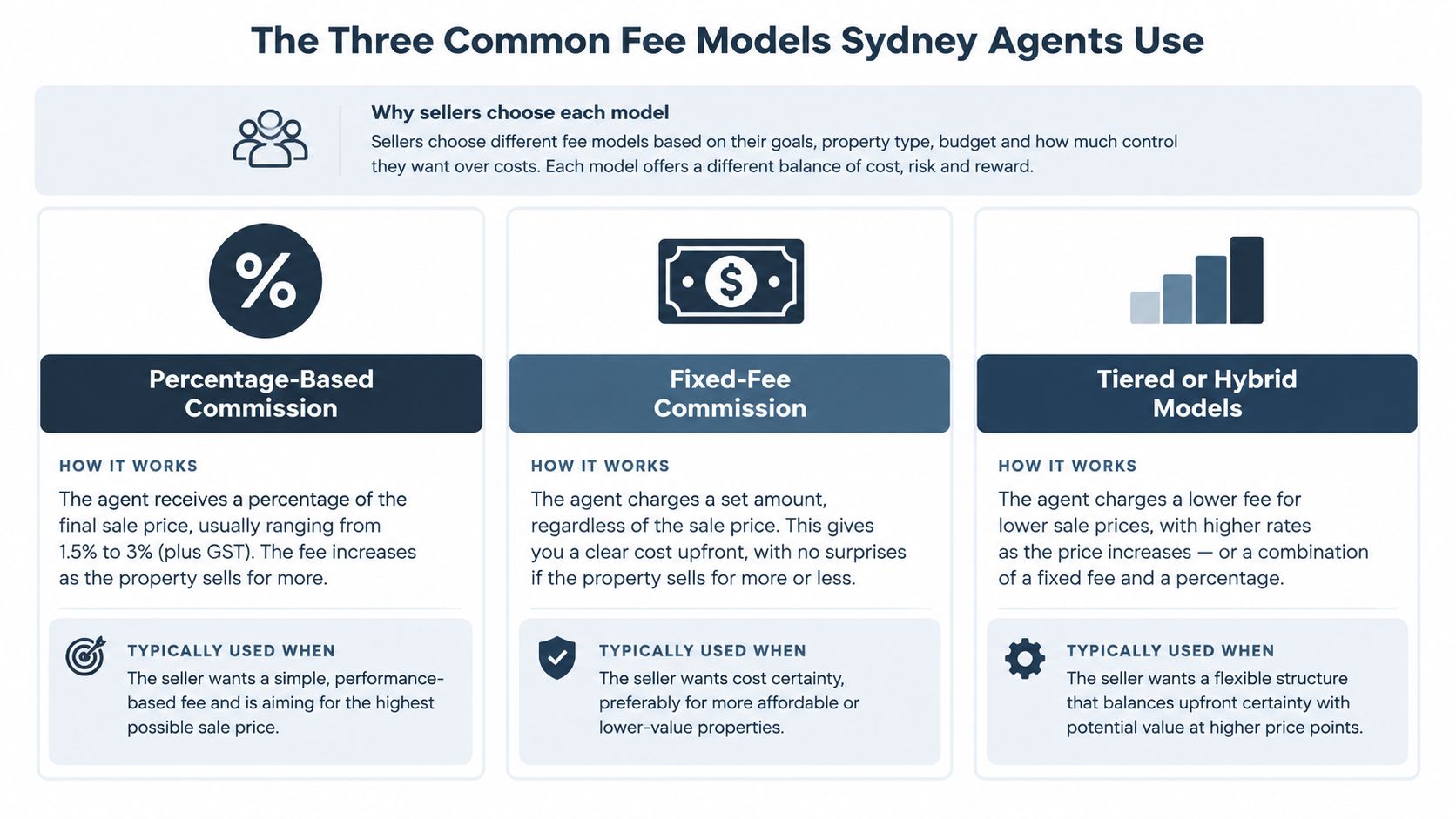
Sydney sellers usually encounter three broad fee structures. The easiest way to understand them is to compare how you pay for a tradesperson. One quote might charge a percentage of the completed renovation, another might offer a fixed project fee, and a third might set a base amount with an extra charge if the work exceeds an agreed outcome.
Percentage-based commission
This is the most familiar model. You agree on a rate, then apply it to the final sale price. It can suit sellers who want the agent's remuneration to move with the value achieved, rather than paying the same amount regardless of the outcome.
The trade-off is that the dollar cost is open-ended until the property sells. A quote should state whether the percentage is inclusive of GST, because a rate that looks similar on paper may produce a different final invoice depending on its treatment.
Fixed-fee commission
A fixed fee sets the agent's remuneration in advance, usually for an agreed service scope. It can make budgeting easier because you know the commission amount before the sale, but you need to check whether the amount is payable only on completion and whether marketing is included.
A fixed fee can also change the incentive structure. The agent receives the agreed fee rather than a larger amount when the sale price rises, so sellers should focus closely on campaign accountability, buyer follow-up and negotiation responsibilities.
Tiered or hybrid models
A tiered structure combines a base rate with a higher rate, or an additional incentive, once the sale price passes an agreed threshold. It can align the agent and seller around a target, but the wording must be precise.
Ask whether the higher rate applies to the entire sale price or only the amount above the threshold. Also confirm how the threshold was selected, which comparable sales support it and whether the incentive is calculated before or after other adjustments.
Ask this before signing: “Show me the fee at several possible sale prices, then show me the marketing and GST separately.”
A practical comparison
| Fee model | How you're charged | What to check |
|---|---|---|
| Percentage-based | A negotiated percentage of the final sale price | GST, inclusions and total cost at different sale prices |
| Fixed fee | An agreed dollar amount for the agency service | Completion trigger, exclusions and campaign expenses |
| Tiered or hybrid | A base calculation plus an incentive at an agreed level | Threshold wording, marginal rate and negotiation authority |
If you're also researching the buyer side of a transaction, this guide to Sydney buyer's agent fees explains the same basic choice between percentage-based and fixed-fee representation. The seller's commission and a buyer's agent's fee are separate arrangements, so neither should be assumed to be included in the other.
What Your Fee Covers and What Costs Extra
You receive an agent's percentage, then discover the campaign has its own line items. The commission generally pays for preparing the property, promoting it, managing buyer enquiries and negotiating offers. Marketing may be included, partly included or billed separately, so two agents quoting the same percentage can produce different final bills. Some agents bundle selected campaign items into their rate, while others invoice them separately, as outlined in Sydney commission and marketing cost guidance.
Read the quote as a cost stack
Read the proposal like a kitchen renovation quote. Start with the commission, then check every item sitting beside it. A campaign may include professional photography, copywriting, floor plans, signage, brochures, online listings, social media, database promotion, open homes, auction support and administration.
Marketing commonly adds several thousand dollars to the commission, although the right package depends on the property. A smaller apartment may need less presentation material than a family home. A property with a large yard, pool or entertaining area may benefit from photography and video that show how the space is used. Ask which items are recommended, which are optional and whether the fee is payable if the property does not sell.
| Cost item | Usually included in commission | Often charged separately |
|---|---|---|
| Price advice and campaign planning | Yes, confirm in writing | Extended preparation work may vary |
| Buyer enquiry and inspection management | Yes | Additional event staffing may vary |
| Offer negotiation | Yes | Confirm auction or special negotiation charges |
| Professional photography | Sometimes | Commonly listed as a campaign item |
| realestate.com.au and Domain listings | Sometimes | Often shown as advertising expenses |
| Signage, brochures and floor plans | Sometimes | Frequently separated by package |
| Social and database promotion | Often | Confirm the channels and duration |
| Administration and settlement coordination | Often | Check for specific administration fees |
What GST changes
GST can change the amount that leaves your account. A commission quoted inclusive of GST is calculated differently from a percentage quoted before GST. Ask the agent to show the commission as a dollar figure, state whether GST is included and repeat that treatment in both the proposal and agency agreement.
NSW Fair Trading regulates licensing and certificate fees for agents. These government-related compliance costs are separate from the selling commission you negotiate with the agency. The quote should identify vendor-paid charges clearly, rather than combining unrelated expenses under one vague heading.
A clean quote should answer three questions: What percentage or fixed amount applies? What does GST do to that amount? Which campaign items are extra?
Compare the all-in selling cost, not only the commission rate. Then ask what each additional campaign dollar buys, such as stronger presentation, wider exposure or more direct buyer follow-up. The lowest percentage may not be the lowest total cost, while a higher campaign budget may be sensible if it gives buyers a clearer reason to inspect and compete.
Real Cost Examples for Liverpool and Fairfield Listings
A percentage becomes clearer when it is attached to a sale price. The examples below separate the agent's commission from marketing, so you can see the full two-part cost stack rather than judging the headline rate alone. Unless stated otherwise, the commission figures are treated as inclusive of GST.
For a Liverpool property sold at $850,000, a 2.0% commission equals $17,000. Add $5,000 for marketing and the campaign total becomes $22,000. A Fairfield sale at $750,000, charged at 1.8%, produces a $13,500 commission. With $4,500 of marketing, the total reaches $18,000. These examples align with the Liverpool agent fee guidance.
Applying the range to South-West Sydney
A $1.45 million family home charged within the cited Sydney range of 1.8% to 2.5% would incur approximately $26,100 to $36,250 inclusive of GST, before marketing and other extras. Once advertising and presentation are added, the amount leaving the seller's account rises above the commission figure.
Use the same approach for a $1.5 million sale. At 1.8%, the commission is $27,000 before GST. At 2.5%, it is $37,500 before GST. That 0.7 percentage-point gap changes gross proceeds by $10,500 before marketing and tax adjustments, as shown in the NSW agent commission comparison.
The maths works like a two-part receipt: commission is one line, campaign spending is another. Add them together before comparing proposals.
The negotiation trade-off
A lower rate may come with a smaller advertising package. That can reduce buyer reach or the competitive pressure created by multiple interested parties. A higher fee may include fuller marketing, stronger local database follow-up and more active negotiation.
The sensible question is what each extra dollar buys. Compare the final campaign total, then ask how the proposed service supports your price, buyer reach and sale strategy.
How to Negotiate Fees Without Losing Service Quality
Begin the fee conversation before the agency agreement is prepared. You'll have more room to adjust the structure when the agent is still designing the campaign than after photography, advertising and inspections have been booked.
Five practical moves
Request a detailed campaign proposal. Ask for the commission, GST, marketing, administration and payment triggers in separate lines. If a phrase such as “premium exposure” appears, ask which channels and deliverables it covers.
Compare marketing spend inclusions. Put proposals side by side. One agent may bundle photography and portal listings, while another may show them as separate campaign expenses. Compare the total rather than treating the lowest percentage as the winner.
Use comparable sales data. Ask how the recommended price range relates to recent properties with similar location, condition, land, layout and buyer appeal. A lower fee doesn't compensate for pricing advice that attracts the wrong buyer expectations.
Ask about multi-channel exposure. Clarify how the agent will use realestate.com.au, Domain, social media, local contacts and its database. Also ask who will answer enquiries, conduct inspections and report buyer feedback.
Negotiate performance milestones. A tiered arrangement may be appropriate if the threshold, calculation method and responsibilities are written clearly. You can also agree on review points for presentation, enquiry quality and offer strategy without turning the contract into a vague promise.
A respectful script: “I'm comparing the all-in cost, not just the rate. Please show me what's included, what's optional and what service changes if we adjust the fee.”
Buyer-side fees in the same conversation
Sellers sometimes ask whether buyer's agent fees affect their own commission. They don't. A buyer's agent has a separate agreement with the buyer, and Sydney buyer representation is commonly structured as either a fixed fee or a percentage, with full-service arrangements reported around $8,000 to $20,000 fixed or 1.5% to 3% of the purchase price (Sydney buyer's agent fee guidance).
That distinction matters if a represented buyer enters your campaign. You should assess the buyer's offer on its terms and rely on your selling agent to negotiate professionally, rather than assuming the buyer-side arrangement changes your agreed agency fee.
Choosing the Right Agent and Next Steps for Your Sale
A sensible decision framework has four parts: understand that the fee is negotiable, identify the model, audit the full cost stack and test the numbers against your likely sale price. Then assess whether the agent can deliver the service described, particularly in your Liverpool or Fairfield micro-market.
Before signing, verify the following:
- Written commission terms: The rate or fixed amount, GST treatment and payment trigger are clear.
- Marketing schedule: Every included and excluded campaign item is listed.
- Agency responsibilities: Inspections, buyer follow-up, reporting and negotiation have named owners.
- Local evidence: The appraisal uses relevant comparable sales and explains the pricing range.
- Communication process: You know when updates arrive and who answers urgent questions.
- Exit and exclusivity terms: The agreement explains the agency period and what happens if circumstances change.
A low quote can be suitable when the service scope matches your property. A higher quote can also make sense when it buys a custom campaign and direct accountability. The test is whether the agent explains the difference in practical terms and gives you enough information to calculate your expected net proceeds.
For homeowners comparing local providers, choosing a real estate agent in Sydney should involve more than a rate comparison. Look for clear pricing, relevant South-West Sydney experience, direct communication and a campaign plan suited to the property rather than a standard package.
Gregory Property Agents offers free market appraisals, campaign design, professional presentation, portal advertising, social and database exposure, offer negotiation and settlement coordination across Liverpool, Fairfield, Green Valley and nearby suburbs. Ask for the commission, GST and marketing components to be presented separately so you can compare the complete cost with confidence.
If you're selling in Liverpool, Fairfield or surrounding South-West Sydney, visit Gregory Property Agents to request a free market appraisal and a transparent campaign cost breakdown. Bring your competing quotes, and ask for a clear comparison of the fee structure, marketing inclusions and negotiation plan before you appoint an agent.