
You're halfway through dinner when the rent reminder appears, a tenant reports a leaking tap, and you realise a routine inspection is due. Then comes the uncomfortable question: did the last entry notice go out on time, and where is the condition report?
That's the daily reality behind residential property management services. Managing a rental in Green Valley, Liverpool, Fairfield or elsewhere in South-West Sydney isn't just collecting rent and calling a tradesperson. It involves leasing, tenant communication, inspections, repairs, records, compliance and owner reporting, all moving together.
After more than 20 years working locally, I've found that landlords usually don't need more information thrown at them. They need a system that makes the next decision clear. This guide explains what that system should include, from choosing a tenant and setting rent to managing repairs, controlling arrears and keeping a complete digital record. If you're still deciding whether property investment suits your circumstances, a practical resource on how to buy an investment property can help you think through the purchase before you take on the management responsibility.
Table of Contents
- Introduction to Residential Property Management Services
- What Residential Property Management Really Covers
- Tenant Sourcing and Screening That Protects Your Asset
- Inspections and Maintenance Coordination Without Delays
- Arrears Control and Compliance Landlords Must Understand
- How a 24/7 Owner Portal Creates Real Transparency
- Choosing the Right Management Service for Your Property
Introduction to Residential Property Management Services
A landlord who self-manages often starts with a simple plan: advertise the property, collect rent and deal with problems as they arise. That approach can work while the property is quiet. It becomes much harder when several small tasks arrive together, such as a late payment, a repair request, a lease question and an inspection that needs to be scheduled around notice requirements.
The problem isn't usually one difficult task. It's the handover between tasks. A maintenance request needs to be assessed, documented, sent to the right trade, approved where necessary and followed through. A tenant application needs more than a quick impression at an inspection. A rent review needs market evidence and careful communication. A tenancy ending now also carries reporting obligations that need to be completed properly.
In NSW, the managing party has ongoing responsibilities for day-to-day rental operations, including arranging repairs and conducting regular inspections. NSW rental-management guidance reflects the broader role of the occupation, which includes rent setting, tenant oversight, property inspections and coordinating repairs or maintenance.
The practical test: A manager should make the property easier to own, not merely send you a rent statement.
The service has five connected parts. First, the agent markets the home and screens applicants. Next, the tenancy is monitored through rent records, communication and inspections. Maintenance is coordinated before small defects become larger problems. Compliance records are kept as part of the management file. Finally, the owner receives usable reporting, rather than having to chase several people for updates.
Jobs and Skills Australia data, cited in the property management industry overview, records 33,300 employed property managers nationally, with 80.0% working in Rental, Hiring and Real Estate Services. NSW accounts for 10,200 roles, or 30.6% of the occupation. Those figures put local property management into perspective. Rental oversight is a substantial professional function, not a casual administrative add-on.
What Residential Property Management Really Covers
Think of a rental property as a small operating business. The home is the asset, the tenant is the customer using it under a legal agreement, and the property manager is responsible for keeping the arrangement functioning.
Rent collection is only the visible part. A manager also needs to set or review rent, advertise vacancies, assess applications, communicate with tenants, arrange inspections, coordinate repairs and maintain records. NSW guidance makes the distinction clear: an owner may self-manage or appoint an agent, but the managing party still has to handle day-to-day obligations such as maintenance and inspections.
Stewardship starts before the tenant moves in
A sound management process begins with the property itself. The agent should understand its condition, identify items requiring attention, prepare accurate marketing and use the appropriate NSW tenancy documents. NSW law requires landlords to provide and maintain a rental property in reasonable repair, disclose items needing repair before move-in and complete repairs noted in the original condition report. The NSW maintenance responsibilities guide sets out those expectations.
Rent setting belongs in the same system. Advertised rents provide context, but NSW Fair Trading's postcode-level rental-bond dataset can give managers a stronger indication of recent tenancy terms. The NSW Fair Trading rental data can support suburb-level reviews in places such as Green Valley, Liverpool and Fairfield.
If you want to understand the mechanics behind a rent review, this guide on calculating monthly rent offers a useful starting point. The important point is that rent should be considered alongside property condition, tenant demand, lease timing and comparable evidence.
The manager carries the operating detail
Once the tenancy starts, stewardship means keeping the home usable, the tenant informed and the owner aware of decisions. It also means preserving evidence. NSW Government resources provide standard residential tenancy agreements, condition reports and landlord information statements, so a properly organised management file should reflect that formal framework.
The role is labour-intensive because every property creates a stream of decisions. Some are routine, such as recording rent or scheduling an inspection. Others require judgement, such as deciding whether a repair is urgent, whether an application is adequately supported or whether an owner's instruction needs further compliance checking.
A useful analogy: Rent is the dashboard light. The management system is the engine, service history and maintenance plan behind it.
Tenant Sourcing and Screening That Protects Your Asset
Finding a tenant quickly can feel like the main objective when a property is vacant. In a tight market, the better objective is to find a suitable tenant and document why the application was approved. Vacancy matters, but a rushed decision can create longer problems through arrears, disputes, avoidable damage or an early termination.
The screening process should work as a risk filter, not a popularity contest. An applicant who presents well may still need the same checks as everyone else. Consistency protects the owner and helps the agent make decisions based on relevant information rather than instinct.
What a thorough application review includes
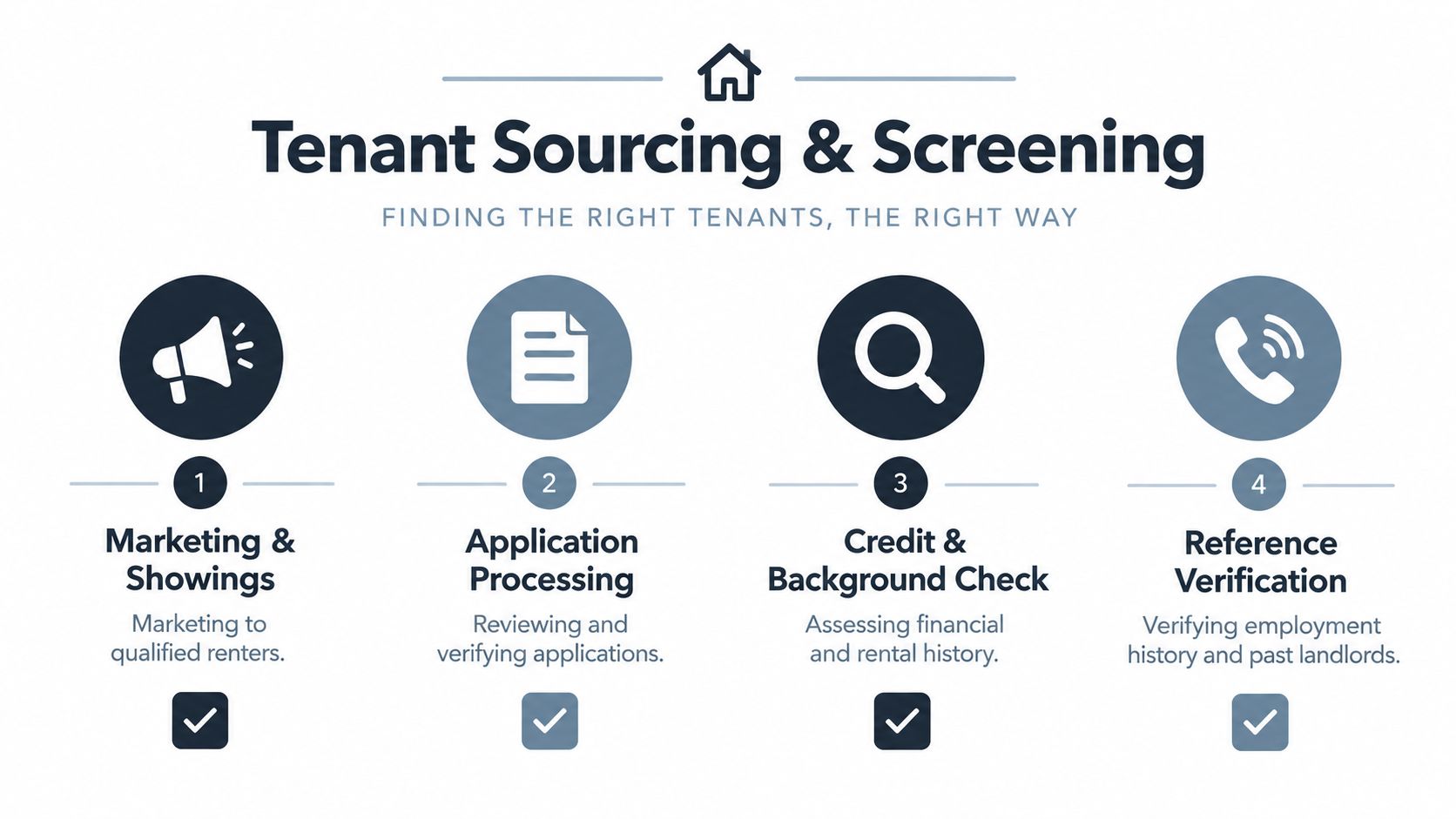
A professional leasing process usually brings together several sources of information:
- Employment verification: Confirming employment details helps test whether the applicant's stated income is supported.
- Income assessment: The agent considers the applicant's ability to meet the proposed rent, using the documents and information supplied.
- Tenancy history: Previous rental arrangements can show how the applicant communicated, paid and cared for a property.
- Reference checks: Speaking with relevant referees helps verify the history supplied in the application.
- Identity and application consistency: Names, dates, addresses and supporting documents should make sense together.
The tenant history checking resource explains why past tenancy information matters. It shouldn't be treated as a single automatic pass or fail. The manager still needs to assess the complete application, apply consistent criteria and record the reasoning behind the recommendation.
Choosing well in a competitive market
Vacancy conditions have remained tight. National vacancy was 1.2% in May 2026 and 1.3% in June 2026, while Sydney sat around 1.5% to 1.7% across mid-2026, according to the SQM Research vacancy update. In practical terms, landlords may receive strong interest, but that doesn't remove the need for careful screening.
The best application isn't always the first application, and the highest offer isn't automatically the safest choice. An agent should explain what was checked, what remains unclear and why the recommended applicant fits the property and the lease terms.
Ask prospective managers:
- Which documents do you request from applicants?
- How do you verify employment and rental references?
- How do you handle incomplete or conflicting information?
- How do you record the approval decision?
- Who speaks with the owner before the application is accepted?
Good sourcing protects the tenancy before the first rent payment arrives. It creates a clear foundation for communication, expectations and future decisions.
Inspections and Maintenance Coordination Without Delays
Inspections and maintenance operate on a timetable, but the timetable has limits. In NSW, routine inspections are generally limited to once every 3 months, and written entry notice must usually be provided 7 days in advance. The NSW property management guidance on inspections explains why scheduling and notice need to be handled carefully.
That restriction changes how a manager finds problems. An inspection can't be treated as an informal drop-in, and it can't replace prompt attention to a tenant's repair request. The agency needs a fixed workflow that connects the inspection date, notice, photographs, report and follow-up action.
The inspection record
A useful inspection report should tell the owner more than “all looks good”. It should identify visible changes, note areas requiring attention and include photographs where appropriate. The manager then needs to separate normal wear, tenant-caused issues, urgent repairs and maintenance that can be planned.
A sensible workflow looks like this:
- Schedule lawfully: Set the inspection within the permitted cadence and issue the required written notice.
- Capture evidence: Record relevant conditions with clear notes and photographs.
- Send the report: Upload the material promptly so the owner can review it without waiting for a phone call.
- Prioritise action: Separate urgent matters from work that can be quoted or planned.
- Track completion: Keep the request, approval, invoice and final update together.
The rental inspection checklist can help owners understand the areas a manager should consider. The goal isn't to create unnecessary disruption. It's to identify defects while the repair is still manageable.
Maintenance needs a clear handoff
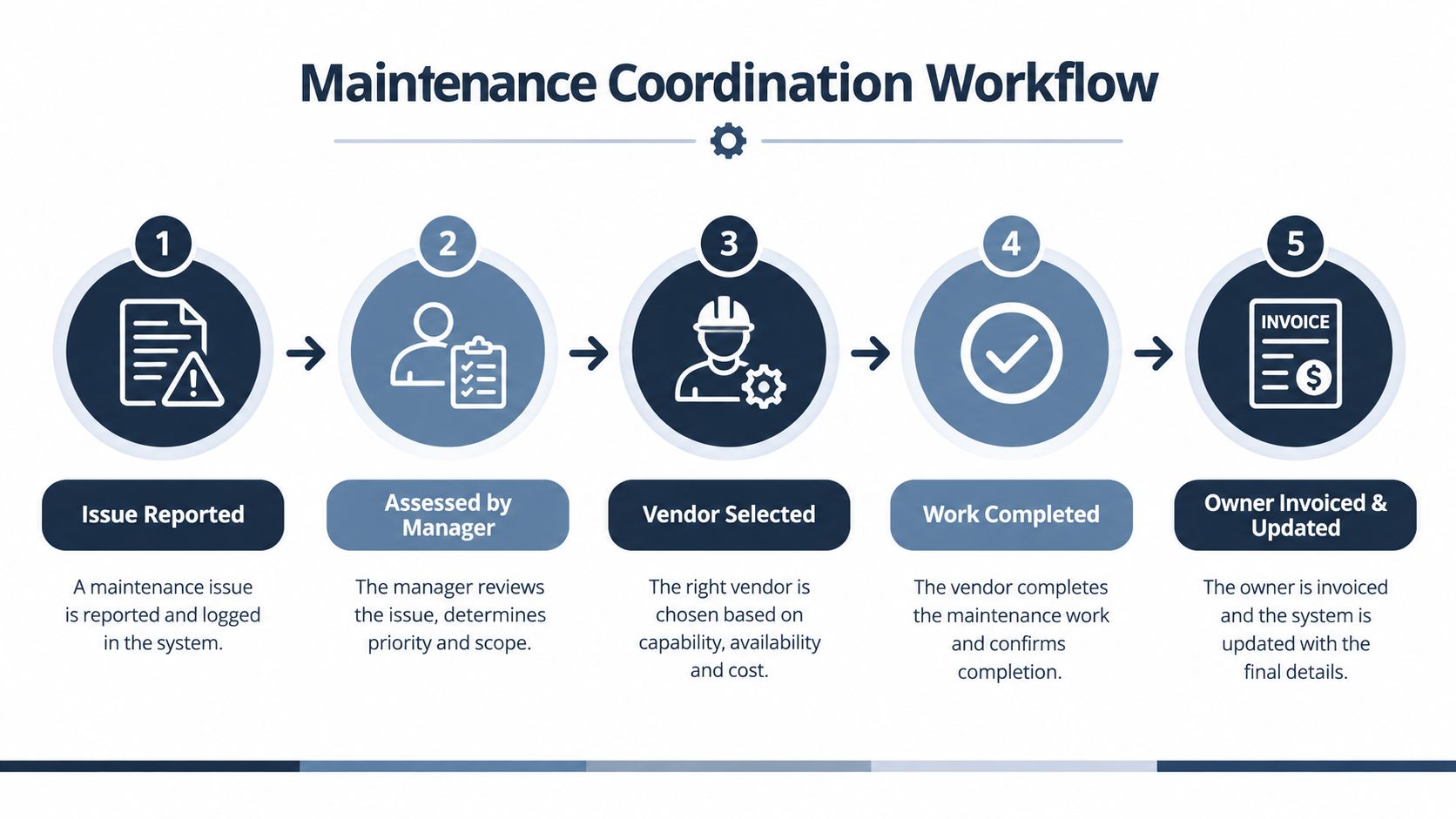
Tenant repair requests should be documented from the beginning. NSW tenant guidance distinguishes urgent and non-urgent repairs and supports written records of how requests are handled. The repairs and maintenance fact sheet is useful context for understanding why a portal should show the request, status, approvals and communication trail.
In practice, a modern workflow can begin when the tenant submits a request. The manager assesses it, asks for photographs or video if needed, selects an appropriate trade, obtains approval where required, sends the job and records the outcome. Automated photo uploads and job dispatch reduce the time spent copying information between systems.
Trade availability also affects pricing. Busy contractors may quote higher prices, while available contractors may be more willing to offer a sharper rate. A broad, reliable network gives the manager more options, but the cheapest quote isn't always the right choice. The trade still needs to be suitable, insured where appropriate and capable of completing the work properly.
A repair should have an owner, a status and a next action. If any of those is missing, the request can stall.
Arrears Control and Compliance Landlords Must Understand
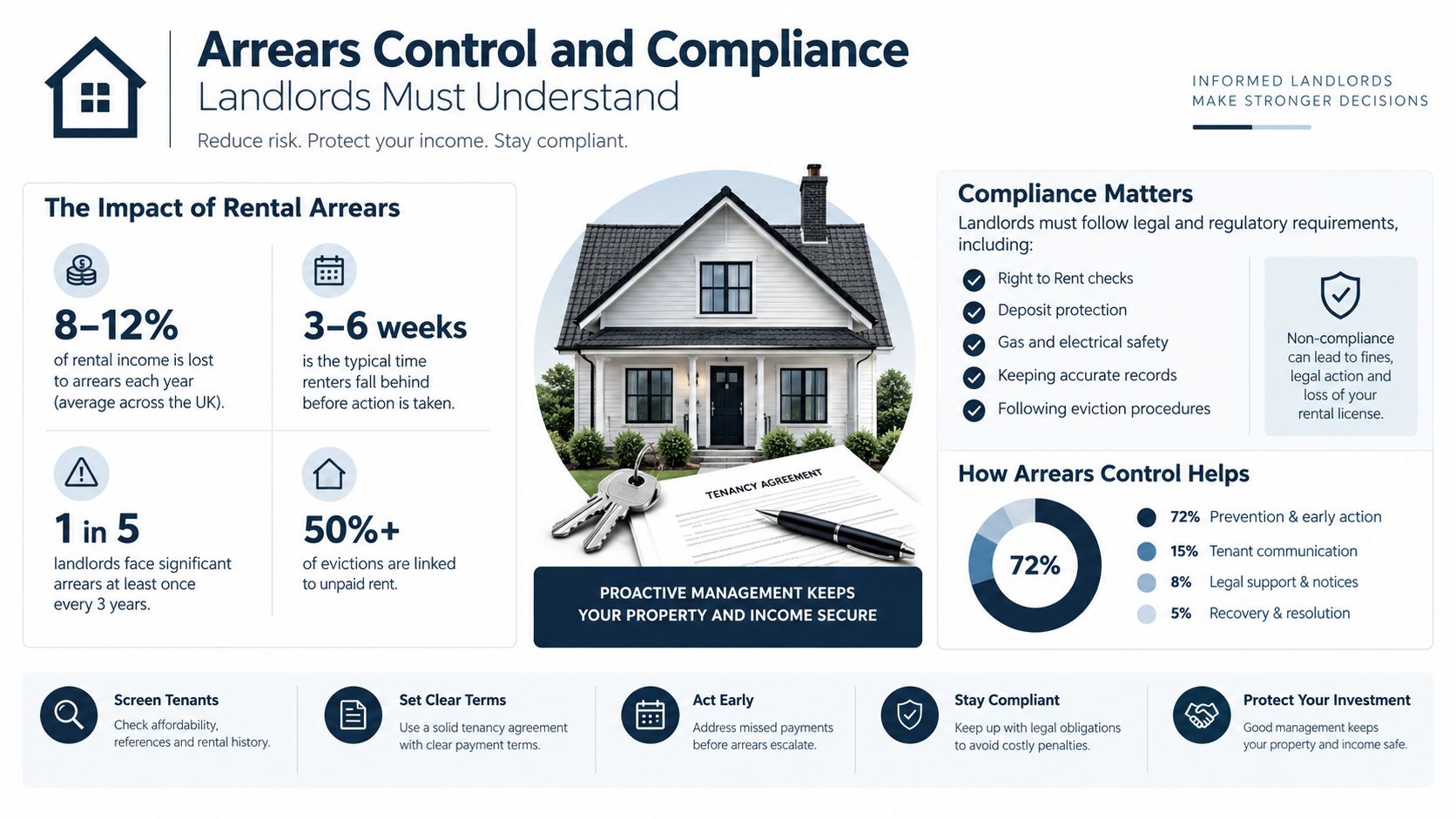
A rent payment can be late for many reasons, but arrears become harder to manage when nobody knows the next step. A clear arrears policy sets out when the manager contacts the tenant, what is recorded and when follow-up occurs. Consistency matters, while practical judgement leaves room for a tenant to explain an unexpected expense.
A tenant with a reliable payment history may need a direct conversation and a short arrangement. That does not remove the arrears. The manager records the agreement, confirms the expected payment and checks that it is met. For the landlord, this creates an auditable process rather than a trail of informal promises.
The new reporting responsibility
NSW introduced a tenancy-end reporting requirement from 1 July 2025. Agents and landlords must report tenancy-end information through Rental Bonds Online, and non-compliance can attract penalties of up to $1,100 per offence, as explained by REINSW's guidance on the new reporting obligations.
The workflow should answer four practical questions:
- Who reports: The owner or agent has a defined responsibility.
- What supports the report: The tenancy file retains the ending information and relevant evidence.
- When it happens: The task sits alongside the final inspection, bond processing and document storage.
- Where it is recorded: Rental Bonds Online activity and supporting records can be retrieved without searching scattered emails.
NSW Fair Trading's data-matching capability monitors more than 950,000 rental properties across the state, as reported in its data-matching program information. Accurate records therefore matter. A 24/7 owner portal can show arrears status, notices, approvals and stored documents as the matter develops, helping the landlord make decisions without waiting for a manual update.
Records protect the income stream
Arrears control and compliance are connected because a tenancy ending can involve rent history, notices, communication, property condition and bond information. Keeping these records together helps the owner understand what happened and gives the manager a reliable basis for the next action.
End-of-lease preparation also requires clear cleaning expectations. Information about vacate cleaning costs and tips can help owners explain the standard before the final inspection. The assessment should compare the property with its documented condition and distinguish ordinary wear from damage.
How a 24/7 Owner Portal Creates Real Transparency
A portal is valuable when it answers the owner's next question without requiring a chase-up call. The useful information is usually practical: Is the rent up to date? What did the inspection find? Has the repair been quoted? Did the owner approval go through? Where is the end-of-year report?
For owners with one property, that clarity prevents small tasks from becoming background stress. For owners with several properties, it creates one place for statements, rent tracking, inspection reports, maintenance quotes, approvals and end-of-year reporting. Mobile access matters because many owners aren't standing near the property when a decision is needed.
A drainage problem solved through shared history
A Green Valley property developed a recurring drainage problem at the front of the home. The drain overflowed during heavy rainfall, but the source of the blockage wasn't obvious.
The latest video was uploaded to the owner portal so the owner could see what was happening rather than relying on a short verbal description. Because the owner had previously lived at the property, they remembered that an inspection point had been buried during paving work in the backyard.
That detail changed the investigation. The manager connected the owner's memory with the tenant's observations, and the buried inspection point helped identify the issue. The blockage was resolved without further expense to the owner.
Automation still needs human judgement
Photos can be uploaded automatically, and jobs can be sent to a trades network from the management system. Approvals can also be requested quickly. Those features reduce delays, but they don't replace the manager's assessment of urgency, scope, cost or tenant circumstances.
Owners also need a communication channel outside the portal. If someone drives past and notices an overgrown lawn, hears a concern from a neighbour or wants to discuss a proposed repair, they should be able to call the manager. Technology gives visibility. Direct communication gives context.
Owners consistently value having information at their fingertips, particularly repair quotes, tenancy ledgers and end-of-year reporting. The portal becomes most useful when it supports both sides of management, fast digital access and a real person who can explain what the information means.
Choosing the Right Management Service for Your Property
A suitable manager should offer more than rent collection. Compare agencies against the full operating picture:
- Accountability: Can you speak with the person responsible for your property?
- Pricing evidence: Does the agency use recent bond-lodgement signals and local knowledge when reviewing rent?
- Tenant selection: Are employment, income, references and tenancy history checked consistently?
- Inspection discipline: Does the process respect the NSW inspection cadence and notice requirements?
- Maintenance control: Can tenants report issues, can owners approve work promptly and can the agency show the outcome?
- Recordkeeping: Are agreements, condition reports, inspection records, invoices and end-of-year documents stored together?
- Portal access: Can you see rent, reports, quotes and approvals without waiting for an email?
The NSW Government requires property professionals to retain written records for pre-purchase inspection reports for at least 3 years, including the inspection date, requester, preparer and professional indemnity insurance information, as outlined in the NSW requirements for pre-purchase inspection records. That kind of document discipline is a useful benchmark for any management service. An owner considering a broader technology approach may also find this overview of a home service pro management solution helpful when comparing workflow features.
For landlords in Liverpool, Fairfield and Green Valley, the strongest arrangement combines local judgement, clear communication, lawful processes and visible records. Property management is stewardship. The manager protects the home, supports the tenancy and gives the owner enough information to make timely decisions.
Gregory Property Agents provides residential property management services across Green Valley, Liverpool, Fairfield and nearby South-West Sydney suburbs, with tenant screening, inspections, maintenance coordination, arrears control and a 24/7 owner portal. Visit Gregory Property Agents to discuss how your rental could be managed with clearer reporting, direct communication and a more organised compliance workflow.