
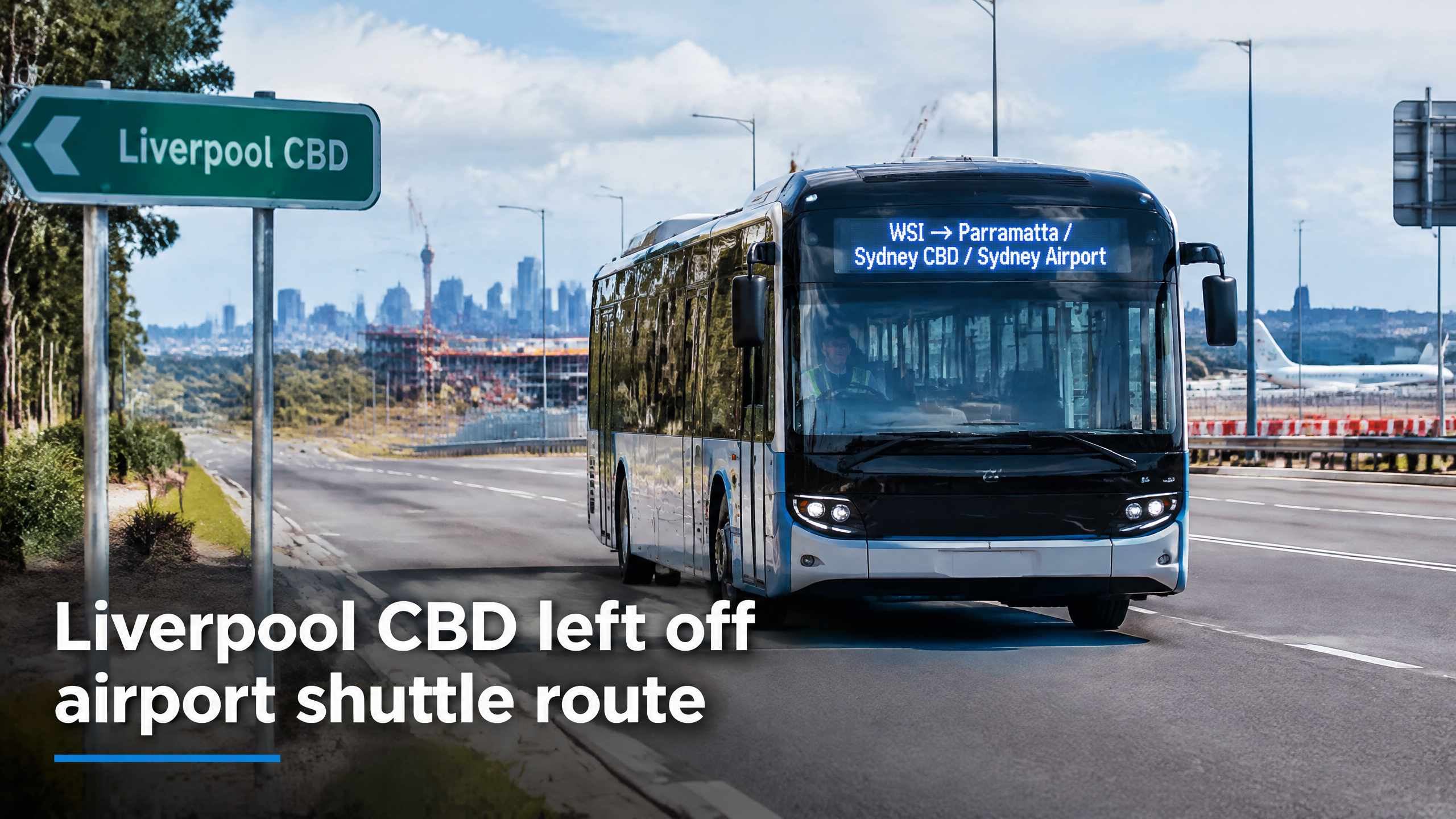
Liverpool CBD left off new Western Sydney Airport Super Shuttle route
When Western Sydney International Airport opens its passenger services later this month, travellers will have a new express electric shuttle option connecting them to Parramatta, Sydney CBD and Sydney Kingsford Smith Airport.
But there is one glaring omission from the first route list.
Liverpool CBD is not included.
Western Sydney International Airport, officially known as Western Sydney International (Nancy-Bird Walton) Airport, has announced a five-year partnership with NSBC Group to operate Super Shuttle WSI, an express electric bus service designed to move passengers between the new 24-hour airport and key Sydney transport and commercial hubs.
According to the airport’s announcement, launch destinations include:
- Parramatta CBD
- Sydney CBD
- Sydney Kingsford Smith Airport
Tickets are now on sale, with launch pricing for one-way adult fares starting at $25 from WSI to Parramatta CBD, $55 to Sydney City, and $65 to Sydney Kingsford Smith Airport.
The service is due to begin with the launch of passenger flights from 25 October 2026.
The buses will be electric, low-floor vehicles with luggage racks, wheelchair and pram space, and dedicated airport boarding bays. The service will initially be scheduled to align with arriving and departing flights.
On paper, it is a sensible addition to the airport’s transport mix.
But for Liverpool, the announcement raises an uncomfortable question:
Why are passengers being offered a direct express link to Parramatta and the Sydney CBD, but not to Liverpool CBD — one of the closest major centres to the new airport?
A major airport on Liverpool’s doorstep — but no direct shuttle to Liverpool CBD
The new Western Sydney International Airport has long been sold as a once-in-a-generation project for Western Sydney and, in particular, South West Sydney.
Liverpool has been consistently described as one of the key cities set to benefit from the airport’s arrival. Its proximity to the airport, its growing CBD, its health and education precinct, its legal and civic services, its multicultural food and retail economy, and its role as a major regional centre all make it a logical destination for airport-linked transport.
Yet in the first Super Shuttle WSI announcement, Liverpool CBD is missing.
That does not mean Liverpool has no transport links to the airport. The airport has pointed to a broader mix of access options, including public buses, car hire, taxis, rideshare and on-site parking.
But the symbolism and commercial reality of an express airport shuttle matter.
When a traveller lands at a new international airport and sees clearly promoted direct shuttle options, those destinations are being positioned as the places to go. They become part of the airport’s first impression.
At this stage, that first impression appears to be:
Parramatta, Sydney CBD, Sydney Airport — but not Liverpool.
For a city that has been told for years it would be central to the airport economy, that omission deserves scrutiny.
What the airport announced
Western Sydney International Airport CEO Simon Hickey said the new shuttle partnership would expand choice and flexibility for passengers travelling to and from Sydney’s new 24-hour airport.
“With the launch of passenger services from 25 October, we’re thrilled to announce Super Shuttle WSI’s express and direct shuttle bus services — available to passengers from the first flight,” Mr Hickey said.
He said the airport’s focus was on making every stage of the journey as smooth as possible, including travel to and from the terminal.
“Passengers will be able to enjoy a great onboard experience including luggage racks, dedicated space for prams and wheelchairs, and exclusive bus bays for boarding and disembarking at the airport,” he said.
“Super Shuttle WSI will provide a comfortable and convenient connection between WSI and some of Sydney’s major transport centres, no matter what time of day or night you are arriving or departing.”
NSBC Group Chief Commercial Officer Paul Anderson said passengers would benefit from the company’s electric, low-floor bus fleet, with each vehicle having capacity for 37 passengers, additional standing room and space for two wheelchair users.
“We are pleased to offer this highly convenient private shuttle service to passengers from when the first flights take off from WSI on October 25, aligned across WSI’s evolving flight schedule,” Mr Anderson said.
He said launch pricing would include discounted fares for adults, children and families.
“The direct, express nature of our services will deliver passengers to the hearts of the Parramatta and Sydney CBDs, as well as Sydney Kingsford-Smith Airport, with a comfortable, efficient and reliable service,” he said.
That quote may be the one that lands hardest in Liverpool.
The service will deliver passengers to the hearts of Parramatta and Sydney — but not the heart of Liverpool.
Why Liverpool CBD’s omission matters
This is not just a transport story. It is an economic development story.
Airport transport routes do more than move passengers from one place to another. They shape spending patterns, business opportunities and visitor behaviour.
A direct shuttle can influence where people:
- book accommodation
- hold meetings
- eat and drink
- shop
- access services
- connect to onward transport
- form their first impression of a region
If Liverpool CBD is left out of the initial express shuttle network, the risk is that airport passengers are encouraged to land in South West Sydney and then immediately leave for Parramatta, the Sydney CBD or Mascot.
That may be convenient for many travellers. It may also make operational sense from the perspective of serving large existing markets.
But it leaves Liverpool in a familiar position: close enough to carry the impacts of major infrastructure, yet not necessarily first in line for the benefits.
Liverpool residents and businesses have heard for years that the airport would bring jobs, visitors, investment and opportunity. A direct airport connection into Liverpool CBD would help convert that promise into actual foot traffic.
Without it, the city risks becoming a neighbour to the airport rather than a gateway to it.
The impact on Liverpool businesses
Liverpool CBD has been working hard to strengthen its identity as a commercial, hospitality and professional services centre.
It is home to restaurants, cafés, medical specialists, legal firms, accountants, real estate agencies, retailers, hotels, community organisations and cultural venues. It also sits near one of the most important health and education precincts in New South Wales.
For many of those businesses, the airport is not an abstract infrastructure project. It is meant to be a source of future customers.
A traveller arriving at Western Sydney International Airport might need:
- a hotel room before an early flight
- a meal after landing late at night
- a meeting room close to the airport
- medical or professional appointments
- shopping and personal services
- a base for visiting family in South West Sydney
- a convenient CBD with transport links
Liverpool can offer many of those things.
But people need to be directed there.
If the simplest promoted shuttle options take passengers elsewhere, Liverpool businesses may miss out on exactly the type of visitor spending the airport was expected to generate.
That matters especially for small and family-owned businesses. A few extra tables in a restaurant, a handful of additional hotel bookings, or steady airport-related trade could make a meaningful difference in a CBD still recovering from years of disruption, construction, cost pressures and shifting work patterns.
The question is not whether Parramatta or Sydney deserve airport links. They obviously do.
The question is why Liverpool CBD was not considered important enough to be included from the start.
“Landing here, spending elsewhere”
There is a phrase that may now start circulating through Liverpool business circles:
Landing here, spending elsewhere.
It captures the concern neatly.
Western Sydney International Airport is physically located in the region that Liverpool helps anchor. The airport’s workforce, service economy and surrounding growth corridor are deeply connected to South West Sydney.
Yet if arriving passengers are immediately funnelled towards Parramatta and the Sydney CBD, the economic benefit may drift away from the communities closest to the airport.
That is a sensitive issue in Western Sydney.
For decades, communities in the west and south west have argued that they host the infrastructure Sydney needs — roads, freight corridors, industrial land, waste facilities, warehouses and now a major international airport — while the prestige, investment and visitor dollars often flow back towards more established centres.
Liverpool CBD’s absence from the Super Shuttle WSI launch routes touches that nerve.
It may be a commercial decision. It may be a staging decision. It may be that future Liverpool routes are under consideration.
But if that is the case, the airport, transport operators and government stakeholders should say so clearly.
Liverpool should not be left guessing.
The case for a Liverpool CBD airport shuttle
A direct express shuttle between Western Sydney International Airport and Liverpool CBD would make practical sense for several reasons.
First, Liverpool is one of the closest major CBDs to the airport. For travellers heading to South West Sydney, it is a logical point of arrival and departure.
Second, Liverpool is already a major transport centre, with rail and bus connections to surrounding suburbs including Warwick Farm, Casula, Moorebank, Chipping Norton, Green Valley, Miller, Prestons, Lurnea, Cabramatta, Fairfield and Bankstown.
Third, Liverpool has an established commercial base that could immediately benefit from airport-linked visitors.
Fourth, the Liverpool Health and Education Precinct has a regional role that extends well beyond the local government area. Visiting specialists, students, academics, health workers, patients and families may all benefit from improved airport connectivity.
Fifth, Liverpool’s night-time economy could gain from passengers and airport workers needing food, accommodation and services outside standard business hours — especially with WSI operating as a 24-hour airport.
The airport has been promoted as a catalyst for a new Western Sydney economy. If that economy is to be more than a slogan, then airport transport must connect to existing centres as well as future ones.
Liverpool CBD is not theoretical. It exists now. It has businesses now. It has workers now. It has capacity to benefit now.
Parramatta gets the $25 fare — Liverpool gets the question mark
The launch fare to Parramatta CBD is particularly notable: $25 one way for adults.
That is a clear, marketable offer. It gives travellers a simple proposition from day one.
Land at Western Sydney International Airport and take an express shuttle to Parramatta.
By comparison, Liverpool CBD has no equivalent Super Shuttle offer in the announcement.
That creates an immediate competitive imbalance. Parramatta businesses, hotels and venues can promote a direct airport shuttle connection. Sydney CBD businesses can do the same. Even passengers connecting to Kingsford Smith Airport have a dedicated option.
Liverpool businesses cannot.
For a city trying to compete for investment and visitor attention, that difference matters.
Transport visibility affects perception. If a destination appears on airport signage, booking platforms and shuttle timetables, it gains status. It becomes part of the official travel map.
If it is absent, it can be perceived as secondary — even when it is geographically closer.
That is why this issue should not be dismissed as a minor route-planning detail.
It is about Liverpool’s place in the airport story.
A test for local leadership
The Super Shuttle announcement should prompt immediate questions from Liverpool’s civic, business and political leaders.
Those questions include:
- Was Liverpool CBD considered for the initial Super Shuttle WSI service?
- If it was considered, why was it not included?
- Is a Liverpool CBD route planned for a later stage?
- What passenger demand modelling was used?
- Were Liverpool businesses, council or community representatives consulted?
- Will shuttle stops be reviewed after passenger services begin?
- How will the airport ensure South West Sydney receives direct visitor economy benefits?
These are reasonable questions.
They are not anti-airport questions. They are pro-Liverpool questions.
If the airport is serious about being a Western Sydney airport — not merely an airport located in Western Sydney — then its transport connections should reflect the region’s actual centres of life, work and commerce.
Liverpool should be at the table early, not added as an afterthought.
The wider transport challenge
It is important to acknowledge that airport access is complex.
No single shuttle service can solve every transport issue on day one. Western Sydney International Airport will need a layered transport network, including roads, public buses, rideshare, taxis, private shuttles, car hire, parking and, over time, rail connections.
The Super Shuttle WSI service is a private shuttle product, not the whole airport transport plan.
There may also be operational reasons why Parramatta, Sydney CBD and Kingsford Smith Airport were chosen first. They are large recognised destinations with obvious passenger demand. The Sydney Airport connection may be useful for transfer passengers. Parramatta is a major metropolitan centre. Sydney CBD remains the state’s largest commercial core.
But acknowledging those reasons does not remove Liverpool’s case.
In fact, it strengthens the argument for transparency.
If Liverpool is not in stage one, when is stage two? If direct demand is considered insufficient, what is being done to build it? If the service is flight-aligned, could Liverpool be added through selected peak services, hotel loops or a shorter express route?
The answer should not simply be silence.
Western Sydney International Airport’s local promise
Western Sydney International Airport has been presented as more than a runway and terminal. It has been framed as a transformative project that would support jobs, growth and opportunity across the region.
For Liverpool, that promise has always carried both hope and risk.
The hope is obvious: more visitors, more jobs, more investment, better transport links, stronger local businesses and greater recognition of South West Sydney’s importance.
The risk is also obvious: that the airport becomes a facility near Liverpool, while the economic rewards are captured elsewhere.
Transport routes are one of the earliest signs of how that balance may play out.
If the first express shuttle services bypass Liverpool CBD, local businesses will understandably wonder whether the benefits are already being directed away from them.
This is not about parochialism. It is about fairness and planning.
Liverpool has the population, geography and commercial base to justify inclusion. It should not need to argue for relevance in its own region.
What Liverpool businesses may want to do now
Local businesses do not need to wait passively.
The announcement provides an opportunity for Liverpool’s business community to make a clear, united case for inclusion in future Super Shuttle WSI planning.
That could include:
- gathering evidence from hotels, restaurants and retailers about likely airport-related demand
- surveying local businesses on the value of a direct airport shuttle
- asking council and MPs to advocate formally for a Liverpool CBD stop
- engaging with Western Sydney International Airport and NSBC Group
- promoting Liverpool as the closest major CBD for many airport users
- developing visitor packages around accommodation, dining and transport
- encouraging major institutions to support a direct connection
Liverpool should be proactive. If route planning is demand-driven, then demand needs to be demonstrated loudly and early.
The city cannot afford to be modest about its role.
The bottom line
Western Sydney International Airport has announced its new Super Shuttle WSI service, offering express electric bus transfers to Parramatta CBD, Sydney CBD and Sydney Kingsford Smith Airport from the launch of passenger services on 25 October 2026.
The service will add convenience for many travellers and provide another transport option for Sydney’s new 24-hour airport.
But based on the airport’s announcement, Liverpool CBD is not included in the initial Super Shuttle WSI route list.
For Liverpool, that omission matters.
It matters because Liverpool is one of the closest major centres to the airport. It matters because local businesses have been expecting airport-related opportunities. It matters because transport links shape where visitors go and where they spend. And it matters because South West Sydney should not be treated as a place people land in, only to be transported somewhere else.
The airport may be called Western Sydney International, but Western Sydney is not a blank space between Parramatta and the runway.
Liverpool is here. Its businesses are here. Its workers, residents, restaurants, hotels, shops, services and institutions are here.
If the new airport is going to deliver on its local promise, Liverpool CBD needs more than proximity.
It needs connection.
And on the first Super Shuttle WSI map, that connection is still missing.