

Liverpool's Q1 2026 median house price hit $1,270,000, up 13.4% year on year, even as house sales fell 28.6% to 390. That's the clearest sign in the South West Sydney property market right now. Demand is still there, but buyers are competing over fewer available homes.
That combination catches people out. Many still talk about South West Sydney as though it's just the “more affordable” side of the city, but that framing misses what's happening on the ground. In practical terms, this is a market where stock type, timing, and suburb selection matter more than broad headlines. If you're buying, selling, or holding property in Liverpool, Fairfield, or the surrounding corridor, you need to read the market by supply pressure and dwelling mix, not by old assumptions.
Table of Contents
- What the South West Sydney Property Market Looks Like Right Now
- Why the South West Has Been a Long-Term Growth Corridor
- How Tight Housing Supply Shapes Near-Term Market Conditions
- House Versus Unit Demand Across Liverpool and Fairfield
- Reframing Affordability for Buyers and Investors
- Practical Next Steps for Buyers, Sellers and Landlords
What the South West Sydney Property Market Looks Like Right Now
If you only track one number this quarter, track Liverpool's turnover. In Q1 2026, the median house price reached $1,270,000, while the median unit price reached $598,750. House values rose 13.4% year on year and unit values rose 4.1%, according to Prudential's 2026 market update.
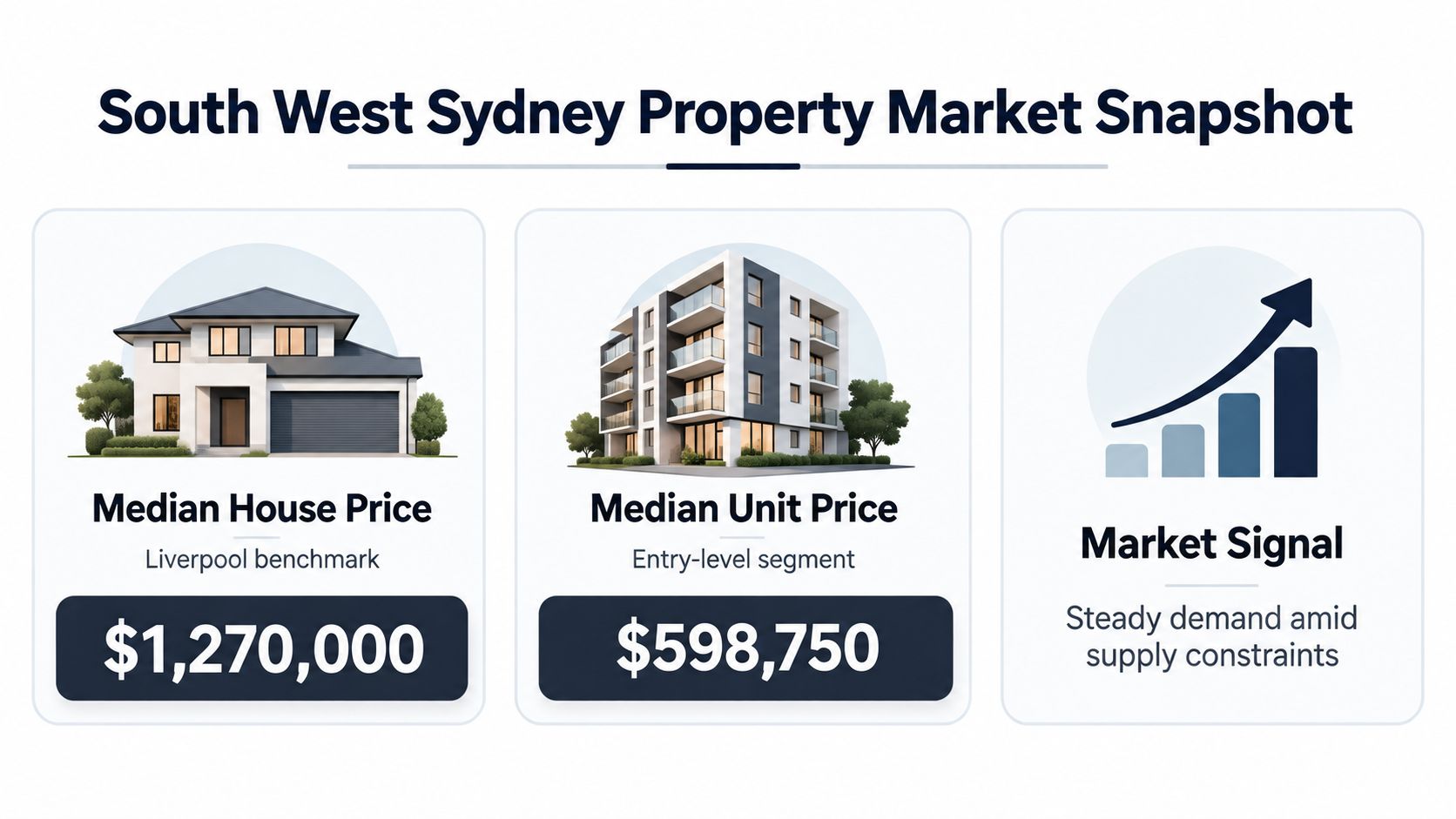
Rising prices with fewer deals
The stronger signal is the drop in activity. Liverpool house sales fell 28.6% to 390, while unit sales fell 15.3% to 260 compared with Q1 2025. The same Q1 2026 snapshot points to owners holding back and buyers competing for a smaller flow of listings.
That combination creates a tight market rather than an easy one. Sellers may have pricing support, but overpricing still leaves a property exposed when buyers compare it with nearby stock. Buyers need to make decisions faster when the right home appears, particularly in family-oriented pockets.
Practical rule: Rising prices with falling turnover call for sharper seller pricing and faster buyer decisions.
Liverpool also contains several distinct price brackets. 27.2% of houses sold at $1,450,000 or above, while 26.3% sold below $1,149,999. The spread shows demand at the premium end as well as meaningful competition for homes below that tier. A single suburb median cannot describe every street, dwelling type, or condition level.
What this means in practice
Sellers should position the property against its actual buyer pool, price bracket, and competing listings. A well-presented family home in a tightly held pocket will attract a different response from an older townhouse or standard unit.
Buyers should turn affordability into a property question: which dwelling type, location, and repayment level can you carry comfortably? Waiting for a broad market change may not improve the choice available if listings remain limited. Suburb-specific resources, including Liverpool properties for sale, provide more useful context than metro-wide commentary.
For investors, house and unit performance requires separate benchmarks. Detached homes face stronger scarcity and family demand, while units offer a more accessible entry point but need closer attention to building quality, position, and resale competition.
Use wider trends in 2026 as background, then judge each opportunity against current local listings and buyer demand.
Why the South West Has Been a Long-Term Growth Corridor
People sometimes talk about South West Sydney as though its growth story began recently. It didn't. This corridor has been building for decades, and that matters when you're judging whether current strength is just a short cycle or something more established.
Research highlighted by OpenAgent's Sydney property market profile reported that southwest Sydney property prices rose faster than anywhere else in NSW across the 25 years from 1993, and the region produced five of the 10 suburbs with the biggest price increases over that period. It also singled out Mount Annan, St Helens Park and Wattle Grove, each with price growth of more than 1,000% over that long run.
How these suburbs changed
Those results didn't come from one boom. They came from a pattern that local agents have watched for years. Land that once sat on the cheaper fringe matured into settled owner-occupier markets. New estates aged into established neighbourhoods. Families upgraded within the same districts instead of leaving them.
That kind of growth corridor behaves differently from inner-city speculative markets. People don't just buy for a short hold. They stay, renovate, extend, and move locally when their next stage of life arrives. That creates continuity.
Long-run growth in South West Sydney has usually followed population movement, household formation and suburb maturity, not short-lived hype.
What history helps with and what it doesn't
Historical outperformance is useful, but only if you apply it correctly. It helps you identify the type of places that tend to strengthen over time. Family-oriented streets, practical transport links, and suburbs that move from fringe to established often hold up well. That's where demographic context becomes useful, especially when you're looking at household change and lending demand. For brokers and buyers trying to read that side of the market, these demographic trends for mortgage brokers are a worthwhile companion read.
What history doesn't do is guarantee the same result in every pocket. Some suburbs mature faster than others. Some streets attract steady owner-occupier demand. Others stay more price-sensitive.
That's why local employment and infrastructure context still matters. Buyers who are trying to understand how jobs and economic direction shape housing demand across the corridor should also look at South West Sydney jobs and Western Sydney Airport data. Growth corridors aren't abstract. They're built by people choosing to live, work, and stay in the area.
How Tight Housing Supply Shapes Near-Term Market Conditions
Supply is the issue too many people leave until last. In South West Sydney, it should be near the top of the list.
The NSW Parliamentary Research and Library estimated 678 dwelling approvals across the South West Sydney region in 2024–25, and a separate pipeline assessment found that South West Sydney and Greater Macarthur could face an undersupply of about 12,100 greenfield lots relative to demand by FY30 if current delivery patterns continue, according to the NSW housing supply research page.
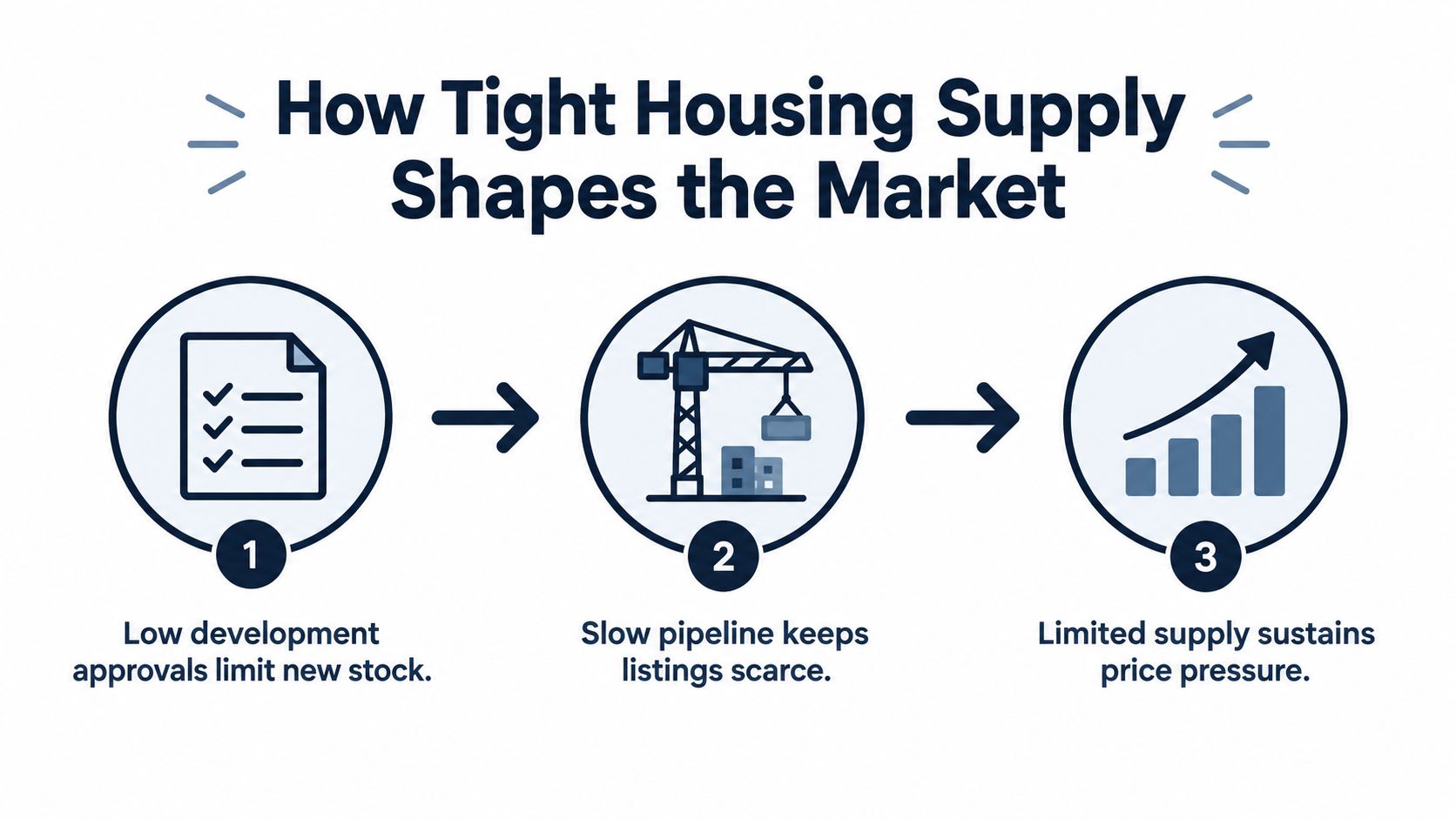
Why approvals matter to everyday buyers
Approvals sound like a planning statistic. They aren't, at least not once you're dealing with real buyers and sellers. If fewer dwellings are approved and lot delivery stays behind demand, buyers don't get enough new alternatives. That keeps pressure on established homes.
In Liverpool and Fairfield, that matters because a lot of demand is still aimed at practical family housing. When fresh stock doesn't arrive on time, owner-occupiers don't disappear. They compete for what's already built.
A common mistake is assuming future land release will automatically soften current conditions. In practice, delayed pipeline delivery often does the opposite in the near term. It keeps established stock important for longer.
What tends to work and what doesn't
When supply is this tight, some strategies hold up better than others:
- For buyers: Focus on properties with clear resale appeal. Scarce markets punish compromise stock more harshly when you go to sell later.
- For sellers: Launching with a loose price guide can backfire. Buyers are already filtering hard and comparing every listing against limited alternatives.
- For developers and land buyers: Timing risk matters. Delays in approvals or lot release can change feasibility quickly.
If new stock is slow to come through, established homes carry more weight than many buyers expect.
There's also a practical approval angle here. People considering a knockdown-rebuild, duplex pathway, or future land play need to read local planning conditions with care. Broad state housing targets don't tell you what a site will do. For a grounded local read on that issue, building approval trends in Liverpool are worth reviewing before you commit to a strategy.
House Versus Unit Demand Across Liverpool and Fairfield
Detached houses and units don't move the same way across this corridor. Treating them as one market is one of the most expensive reading errors buyers and investors make.
A housing supply report cited in the Anglicare Rental Affordability Snapshot for Sydney and Illawarra shows that flats make up about 12.1% of Liverpool dwellings and 11.5% of Fairfield dwellings, compared with 23.9% across Sydney. The same reporting notes that separate housing accounts for 70.8% of Fairfield dwellings.
Housing composition in Liverpool and Fairfield
| Suburb LGA | Detached housing share | Flats share | Greater Sydney flat share |
|---|---|---|---|
| Liverpool | Main stock type across the subregion | 12.1% | 23.9% |
| Fairfield | 70.8% | 11.5% | 23.9% |
Why houses behave differently
Where flats are a smaller share of the total stock, detached homes carry more of the market's family demand. That changes buyer behaviour. People aren't only comparing house prices. They're competing for land content, street position, school access, and the ability to stay in the area long term.
That creates a scarcity premium in many freestanding-home pockets. It also means inner-Sydney style unit commentary often doesn't travel well to Liverpool and Fairfield.
Where units fit
Units still matter. They serve a different function. They are often the access point for first-home buyers, single purchasers, and investors who want a lower entry price than detached housing. But they should be benchmarked against similar unit stock, not against house movement.
A few practical comparisons help:
- Houses suit buyers who need land, flexibility, or family-scale living and can absorb higher holding costs.
- Units suit buyers who value entry price, simpler maintenance, or proximity to transport and centres over land size.
- Investors need to separate demand drivers. House tenants and unit tenants often aren't looking for the same thing, and resale pools differ as well.
The key point is simple. In the South West Sydney property market, dwelling type isn't a detail. It's the starting point for pricing, buyer competition, and long-term expectations.
Reframing Affordability for Buyers and Investors
“Is South West Sydney affordable?” is the wrong question. It's too broad to help anyone make a good purchase decision.
The more useful question is this: which property type gives you a realistic entry point once you factor in purchase price, deposit, stamp duty position, and borrowing comfort?

Houses may be “cheaper than elsewhere” and still hard to enter
Liverpool's detached-house benchmark tells the story clearly. A market can still carry the old “more affordable than inner Sydney” label while becoming difficult for ordinary buyers to enter at the house level. Once prices move up, the issue isn't just the listing price. It's the full cash and lending pathway around it.
That's where many buyers lose time. They search by suburb first, then discover the product they wanted in that suburb no longer matches their borrowing range.
A suburb can look affordable on a Sydney map and still be difficult to enter if the detached-house segment has moved beyond your finance settings.
Units change the entry conversation
The practical reason units matter is that they can change both purchase feasibility and concession eligibility. Verified reporting notes Liverpool units at a Q1 2026 median of $598,750, and separate reporting referenced in the PRD Liverpool market update for the first half of 2026 says Liverpool units were around $520,000 in 2026, below the NSW first-home-buyer stamp duty exemption threshold of $800,000.
That doesn't mean every unit is the right buy. It means units often deserve serious consideration from buyers who are still trying to force a detached-house brief that no longer fits their numbers.
A practical way to assess your entry point
Buyers and investors usually make better decisions when they work through the trade-off directly:
- Start with borrowing comfort, not maximum borrowing. The property has to work after settlement, not just on approval day.
- Separate lifestyle needs from property type assumptions. Some buyers need a house. Others just prefer one.
- Test concession eligibility early. That can change the decision between waiting longer and buying sooner.
- Compare future flexibility. A strong unit in the right location can be a better first step than years spent chasing an unrealistic house target.
Affordability in South West Sydney isn't one answer. It's a property-type decision.
Practical Next Steps for Buyers, Sellers and Landlords
Good market reading only matters if you turn it into action. In South West Sydney, the right next step depends on which side of the transaction you're on.
If you're selling
Don't lean on broad confidence alone. Price the property against the right segment, not the suburb median in isolation. House and unit campaigns need different positioning, and premium streets need tighter buyer targeting than standard stock.
Use a short checklist before launching:
- Check competing stock carefully. Buyers compare hard when listings are limited.
- Match the campaign to the asset. Auction, private treaty, and off-market strategies each suit different conditions.
- Prepare the property properly. Presentation still affects how buyers interpret value in a constrained market.
If you're buying
Start by deciding whether you're shopping for a house because you need one, or because you've assumed that should be the goal. That distinction saves people months.
Then narrow your search properly:
- Choose streets, not just suburbs. Conditions can vary noticeably inside the same postcode.
- Sort finance before emotion takes over. A clear budget sharpens decision-making.
- Do due diligence early. Strata, zoning, layout, and resale appeal all matter more than a polished listing pitch.
For buyers who want local guidance, options include a buyer's agent, a broker with corridor experience, or a local agency that offers advisory support alongside listings. Gregory Property Agents, for example, provides buyer advisory, suburb-level guidance, and property management across Liverpool and Fairfield for owners who want one local point of contact.
If you're a landlord
Landlords do better when they treat management as risk control, not administration. In this corridor, the basics still drive outcomes.
Focus on the parts that protect the asset:
- Tenant selection matters first. Employment, references, and income checks reduce avoidable risk.
- Routine inspections need consistency. Small issues are cheaper when they're picked up early.
- Maintenance workflows should be clear. Delayed repairs often cost more and create tenancy problems.
- Reporting needs to be transparent. Owners should be able to see rent status, inspections, and approvals without chasing updates.
The owners who get the best long-term results usually make fewer reactive decisions. They set a clear strategy, then execute it well.
If you're unsure where to start, don't ask whether the market is “good” or “bad”. Ask what stock type you're dealing with, what the local supply picture looks like, and what decision gives you the strongest position over the next few years.
If you need suburb-level advice in Liverpool, Fairfield or the wider south west corridor, Gregory Property Agents handles sales, buyer advisory and property management with a direct local focus. If you want a grounded read on pricing, strategy or rental management rather than broad Sydney commentary, visit Gregory Property Agents.