

More than one in five Sydney homes now sell off-market, and that’s no longer a side story. The AFR reported the market has now sat at that level for a second consecutive year, and Quiet List analysis cited there showed 25% of residences in North Sydney in 2025 weren’t featured on major property websites like Domain or realestate.com.au (AFR report on Sydney homes selling without appearing online). In South-West Sydney, that changes the conversation for both buyers and sellers, because off-market property isn’t rare, it’s part of how the Sydney market clears stock.
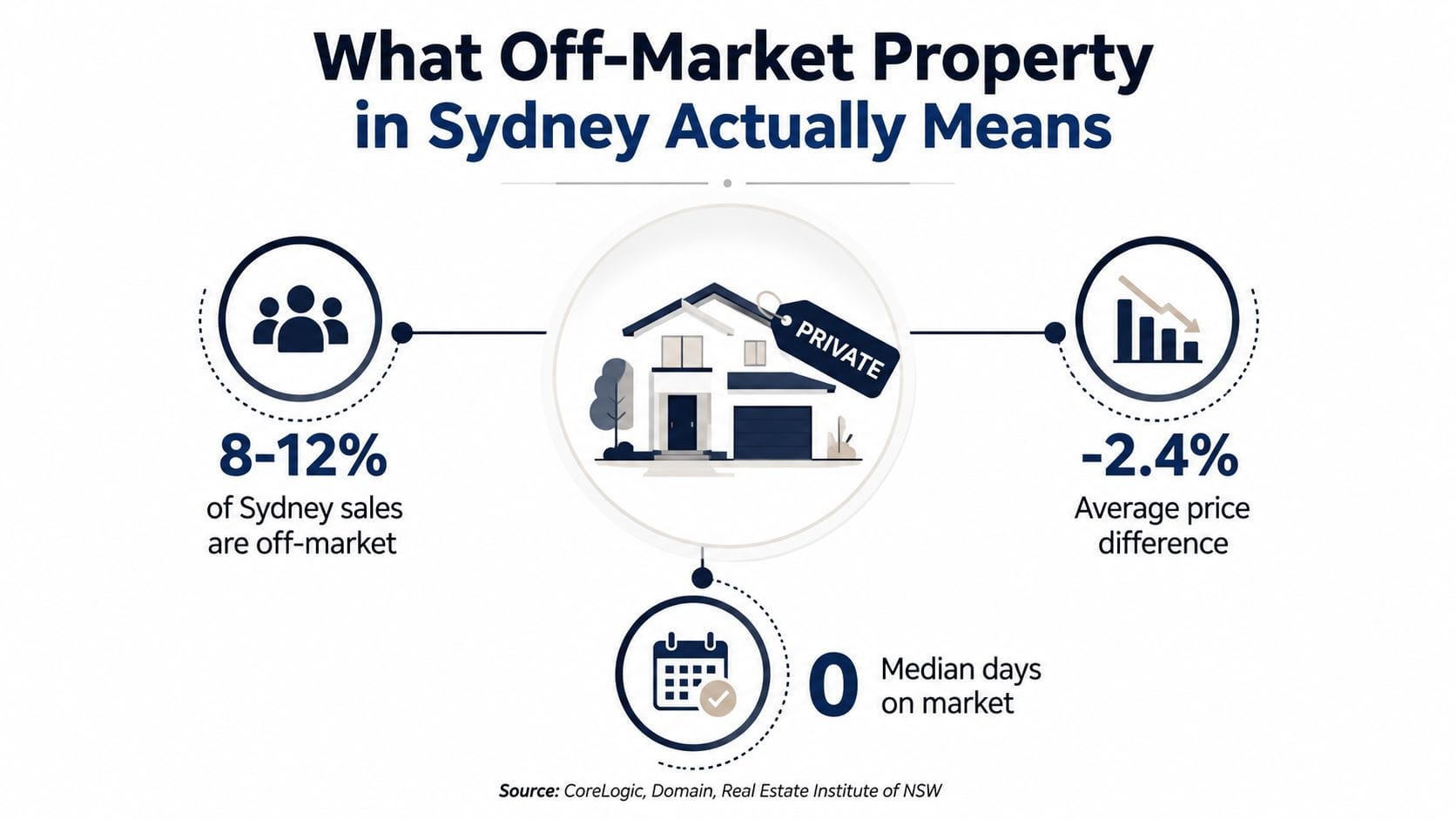
Table of Contents
- What Off Market Property in Sydney Means
- The Three Types of Off Market Sales Explained
- The Price Cost of Selling Off Market
- How Buyers Access Off Market Opportunities in South-West Sydney
- Creative Tactics That Work for Finding Hidden Properties
- When Sellers Should Choose Off Market Versus Public Listing
- How Buyers Avoid Overpaying in Off Market Negotiations
What Off Market Property in Sydney Means
Off market property in Sydney is a home sold without a public campaign on the major portals. In practice, that usually means no Domain listing, no realestate.com.au listing, and no broad open-home push. Buyers see the property privately, often through an agent’s network, and usually only if they are already known to be active and qualified.
That mechanism changes who sees the property, how quickly it moves, and how price discovery happens. A public listing spreads the net wide. A private campaign narrows the field to a smaller group, which can suit privacy, speed, or a quiet test of demand, but it also changes the level of competition.
Independent reporting cited analysis showing more than 20% of Sydney homes sold without appearing online, which is enough to shape local stock flow, not just individual deals (Yahoo Finance report on Sydney’s private-trend housing sales). In South-West Sydney, that affects how buyers in Liverpool, Fairfield, Casula, and Green Valley search for homes, because hidden stock is part of the normal market process now.
Practical rule: if a property never reaches the portals, you are not just missing a listing. You are missing the price-setting process that comes with a wider buyer pool.
Sellers use off-market to limit exposure, test demand, or keep life private, and each choice changes how the price is discovered. Buyers use it to reach stock that never shows up in a general search, but they have to work harder to check value because the public market has fewer chances to do that work for them.
The Three Types of Off Market Sales Explained
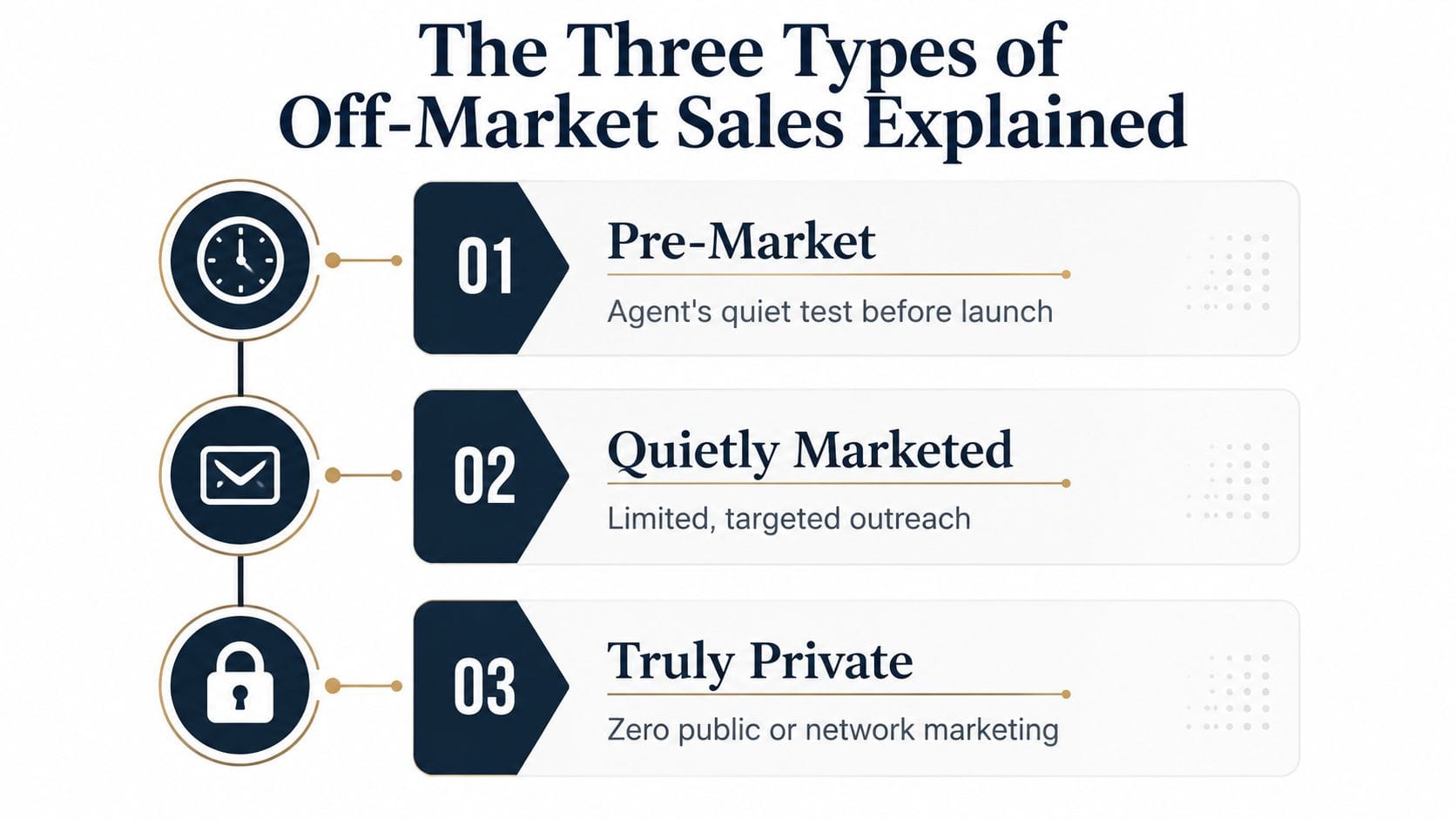
A private sale in Sydney can mean a few different things, and the differences matter. If you treat every off-market deal as the same, you can misread the seller’s urgency, the level of competition, and how much room there really is to negotiate.
Pre Market
A pre-market listing is signed up, but the full campaign has not gone live yet. The agent usually shows it to selected buyers first to gauge interest before opening it up more widely. For a buyer, that can mean earlier access to a property before the broader crowd even knows it is available. For a seller, it can be a useful test before committing to a full public push.
Marketed Privately
A marketed property sits between public and fully private. The agent may share it with their database, trusted contacts, or a small group of buyer advocates. That approach is common when the owner wants less disruption, less noise, or a more controlled sale process. In South-West Sydney, it often suits long-term owners who do not want a constant flow of open-home traffic through a lived-in house.
Private Sale
A private sale is kept out of the general market altogether. It is shown only to a very small circle, sometimes because the owner wants discretion, sometimes because they are willing to sell only if the right buyer appears. This is the version typically meant when people talk about hidden property.
The distinction matters because each type carries a different level of exposure and a different kind of negotiating pressure. A pre-market home may still have a wider runway, while a private sale can depend heavily on the agent’s existing relationships and buyer database. In Liverpool and Fairfield, knowing which lane you are in helps you judge vendor motivation without guessing.
A neutral source also notes there is no single legal definition of off-market property, which is why the wording an agent uses should always be checked carefully (Iconic Assets on off-market properties in Sydney). If the seller wants speed, privacy, or a softer first pass, the category matters as much as the address.
The Price Cost of Selling Off Market
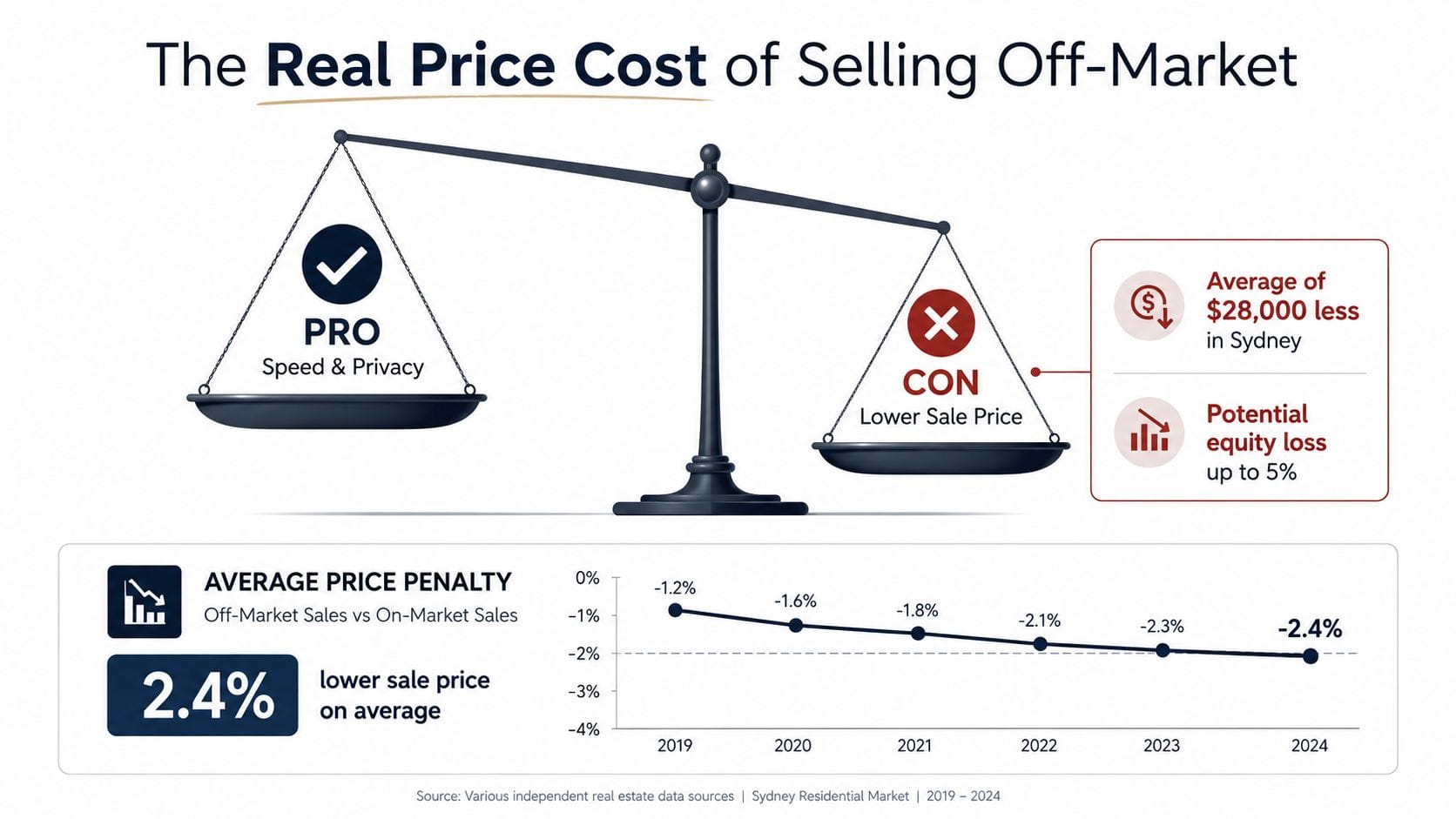
Off-market convenience usually comes with a price, and sellers need to face that trade-off before they give up broad exposure. PropTrack’s analysis found Sydney sellers who sold off-market between July 2021 and March 2022 received about 4.2% less than comparable properties listed on major portals, which it said translated to an average loss of more than $60,000 in greater Sydney (PropTrack off-market sales performance report). A later summary reported a similar result, with Sydney houses sold off-market at 4.3% lower prices and units at 2.8% less on average (PropTrack off-market sales performance report summary).
The reason is simple. A private network is smaller than the open market. Fewer eyes usually means fewer competing bids, and fewer competing bids usually means less pressure on the final price. That does not make off-market selling a bad choice, it just means privacy and speed have a cost attached.
For South-West Sydney owners, that trade-off becomes very real. If a family home sits in Sydney’s typical price range, even a small percentage difference can become a large equity gap quickly. The practical question is not whether off-market is good or bad. It is whether the certainty and lower disruption are worth giving up broader competition.
Privacy is not free. A seller usually pays for it through reduced buyer competition, and sometimes that bill is larger than people expect.
The trade-off also changes by property type. The same PropTrack summary said the discount for units was smaller than houses in Sydney, which points to different buyer behaviour across asset types. Sellers in Liverpool and Fairfield should not assume their property will perform the same way as a prestige home elsewhere in Sydney. The mechanism stays the same, but the result depends on the buyer pool behind it.
How Buyers Access Off Market Opportunities in South-West Sydney
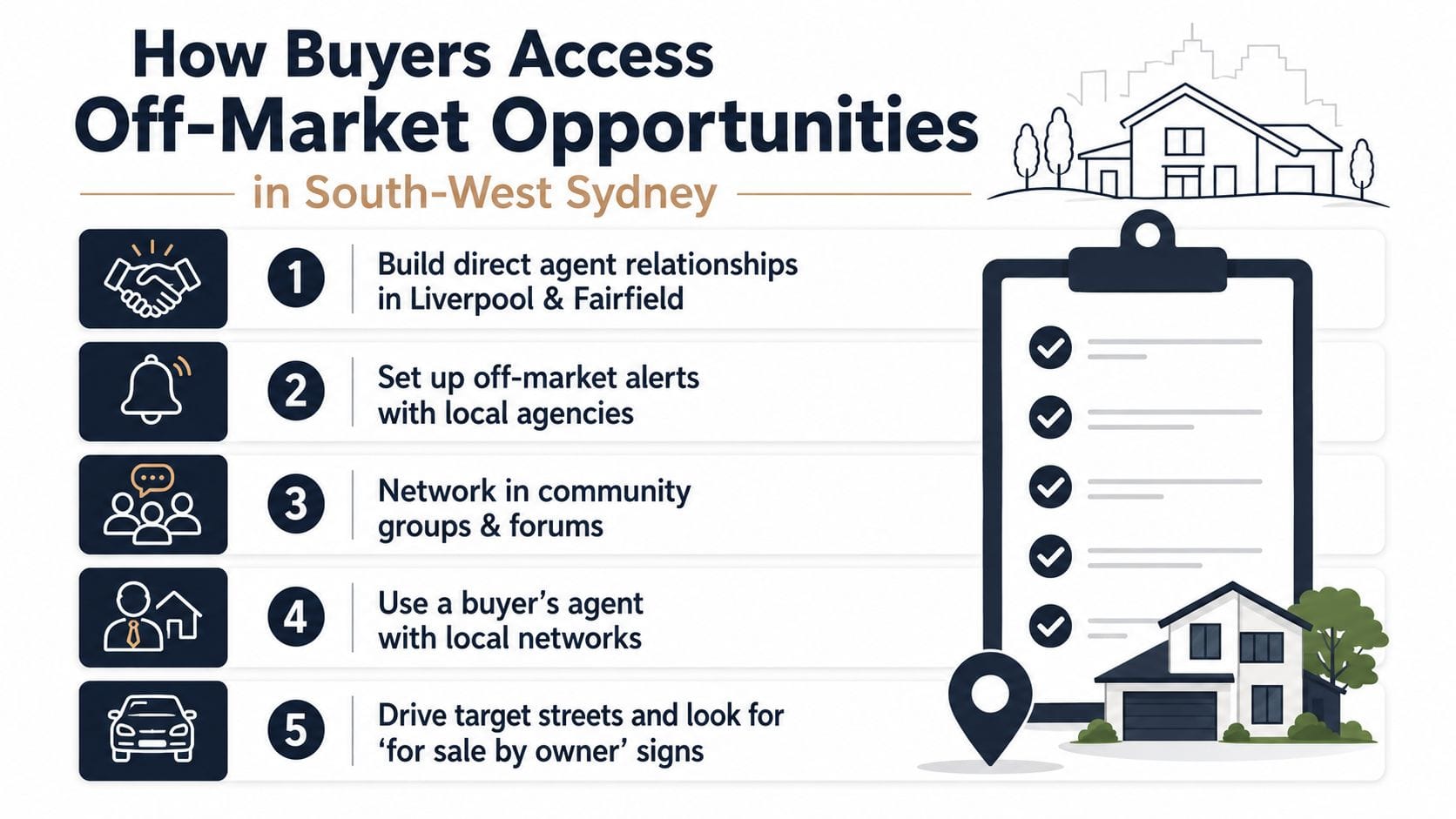
Work starts with agent relationships. Sellers choose off-market exposure because they want to test demand, protect privacy, or skip the cost and noise of a full campaign, and agents then place the home in front of buyers they already know will act seriously. That makes reputation and responsiveness more important than casual enquiry.
A strong local agent network is still the main channel. If you want hidden stock in Liverpool or Fairfield, you need to be the buyer who answers quickly, gives clear criteria, and doesn’t waste time. That’s why serious buyers stay active with local agencies, not just one enquiry form on a website.
If you’re building that presence, practical steps matter more than generic networking advice. One useful route is to stay visible to the right people in the area you’re targeting, and that includes street-level observation. Landscaping upgrades, fresh exterior work, or a large commercial rubbish bin on site can all signal a homeowner may be preparing to move, which gives you a reason to make a polite enquiry before the property ever reaches a portal.
For buyers who want a tighter local feed, a dedicated agent can help. Gregory Property Agents offers buying support in Liverpool and South-West Sydney, including access to off-market opportunities, which suits buyers who want suburb and street-level guidance through one point of contact, as described on its Liverpool real estate agent page.
What actually works on the ground
- Talk to local agents often: Not once, not twice, but regularly enough that they remember your brief when a seller wants quiet buyer matching.
- Be specific about budget and timing: Agents can’t match you to a private listing if they don’t know your approval range, preferred suburbs, and move-in window.
- Watch the street: Small signs of a sale coming are often visible before any campaign starts.
- Treat buyer databases seriously: If an agency keeps an internal list, make sure your details are current and complete.
- Move fast when contacted: Off-market opportunities can disappear before the wider public even hears about them.
Creative Tactics That Work for Finding Hidden Properties
A buyer I worked with took a simple approach that paid off. He printed business cards with a photo of himself and his partner, then added their budget, approved areas, email address, and preferred inspection times on the back. He handed them to agents, stayed front of mind, and found the right property within weeks.
That works because agents deal with memory and timing. When a seller says they would sell if the right buyer appeared, the agent reaches for the buyers who are easy to contact and easy to trust. A clear card or short buyer profile makes that matching process easier.
What works on the ground
Local visibility matters beyond real estate offices. A community station like 89.3FM The Pulse is not a property channel, but it keeps people tuned into what is happening around Liverpool and Fairfield. That kind of local awareness can help your name come up in the right conversations, and that is often where off-market leads begin.
Keep your message short and practical. Agents do not need your life story. They need your price range, preferred suburbs, settlement flexibility, and proof that you are ready to inspect and act. The less friction you create, the more likely they are to call you before a property is widely shared.
Street-level signals help too, especially in South-West Sydney where quiet sales often start with small changes around the house. Fresh exterior paint, landscaping work, cleared out rooms, or a skip bin on site can all point to a sale being prepared before a portal listing appears. In suburbs with a mix of owner-occupiers and long-term investors, those signals matter because they often show up before the wider market notices anything.
If you want a local example of how that thinking plays out in practice, the Casula market page on Gregory Property Agents’ site gives useful background on how hidden pockets are discussed by buyers who are trying to match street knowledge with private stock: Casula NSW property market hidden pockets.
Agents remember buyers who are easy to match, not buyers who ask for everything and give back nothing.
The edge is not flash. It is being easy to place. If your brief is clear, your finance is ready, and your contact details are hard to miss, you improve your odds. If you also understand the trade-off, private deals can carry less competition, but they can also carry a price penalty and more due-diligence work for the buyer, especially where there is limited public price history.
When Sellers Should Choose Off Market Versus Public Listing
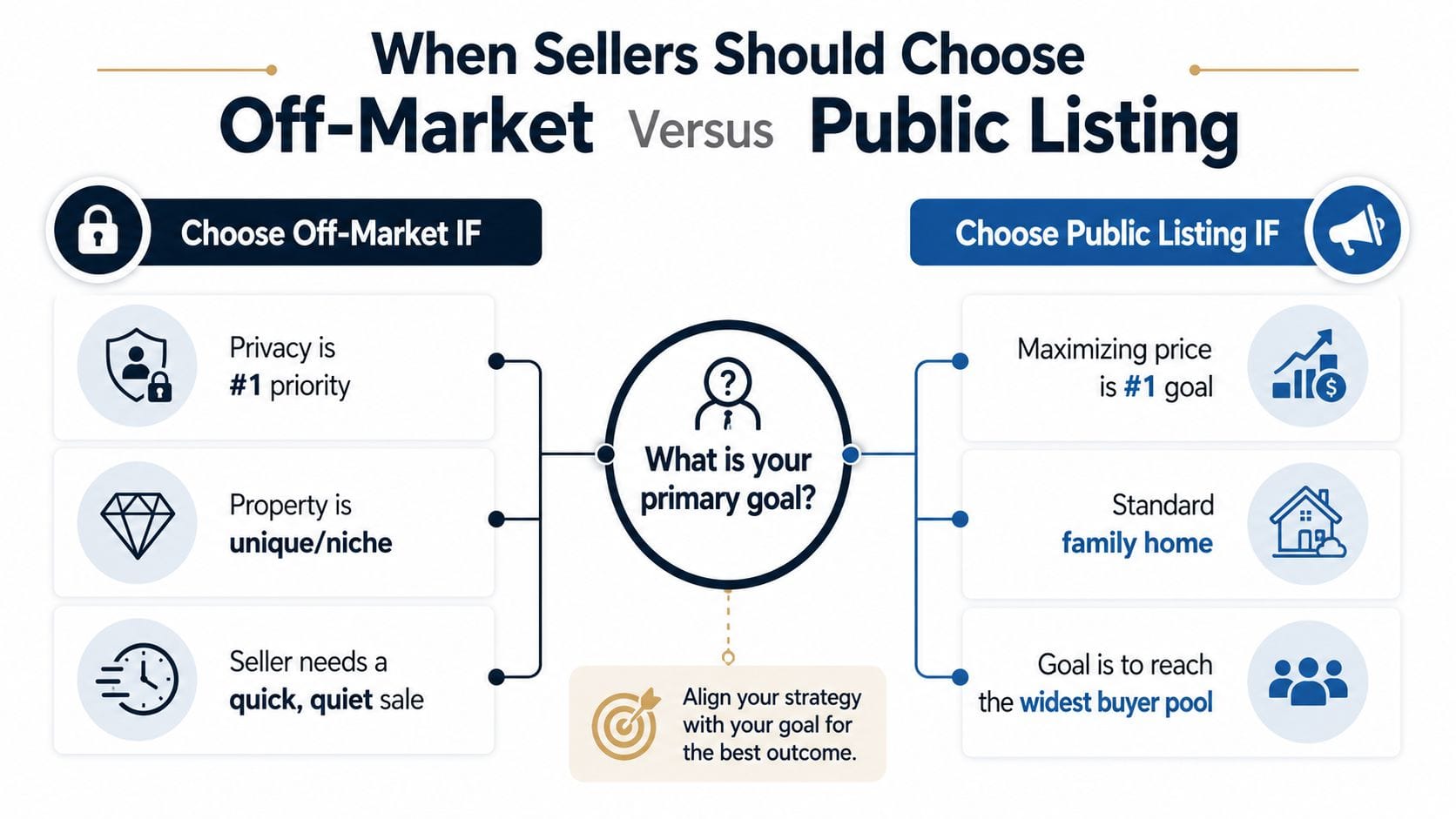
The choice usually comes down to one question: what does the seller need most from the sale? Privacy, speed, control, and price discovery do not all pull in the same direction, so the right strategy depends on which result matters most.
In South-West Sydney, a majority of off-market listings stay private because the homeowner asks for it, especially in deceased estates and downsizer sales. A public campaign still gives the agent wider exposure and usually more buyer competition, so the seller is the one deciding to give up some reach in exchange for a quieter process.
Where off-market makes sense
- Deceased estates: Families often want less traffic, fewer interruptions, and a more contained process while they handle the sale.
- Downsizers: Long-term owners may want a quieter sale while they sort belongings, memories, and the next move.
- Time-sensitive sales: Some owners care more about certainty and a quicker transaction than about testing every buyer in the open market.
- Privacy-first situations: Not every seller wants neighbours, colleagues, or extended family watching the process unfold.
Off-market also works better when the property is not likely to benefit from a noisy launch. If the home needs work, the photos will not carry a campaign, or the owner is not ready for open inspections, a private approach can reduce pressure. That said, the trade-off is real, because fewer buyers usually means less competition and, in some cases, a lower final price than a broad public listing might have delivered.
Where a public listing is the stronger fit
- Maximum price is the priority: Broad exposure gives more buyers a chance to compete.
- The home has wide appeal: Standard family homes often benefit from visibility rather than a quiet launch.
- There is time for a full campaign: If the owner can wait, a proper launch may create better price discovery.
A public listing also suits sellers who want the market to test the number properly. That matters in suburbs where good homes can attract strong enquiry fast, because the wider the audience, the easier it is to see whether the asking price is realistic or just hopeful. In Liverpool and Fairfield, where many owners are equity-rich, downsizing, or managing family transitions, the right call often depends on emotion, timing, and how much hassle they are prepared to carry.
The practical rule is simple. Use off-market when privacy, discretion, or a cleaner process matters more than squeezing every last dollar. Use the public market when the goal is to stretch demand and let competing buyers set the pace.
How Buyers Avoid Overpaying in Off Market Negotiations
Off-market deals do not automatically mean a bargain. Many pre-market opportunities are just homes being shown early, and some are priced exactly where the seller wants them, not where the buyer hopes they’ll be. The unseen nature of the deal is what creates risk.
The first step is to benchmark hard. Check at least three recent comparable sales in the same suburb, then look at the property type, land size, condition, and sale timing before you even think about making an offer. If the agent can’t or won’t explain how the asking price sits against recent sales, that’s a warning sign.
You also need to ask why the seller chose privacy. A quiet sale can mean flexibility, but it can also mean the owner is testing whether a buyer will pay more to avoid the public process. That’s where buyers get caught paying for convenience that should have been free.
A simple due-diligence checklist
- Compare recent sales carefully: Use actual local comparables, not broad suburb averages.
- Ask about vendor motivation: Speed, privacy, and testing the market all point to different negotiation tactics.
- Check local selling context: If the area usually clears quickly, a long private negotiation can hide weakness.
- Watch for price anchoring: If the seller starts high without evidence, don’t assume scarcity means value.
- Keep your walk-away point firm: A hidden listing only helps if the numbers still make sense.
For buyers who want another layer of local reality, a formal appraisal can anchor the discussion before emotions take over. Gregory Property Agents’ property appraisal page for Liverpool is one way local owners and buyers can frame value around the actual market, not just what’s whispered privately.
The sharpest off-market buyers in Liverpool and Fairfield don’t chase secrecy. They chase clarity. If you can’t explain why the price is fair without relying on the fact that no one else saw the property, you’re probably overpaying.
If you’re weighing an off-market purchase or deciding whether to sell in South-West Sydney, speak with Gregory Property Agents about the local stock, the likely buyer pool, and the trade-offs before you commit. Visit Gregory Property Agents to discuss an off-market strategy that fits your suburb, your timing, and the way you want the sale handled.
2 Comments
Comments are closed.