

A Tuesday evening in Liverpool often brings the same uncomfortable question to the kitchen table: which agent should handle the family home? One representative arrives in a franchise shirt, talks quickly about brand exposure, and leaves after a short inspection. A boutique principal walks through the backyard, asks about the granny flat, notices the condition of the roofline and wants to understand where the family plans to move next.
That choice isn't just between a large signboard and a smaller one. It's a choice between a broader corporate system and a principal-led boutique real estate agency in Sydney, where the same accountable person may remain involved from appraisal through settlement. After more than 20 years working the Liverpool and Fairfield corridor as a second-generation Sydney agent, I've found that the right decision depends on the property, the owner's priorities and the quality of the process behind the brand.
Table of Contents
- A Quick Picture Before You Choose
- What Defines a Boutique Agency in Sydney
- Boutique Versus Franchise for South-West Sellers
- How a Personal Agent Runs a Local Sale
- Pricing and Timing Inside the Liverpool Fairfield Market
- Property Management That Stays Local and Transparent
- When the Owner Is an Empty Nester or an Estate
- Questions to Ask Before You Sign With a Boutique Agency
A Quick Picture Before You Choose
Boutique should mean a small, locally embedded team with direct principal involvement. It shouldn't mean an unstructured one-person operation, and it doesn't automatically mean better service. The useful question is who will make the decisions when the campaign meets a difficult buyer, a valuation gap or an unexpected issue with the property.
A Liverpool owner may need an agent who understands the difference between a tidy brick home near established transport links and a newer property whose appeal depends on layout, parking and strata conditions. A Fairfield seller may need sharper advice about street-level buyer demand, presentation and campaign timing. A franchise can provide broad systems and a recognisable name, while a boutique office can provide tighter accountability. Neither model removes the need for sound pricing and honest communication.
The practical test: Ask whether the person who appraises your home will still be available when the first offer arrives.
NSW Class 1 licensing is the baseline for a licensee in charge, not a substitute for good service. The NSW framework sets different responsibilities for Class 1 and Class 2 licence holders, and only a Class 1 licensee in charge can authorise trust account withdrawals for the business. You can check the NSW property agent licensing framework before signing, but licensing alone won't tell you whether an agent knows your suburb or answers calls promptly.
The rest comes down to fit. Do you want a national brand with potentially wider corporate reach, or a local operator whose reputation is built in the same streets where you own property? The answer should emerge from specific questions about coverage, communication, fees, buyer access and who holds responsibility when something goes wrong.
What Defines a Boutique Agency in Sydney
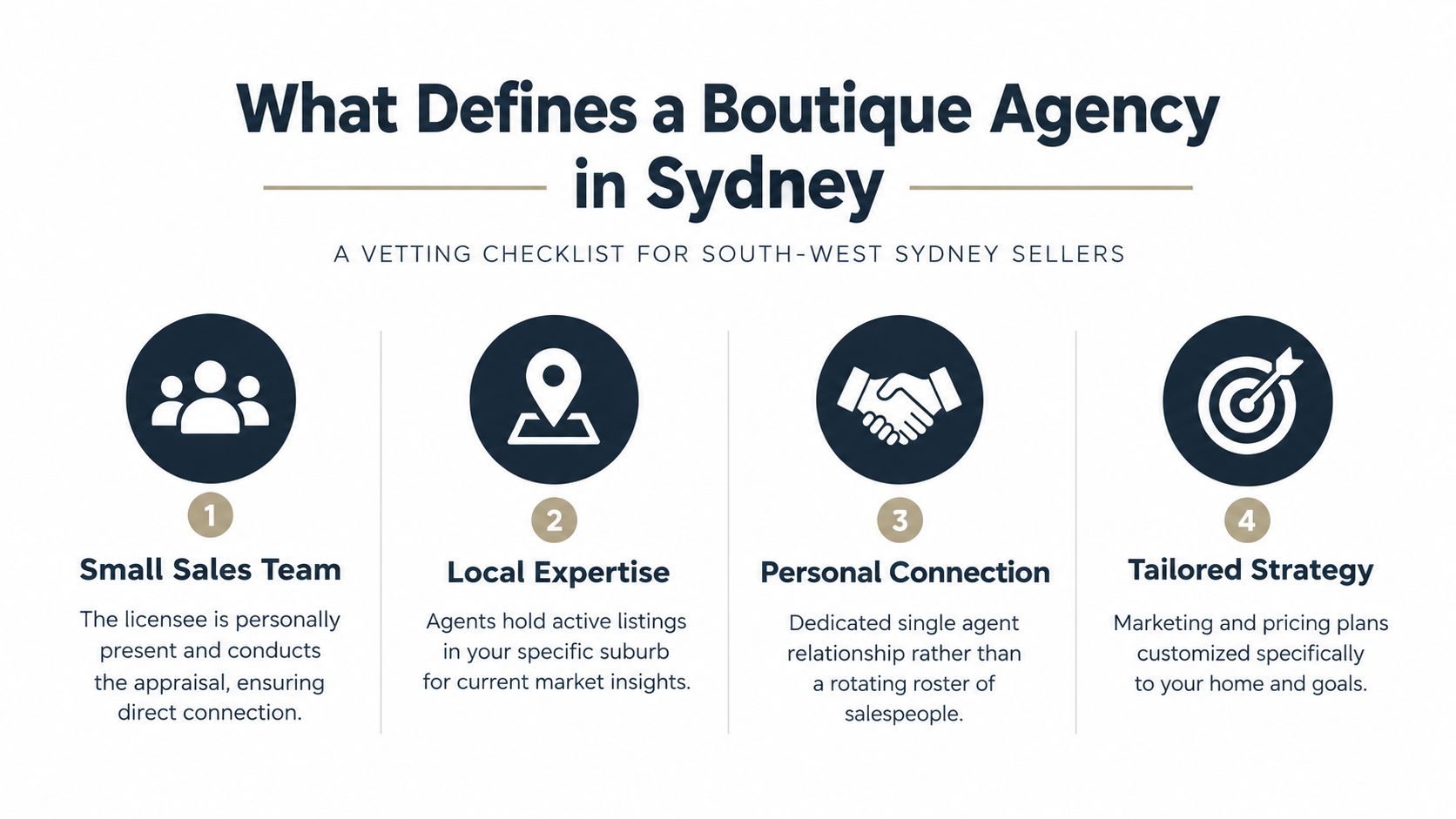
A useful definition starts with structure, not slogans. Before you shortlist a boutique agency, establish whether its small size creates genuine accountability or merely reflects a lack of capacity.
Check who conducts the appraisal
Ask whether the licensee in charge will personally inspect the property, prepare the pricing advice and explain the proposed campaign. A principal who has walked the home can assess details that a rushed desktop appraisal may miss, including a difficult rear access, an adaptable floor plan, a granny flat, drainage concerns or a renovation that will influence the likely buyer pool.
Then ask, “Who will conduct the next inspection and who will call me after an offer?” If the answer changes from the appraisal to the campaign, you may be dealing with a small office rather than a genuinely principal-led service.
Test suburb-level knowledge
Local knowledge should be verifiable. Ask the agent to discuss recent activity in your specific suburb, not just general Sydney conditions. For Liverpool, that may mean distinguishing established family streets from newer pockets and understanding how buyers compare houses with apartments. In Fairfield, it may mean knowing how presentation, access, flood exposure and proximity to local services affect buyer confidence.
The agent should also understand which school zones influence demand, which streets have recurring drainage concerns and which strata by-laws may affect townhouse stock. A local specialist should be able to explain how those details change the marketing plan.
Confirm the relationship and the strategy
You should have one clearly named point of contact, a written communication rhythm and a campaign designed for your property. A generic photography package and copied listing description don't amount to a strategy built around your needs.
Owners comparing agencies can also review practical guidance on local SEO for agents, particularly when assessing how an office builds local visibility beyond portal listings. Ask what the agency does in your community, how it reaches its existing buyer database and how it combines local relationships with major property platforms.
Finally, check that the business is properly organised. Boutique doesn't mean casual. You should see clear agency agreements, documented processes, appropriate insurance, licence details and a realistic explanation of what the principal can personally manage.
Boutique Versus Franchise for South-West Sellers
The franchise model has real strengths. A recognised name can reassure some vendors, established systems can support campaign administration and a larger office may offer access to a substantial database. For executive stock, corporate relocation or buyers moving from interstate, that reach can be useful.
A boutique office generally competes differently. The owner's benefit may come from direct attention, faster decisions and local knowledge rather than from the size of the network. In a franchise arrangement, part of the charges may support the national franchise system. A local agency may instead present a more direct fee structure, but the only safe comparison is the written proposal, including commission, marketing, GST and any withdrawal costs.
The trade-offs in plain terms
| Factor | Boutique Agency | Franchise Agency |
|---|---|---|
| Accountability | Often centred on the principal and a named agent | May involve a larger team, assistant or office manager |
| Local knowledge | Usually focused on selected suburbs and micro-markets | Can combine local office knowledge with a broader network |
| Buyer reach | Uses portals, database, community connections and targeted media | May add national databases, corporate channels and brand recognition |
| Communication | Direct contact can be quicker and more personal | Systems may provide structure, but messages can pass through several people |
| Fees | May be presented as a local, inclusive proposal | May include franchise-related marketing or administrative components |
| Capacity | Smaller team means less redundancy if the principal is unavailable | Larger team may provide cover during leave or busy periods |
A seller considering a $900,000 Liverpool sale should ask for the final dollar breakdown rather than relying on a verbal percentage. The same commission rate can produce a different total once marketing, photography, auction costs, GST and other agreed expenses are included. The number itself isn't the strategy. The important point is whether the cost is transparent and connected to a campaign that suits the home.
A first-home seller in Moorebank may value careful guidance, plain-English explanations and one dependable contact. An investor selling a Cabramatta unit block may prefer a larger database and a team accustomed to dealing with multiple buyers, valuations and documentation. Boutique service can fail when the office takes on more listings than it can properly service. Franchise service can fail when responsibility becomes diluted.
How a Personal Agent Runs a Local Sale
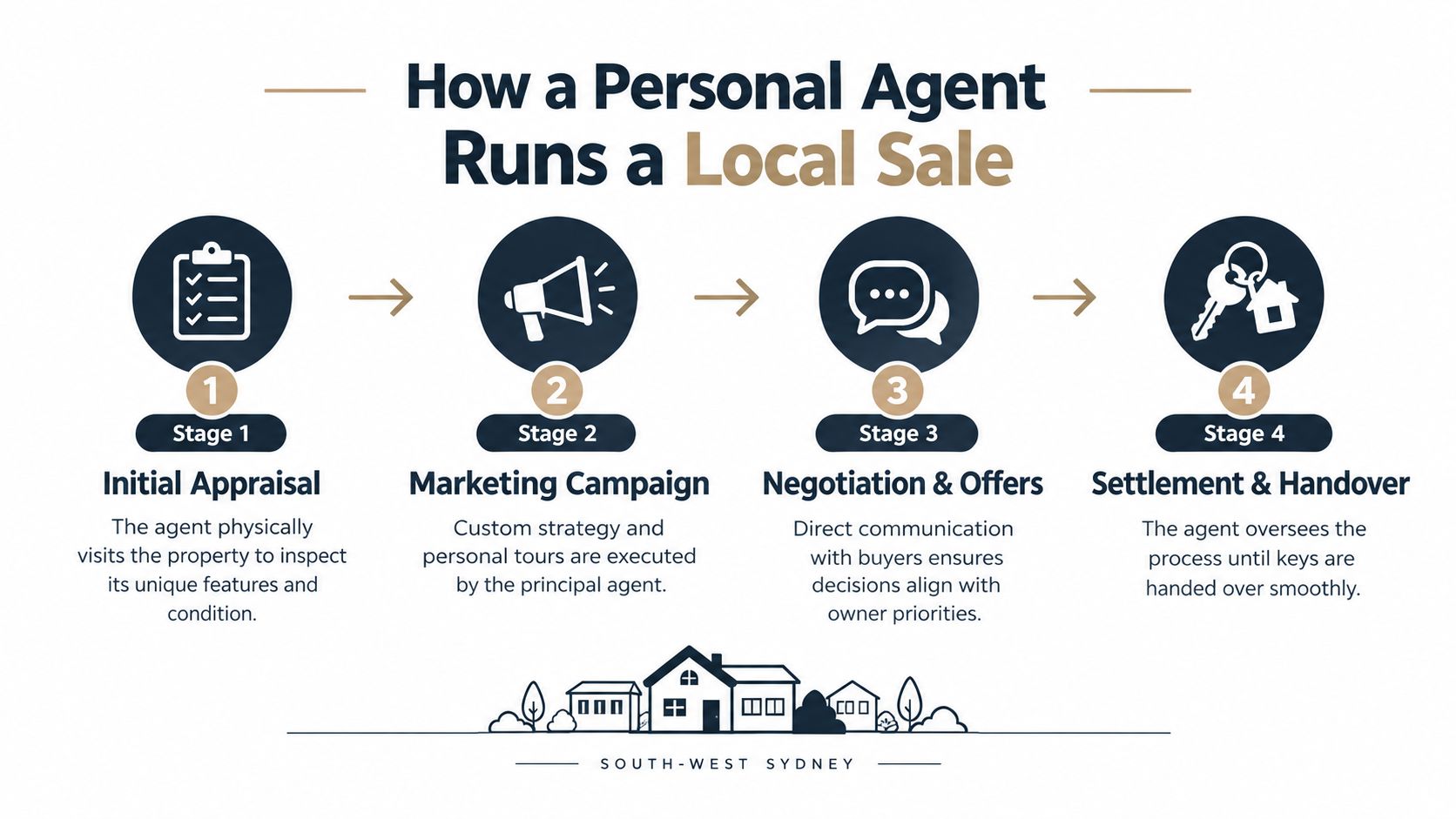
Consider a 1970s brick home in Moorebank. The principal begins with a physical appraisal, not just a suburb report. The inspection covers the condition, access, light, entertaining space, parking, possible additions and any features that could attract or exclude a buyer.
The comparable evidence should be selected carefully. A home in Moorebank can't be priced by looking only at a citywide median. Recent sales in Edmondson Park and Carnes Hill may offer useful context, but they aren't automatically direct comparables. Construction age, land component, layout, presentation and buyer profile all matter.
The campaign follows the property
The principal then decides whether auction or private treaty is more suitable. That choice should reflect the likely buyer pool, the vendor's time frame, the property's condition and current local auction momentum. A citywide clearance figure can provide background, but it shouldn't decide the campaign on its own.
Open homes should fit the people most likely to buy. In the Liverpool corridor, that may mean considering school pick-up patterns, weekend work and the needs of families who can't attend a midweek inspection. The agent should record useful feedback, separate genuine objections from casual comments and adjust the advice when the evidence changes.
Negotiation is where accountability shows
When the serious offer arrives, the principal should know the seller's priorities. Price may lead, but settlement timing, conditions, inclusions and finance certainty can alter the right decision. One experienced negotiator handling the call can reduce the risk of a junior agent making promises without understanding the owner's position.
The final handover still involves the conveyancer, solicitor, lender and buyer. The agent's role is to keep the parties communicating, coordinate agreed steps and help prevent avoidable delays. Personal service doesn't guarantee a particular price or settlement date. It does make it easier for one accountable person to see the whole transaction rather than treating each stage as a separate file.
Pricing and Timing Inside the Liverpool Fairfield Market
South-West Sydney cannot be priced from a generic Sydney headline. Domain reported a median house price of $1.1 million in the South West SA4 in June 2024, while the Outer South West was at $945,000. The same coverage recorded annual house-price growth of 10.0% in South West and 6.9% in Outer South West. These figures are useful context, but they aren't a valuation for a particular street or home. (Domain's regional Sydney pricing coverage shows why local segmentation matters.)
Domain also reported a 19% annual rise for Bonnyrigg, taking its median house value to $1.08 million in late-2024 coverage. Separate reporting placed the inner south-west clearance rate at 73.9% in February, while south-west Sydney clearance rates had improved by 24 percentage points year on year. Those signals can inform campaign timing, but a boutique agent still needs to examine the actual enquiry, competing stock and buyer feedback around Liverpool and Fairfield.
Read the signal, then act
| Signal | Threshold to watch | Action it triggers |
|---|---|---|
| Regional median | South West at $1.1 million and Outer South West at $945,000 in the cited Domain period | Use the correct submarket as context, then compare the home with local evidence |
| Local growth | Bonnyrigg's reported 19% annual rise | Recheck comparable sales instead of relying on an older appraisal |
| Auction momentum | Inner south-west at 73.9% in the cited February coverage | Consider whether auction conditions support a competitive campaign |
| Year-on-year movement | South-west clearance rates improving by 24 percentage points | Review reserve and buyer targeting, while testing the quality of current demand |
A family home in Green Valley may appeal to first-home buyers seeking value and practical living. A larger home in Wattle Grove may attract an upgrader family with different requirements around schools, parking and entertaining. Liverpool apartments require another comparison set entirely. Public listings such as Liverpool properties for sale can help buyers and sellers see how stock is being presented, but an agency should explain why each comparable is relevant.
Campaign timing should also account for school terms, vendor preparation and buyer availability. The best boutique agencies don't chase a headline. They update the advice when new evidence arrives and tell the owner when a desired price is unsupported by the current buyer pool.
Property Management That Stays Local and Transparent
A local property manager earns trust through repeatable routines, not friendly promises. For a Liverpool or Fairfield landlord, that starts with tenant selection, accurate condition reporting, clear maintenance approvals and statements that can be understood without chasing the office.
The manager should complete an in-person ingoing report that matches the relevant RTA checklist, document the property's condition carefully and screen applicants using employment, references and income information. Any screening process should comply with NSW requirements and the agency's privacy obligations. If a landlord asks how TICA checks are handled, the manager should explain the process rather than treating the database as a substitute for judgement.
Build a visible management routine
A sensible management service should set expectations for:
- Inspections: Reports should identify maintenance, safety or presentation concerns, not merely confirm attendance.
- Repairs: The owner should know when quotes are required, who can approve urgent work and how invoices are stored.
- Statements: Monthly records should make rent, fees and vendor-paid invoices easy to reconcile.
- Communication: Owners should have a direct contact for routine matters and a defined after-hours process for urgent issues.
- Technology: A 24/7 owner portal should show rent tracking, inspections, maintenance, statements and end-of-year reports.
The portfolio size matters, and it should be transparently disclosed. A manager overseeing a smaller number of properties may offer more direct attention, while a larger franchise office may provide relief staff, specialised departments and broader administrative coverage. Neither is automatically superior. Ask who will answer when a tenant reports a leak, how quickly the owner receives the report and who authorises urgent work.
The rental market also deserves a realistic conversation. REINSW reported that NSW residential tenancy agreements signed fell by more than 25,000 from FY25 to FY26, while exclusive management agreements declined from 77,641 in 2023–24 to 72,296 in 2025–26. NSW Government analysis in March 2026 reported that tenancies lasting five years or more reached 20.4% of the market, equal to the one-to-two-year tenure band. (REINSW and the cited rental-management coverage provide the stated context.)
That environment makes retention, compliance and occupancy discipline important. A local manager should explain how the office responds when a tenancy lasts longer, fewer new agreements are signed and maintenance decisions affect the landlord's long-term return. Local rental property management in Sydney is one example of a service model built around direct management and an owner portal.
When the Owner Is an Empty Nester or an Estate
Selling a long-held family home isn't a standard campaign. An empty nester in Moorebank or Casula may have lived with the same floor plan, neighbours and garden for decades. An executor dealing with a Fairfield Heights property may be carrying grief, legal duties and disagreements between beneficiaries at the same time.
The agent's job is to project-manage the transition. That can include arranging access for trades, coordinating minor repairs, helping organise clearance, communicating with the solicitor or Public Trustee and allowing time for documents to be gathered. A small team can sometimes pause a campaign when the family needs another week, rather than pushing ahead because a calendar has already been printed.
Protect the legal and practical details
The agent should not give legal advice outside their role, but they should identify issues early and refer the family to the right professional. That includes checking the will's date against the Certificate of Title, noting any deceased joint-tenant caveats and confirming who has authority to instruct the agency.
A family also needs an honest repair-versus-as-is discussion. Fresh paint, garden work or removal of old furniture may improve presentation, but not every repair produces a worthwhile return. The agent should explain the likely buyer response, the cost, the time involved and the risk that preparation delays the campaign.
A compassionate sale still needs a written plan. Empathy and process should work together.
Executors and families can use a practical wills guide for professionals as background when organising broader estate-planning questions, while relying on their solicitor for advice specific to the estate. Probate timing, title issues and beneficiary instructions must be handled properly before the campaign proceeds.
The same care applies to downsizers. A principal should help coordinate removal, presentation, settlement timing and communication with the next professionals in the chain. The result isn't just a sale. It's a managed handover that respects the people attached to the property while keeping the transaction moving.
Questions to Ask Before You Sign With a Boutique Agency
Before signing an agency agreement, ask questions that expose the operating model. A polished appraisal can sound persuasive, but the details below show whether the principal has the capacity, licence and local evidence to support the promise.
Accountability and licensing
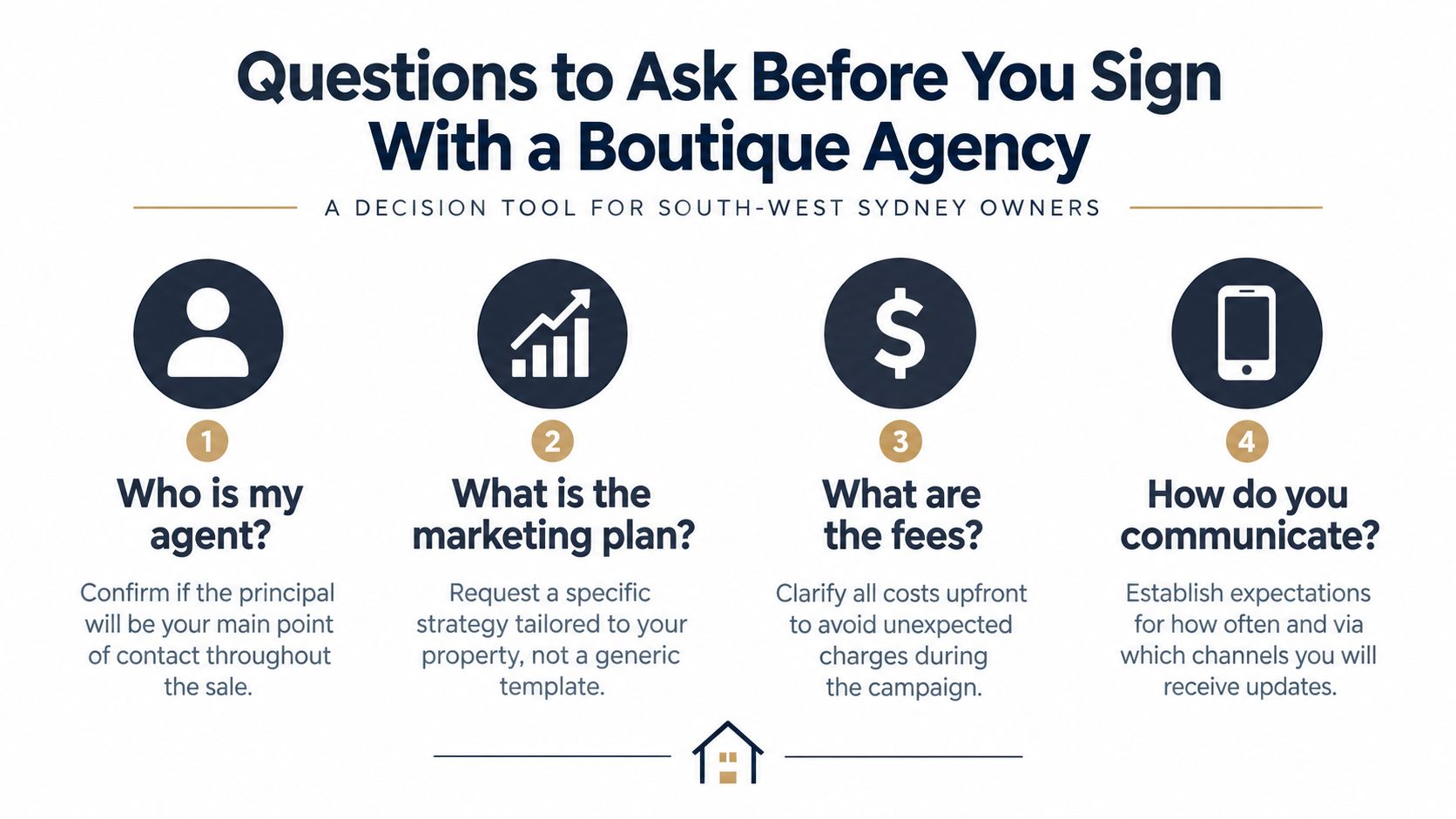
- Who attends the appraisal? Confirm whether the principal will inspect the property and remain involved through negotiation.
- Who runs the auction or receives offers? Get the person's name, role and availability in writing.
- What is the current NSW Class 1 licence number? Check the licence and ask to see the Professional Standards Certificate.
- Who is the licensee in charge? Understand who holds operational responsibility and trust-account authority.
Local evidence and campaign design
- Which recent sales support the price? Ask for the last six relevant sales in Liverpool, Fairfield or your specific suburb, with addresses you can independently verify through appropriate property records such as PEXA.
- What will change the price guide? Ask how the agent will respond to enquiry levels, inspections, competing stock and buyer feedback.
- What happens if the campaign needs to change? Clarify who can adjust timing, reserve advice, advertising or negotiation strategy.
Fees, management and disputes
- What is the complete fee schedule? Confirm the commission percentage, marketing cap, GST treatment and withdrawal fees. The guide to real estate agent fees in Sydney can help you identify topics that need to appear in the proposal.
- Who manages the rental? Ask for the number of properties per manager, inspection turnaround, maintenance approvals and after-hours triage.
- What is the complaint pathway? Ask how the agency handles disputes and where you can seek assistance through REINSW or NSW Fair Trading.
Call the referees yourself. Ask what happened when the campaign slowed, why a contract had to be renegotiated or extended and whether the agent remained available after the sale. Glossy testimonials usually describe the outcome. A direct referee conversation can reveal how the agency behaved when the transaction became complicated.
Gregory Property Agents provides principal-led sales, buyer advisory and property management across Liverpool, Fairfield and South-West Sydney, supported by local market knowledge and a 24/7 owner portal. If you want to discuss your property, campaign options or management needs with a local Class 1 licensed operator, visit Gregory Property Agents.