

A tenant enquiry comes in while you're at work. Nobody answers it. A week later, the property is still vacant, a maintenance invoice arrives without the approval you expected, and the manager who promised personal attention is suddenly difficult to reach. Owners in Liverpool and Fairfield usually don't change managers because of one awkward email. They change because small failures keep turning into lost rent, rushed decisions and avoidable disputes.
Choosing a property manager is therefore not a commission-shopping exercise. You're choosing the person who will price the property, screen the tenant, chase arrears, organise repairs, document the condition and explain what the law allows. The right questions reveal whether that person has the local knowledge, systems and accountability to protect your rental.
Table of Contents
- Why the Choice of Property Manager Matters More Than Most Owners Realise
- Start With NSW Licensing and Compliance Credentials
- The Seven Criteria That Actually Predict a Good Manager
- Interview Questions Worth Asking Before You Sign
- Looking Past the Management Fee to Realised Net Return
- Your Property Manager Comparison Matrix
- Red Flags and Your Next Steps
Why the Choice of Property Manager Matters More Than Most Owners Realise
A property manager controls far more than the listing on realestate.com.au. They influence how quickly an enquiry receives a response, whether an applicant's income and rental history are checked properly, when a rent review is considered, and how quickly arrears move from a reminder to formal action. They also create the records that may matter if a disagreement reaches the NSW Civil and Administrative Tribunal.
In Liverpool, Fairfield, Green Valley, Cabramatta and the surrounding suburbs, local judgement matters because streets and property types behave differently. A well-presented apartment near transport may attract a different tenant profile from a family home in a quieter pocket. An agent who knows those differences can recommend a realistic asking rent and explain the trade-off between holding out for a higher figure and accepting a suitable applicant promptly.
Sydney's rental market remains tight but is changing. In August 2026, Sydney's vacancy rate was 1.7%, with 12,821 dwellings available, compared with 1.4% a year earlier, and available vacant properties were 26% higher than in August 2025, according to the Sydney vacancy rate tracker. That combination makes vacancy control important. Owners shouldn't assume that strong demand will rescue a slow response, an inflated asking rent or poor inspection follow-up.
The work owners rarely see
A good manager handles the unglamorous work consistently:
- Tenant selection: Applying documented criteria rather than approving the first applicant who looks promising.
- Arrears escalation: Following up quickly and recording every relevant contact.
- Condition reporting: Capturing enough detail to support a fair assessment at the end of the tenancy.
- Maintenance control: Separating urgent repairs from improvements and keeping approvals visible.
- Renewals and notices: Acting within the tenancy rules instead of relying on old habits.
- Owner reporting: Showing what was collected, spent, approved and still outstanding.
NSW guidance places limits on access and inspections, including at least seven days' notice for some access events once in a 12-month period. Routine inspections must therefore be organised around lawful notice requirements, rather than merely fitted into whichever day suits the office.
Practical rule: Ask who will handle the file after the appointment is signed. The answer matters more than the person who gives the presentation.
A boutique office with one accountable manager may suit an owner who wants direct decisions and a consistent contact. A larger franchise may offer broader staffing, established software and backup coverage. Neither model is automatically right. The test is whether the person responsible for your Liverpool or Fairfield property remains visible when the tenant stops paying, the hot-water system fails or a notice needs careful handling.
Start With NSW Licensing and Compliance Credentials
Before comparing fees, verify that the people managing the property are legally authorised to do the work. NSW Government guidance states that an agent managing residential property must be a licensed real estate agent or an assistant real estate agent working under supervision. Licence applicants must meet requirements including being at least 18, fit and proper, appropriately qualified, not disqualified and connected to a qualifying NSW registered office arrangement. The NSW Government guidance for landlords explains the baseline.
The check is straightforward, and a professional manager shouldn't resist it.
A practical verification sequence
- Identify the actual licence holder. Ask for the full name of the person responsible for your portfolio, not only the trading name on the signboard.
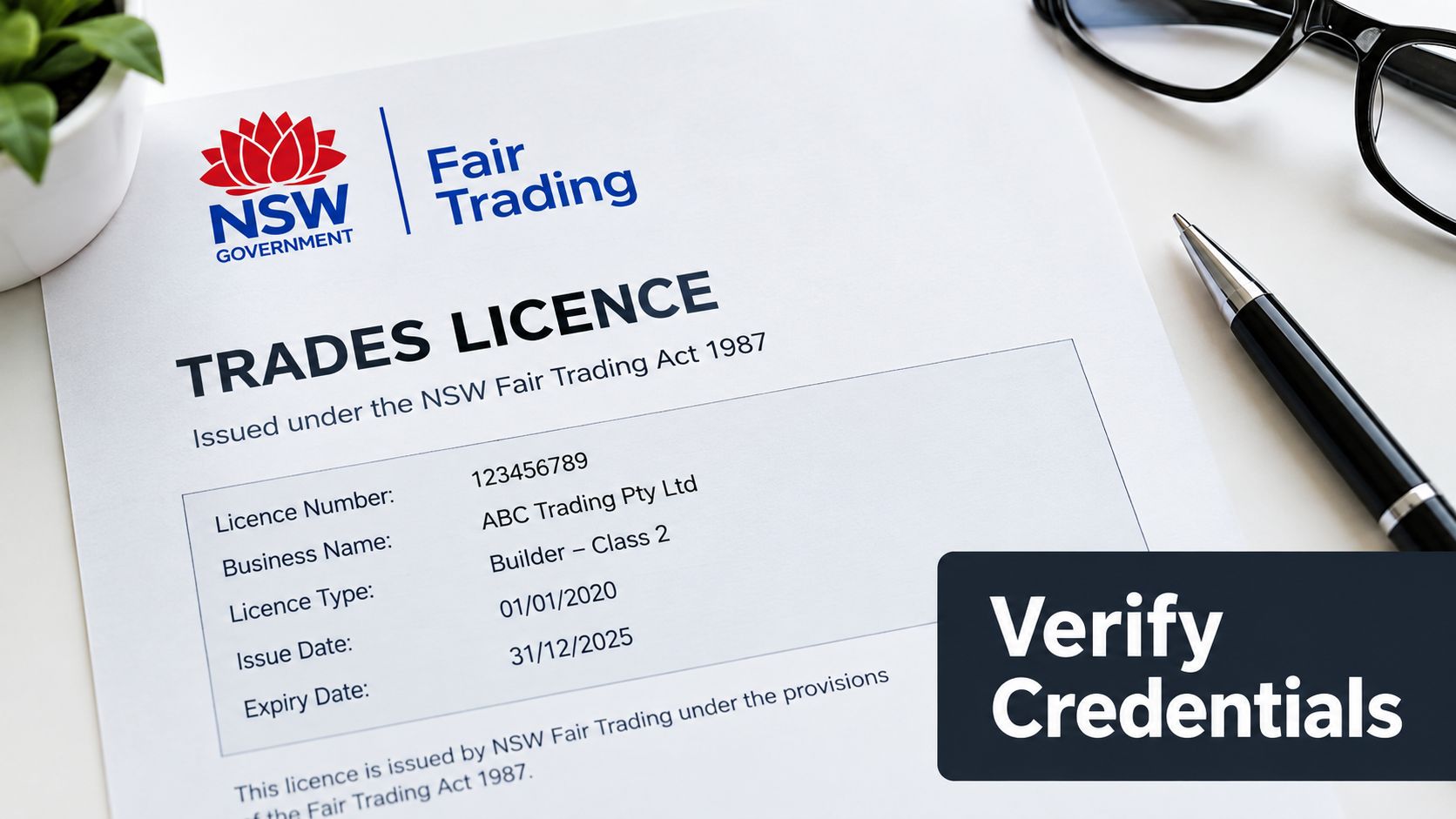
- Check the public register. Confirm that the licence is current, not suspended and authorised for the work required. NSW Fair Trading also provides a public property management licence and compliance resource.
- Confirm the licence class. A salesperson who introduces the service may not be the person authorised to make the decisions or supervise the work.
- Ask about annual CPD. NSW requires continuing professional development each year from 1 July to 30 June. Class 1 licence holders must complete prescribed annual CPD, including 7 hours of interactive training and 5 hours in a NSW Fair Trading accredited forum relevant to their licence category.
- Request professional indemnity details. Ask for the current certificate of currency and clarify who is insured to provide the service.
- Check the trust-account process. If accounting is outsourced, ask who reconciles the records, who approves payments and how owners receive supporting documents. These outsourced trust accounting tips are useful background before you review an agency's process.
The public register screenshot below shows the kind of official record owners should use rather than relying on a salesperson's verbal assurance.
What should make you pause
An expired or suspended licence is an immediate concern. So is a mismatch between the person named in the agreement and the person who says they'll manage the property. Be cautious if the proposed manager can't explain their CPD, avoids questions about supervision or changes the subject when you ask for insurance and trust-account information.
For a clearer picture of what a complete management service may include, compare the published residential property management service details with the proposal in front of you. The point isn't to copy another agency's package. It's to identify missing responsibilities before they become extra charges or owner tasks.
The Seven Criteria That Actually Predict a Good Manager
A polished pitch can hide an ordinary operation. I'd assess a Liverpool or Fairfield manager against seven practical criteria, then ask one question that forces a specific answer.
| Criterion | Good | Average | Exposure Question |
|---|---|---|---|
| Local knowledge | Prices by street, property type and tenant demand | Relies on broad suburb averages | “Which nearby properties support your recommended rent, and why?” |
| Tenant placement | Verifies identity, income, employment, rental history and references | Checks only the application form | “What do you verify before recommending an applicant?” |
| Communication | Names the contact, channel and update rhythm | Responds when chased | “Who calls me when a decision is urgent?” |
| Maintenance | Uses suitable contractors, documents approvals and separates urgent work from improvements | Sends invoices after the work | “What can you authorise without me?” |
| Arrears | Tracks action by date and follows a defined escalation process | Treats each missed payment as an isolated incident | “When do you contact the tenant, and what happens next?” |
| Reporting | Provides readable statements, records and year-end information | Sends a basic rent summary | “Can I see a sample owner statement and year-end report?” |
| Accountability | One named person owns the file | Handoffs are common and unclear | “Who is accountable when I need an answer today?” |
Local knowledge only matters when it changes a decision. A manager should be able to explain why a particular unit needs a different launch strategy from a family home, which tenant groups suit the property and what condition issues could affect enquiry.
Tenant screening should be consistent, documented and relevant. Fast placement is useful only if the applicant is properly assessed. A vacant property creates pressure, but a weak tenancy can produce arrears, damage, turnover and conflict that cost more than the original vacancy.
Systems beat promises
Ask to see the owner portal, sample inspection report and maintenance approval workflow. A portal should make it easy to find rent status, invoices, inspection records and correspondence. Software alone doesn't create accountability, but missing records usually expose a weak process.
The same principle applies to contractor management. “We have good tradespeople” is not enough. Ask how contractors are selected, whether quotes are compared when appropriate, how emergency work is approved and how the manager checks completion.
Owners preparing for a move or renovation often use a separate removalist selection guide to compare service standards and hidden costs. Property management deserves the same discipline. Compare what is included, who does the work and what happens when the relationship ends. You can also review the residential property management service model as one example of how responsibilities may be set out.
Interview Questions Worth Asking Before You Sign
Take the same questions to every shortlisted firm. A manager who gives a precise answer about your Liverpool or Fairfield property is easier to assess than one who repeats general marketing language.
Tenant placement
Ask:
- “How will you set the initial asking rent for this property?”
- “What identity, income, employment and rental-history checks do you complete?”
- “Who reviews the application before it reaches me?”
- “How do you respond if the strongest applicant wants a lower rent?”
A strong answer connects the recommendation to comparable local properties, presentation, timing and applicant quality. It explains the screening workflow without promising that every tenancy will be risk-free. The tenant screening service information gives owners useful language for discussing identity, income, employment and reference checks with any manager.
Communication and inspections
Ask:
- “Who will be my day-to-day contact?”
- “How quickly do you acknowledge an owner query?”
- “How are routine inspections booked and reported?”
- “What do I receive after an inspection?”
Look for a named person, a backup arrangement and a clear reporting channel. A strong answer explains how the manager handles access notices and what happens when a tenant doesn't cooperate. You should see a sample report, not just hear that inspections are completed.
Arrears and Tribunal preparation
Ask:
- “What happens on the first missed payment?”
- “How do you record contact with the tenant?”
- “When do you recommend formal action?”
- “How do you prepare documents if a dispute progresses to the Tribunal?”
The answer should be chronological and written down. “We chase arrears” says very little. You want to know who acts, what the owner sees and how the file remains complete if the matter becomes contested.
Maintenance and contractors
Ask:
- “What can you approve without contacting me?”
- “How do you distinguish urgent repairs from improvements?”
- “Which contractors do you use for plumbing, electrical and general repairs?”
- “Will I receive photographs, quotes or completion notes?”
A sound process protects both the tenant and the owner. It gets urgent issues moving while preserving an approval trail for non-urgent work.
Fees and reform-related work
Ask:
- “Is the management fee charged on rent collected or another basis?”
- “What are the letting, renewal, inspection and maintenance-related charges?”
- “Which compliance tasks are included?”
- “How will changes to termination and rent-increase rules affect your service?”
NSW tenancy reforms require reasons for ending a tenancy and limit rent increases to once every 12 months, as outlined in this NSW compliance overview. The manager should explain how those changes affect notices, renewals and owner decisions without bluffing.
Before choosing, request the management agreement, letting-fee schedule, complete fee schedule and a sample statement of account. Read the exit terms as carefully as the appointment terms.
Looking Past the Management Fee to Realised Net Return
A lower management fee can cost more if the property sits vacant, good tenants leave after poor communication, or a notice is mishandled. A higher fee can also fail to deliver if the agency provides little oversight. “Boutique” is not proof of better service. The operating model and the results it produces matter more.
NSW management fees typically sit in the high single digits as a percentage of rent collected. That headline figure tells you little without the surrounding costs. Compare rent collected, vacancy, letting fees, repairs between tenancies, renewal decisions and compliance exposure, including the requirements covered in this NSW property compliance overview.
Use your own property figures rather than accepting a manager's polished case study. Current Sydney vacancy conditions, the property's location and its presentation will affect the outcome.
| Line item | High-volume or franchise model | Single-point-of-accountability model |
|---|---|---|
| Asking-rent decision | May follow a broad suburb estimate | Tests the property against nearby comparable stock |
| Enquiry response | Can pass through a central team | Has a named person responsible for follow-up |
| Vacancy control | Measures listing activity | Reviews enquiry quality, inspections and pricing together |
| Tenant change | Treats each move-out as a leasing task | Connects exit condition, repairs, pricing and re-letting |
| Compliance | Relies on standard templates | Checks the facts, notice and supporting documents |
| Owner approval | May arrive after the work | Uses an agreed threshold and visible approval trail |
| Fee assessment | Focuses on the percentage | Compares total cost with rent realised |
Calculate the cost of an empty property
Start with the weekly rent you could realistically collect and multiply it by the vacant weeks. Add advertising, cleaning, repairs between tenancies, letting charges and rent lost through delayed decisions. Then compare that total with the difference between management fees.
The calculation exposes the trade-off. A cheaper manager who responds slowly to applicants can erase the apparent saving. A higher-fee manager who prices accurately, follows up inspections and renews suitable tenancies lawfully may produce a stronger net result. That remains an evaluation, not a guarantee.
Ask every manager how they define vacancy. One may count from key return, while another starts only when advertising goes live. Ask how withdrawn listings, delayed repairs and unsuccessful applications appear in reporting. Sydney vacancy data is useful only when the manager measures the same period and property type consistently.
The same discipline applies to compliance. A manager should show how their process handles notices, records and owner approvals under NSW tenancy reforms, rather than treating templates as a substitute for judgement.
Review the agency's reporting before signing. A property management software buyer's guide can help you test whether the system provides clear statements, approval records, inspection evidence and owner access. The fee is one line in the account. Realised net return is the result that counts.
Your Property Manager Comparison Matrix
Shortlist at least three firms and complete the same matrix after each interview. NSW strata guidance encourages owners to compare proposals, responsibilities and accountability, while strata appointments require the owners corporation's majority vote at the AGM. The NSW guidance on strata managers and other workers remains useful for rental owners because it highlights written proposals, defined authority and clear accountability.
Score each manager from 1 to 5 against every criterion. The score reflects your priorities, not an industry rating. Record the evidence beside each mark. A polished pitch should not outweigh what the manager can demonstrate.
| Criterion | Weight (1–5) | Manager A score | Manager B score | Manager C score |
|---|---|---|---|---|
| NSW licence and CPD currency | ||||
| Days-vacant benchmark and measurement | ||||
| Fee transparency | ||||
| Maintenance approval threshold | ||||
| Communication service level | ||||
| Liverpool and Fairfield portfolio depth | ||||
| References from owners with multiple properties |
Weight the matrix around your risk
A single-property owner may give fee transparency and communication greater weight because one unresolved repair or arrears issue affects the whole investment. A portfolio owner may prioritise capacity, reporting, licence compliance and a consistent process across several properties.
Do not give a high score for an unverified answer. A manager claiming strong Liverpool or Fairfield coverage should identify comparable properties or provide relevant owner references. Someone promising fast maintenance should explain approval limits, contractor contact and escalation. A manager claiming compliance expertise should show how the team keeps its NSW knowledge current.
Set your minimum acceptable total before the interviews. There is no universal pass mark because properties, risk tolerance and service requirements differ. Remove any firm that fails a required item, even if its overall score is attractive.
Recalculate the matrix straight after each meeting, while details are fresh. Record the person who will manage the file, the disclosed fees, the inspection process and every unanswered question. Include whether a boutique single-point-of-accountability model suits you better than a large franchise structure with separate leasing, inspections and accounts contacts. Compare evidence, not presentation style or memory.
Red Flags and Your Next Steps
Some answers should end the conversation, regardless of how polished the proposal looks.
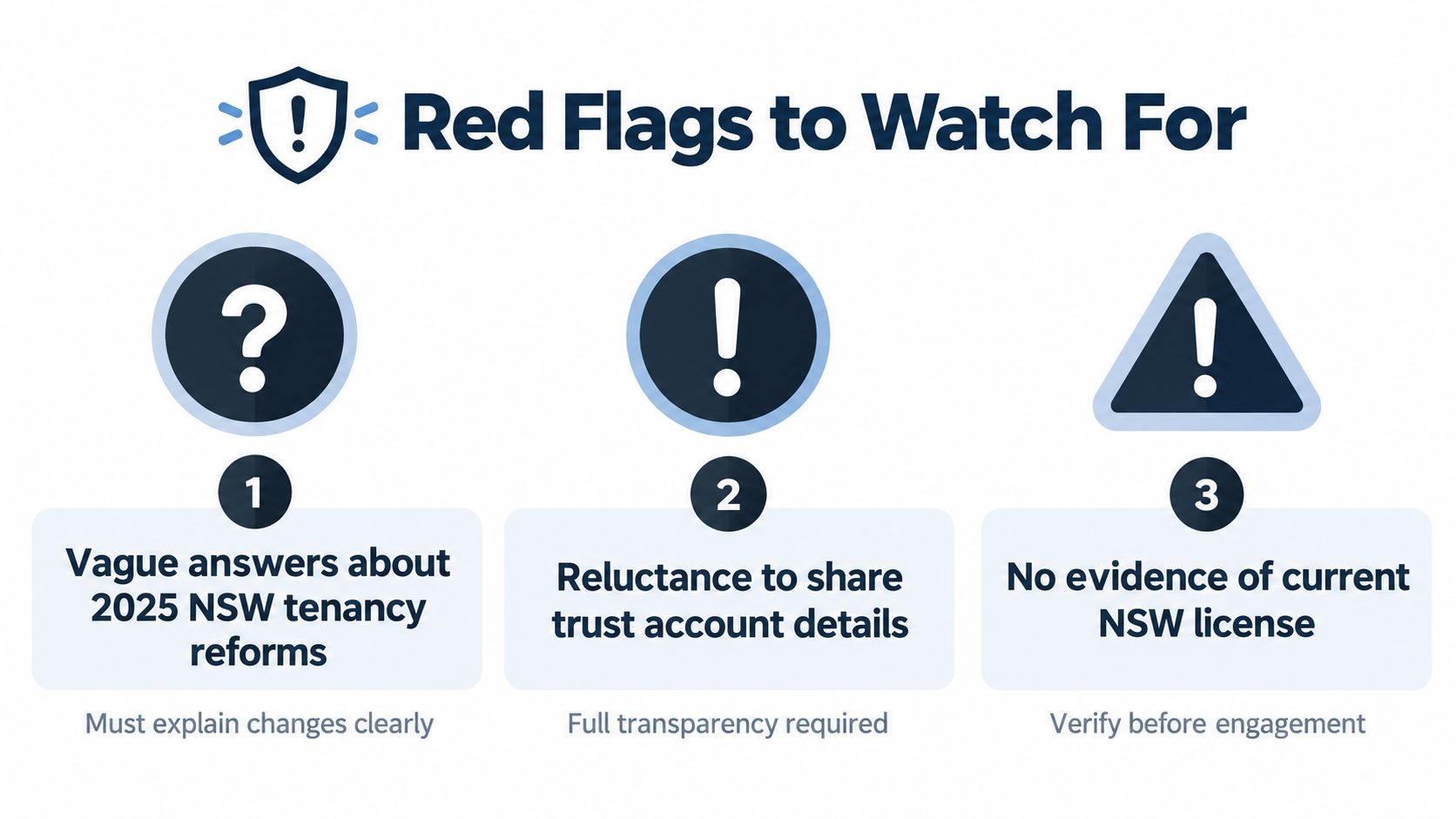
Vague reform answers. If the manager can't explain how the 2025 NSW tenancy reforms affect termination reasons, rent-increase timing and renewal decisions, they may be relying on outdated habits. They don't need to deliver legal advice, but they do need a clear operational process and a willingness to refer complex matters appropriately.
Reluctance to discuss trust accounting. An agency that avoids questions about licence status, supervision, reconciliations, owner statements or recent CPD topics is asking you to accept risk without visibility. Request the responsible person's details and the written accounting workflow before signing.
Pressure to sign before you understand the documents. A manager who pushes for immediate appointment while avoiding the management agreement, fee schedule or condition-report workflow is prioritising the win over the handover. Ask how the property's condition will be recorded, how approvals work and what the exit process says.
Your next seven days
- Verify the licence: Check the responsible person and licence status on the NSW Fair Trading public register.
- Request references: Ask for two Liverpool or Fairfield owner references, preferably from owners with more than one property, and call them.
- Complete the matrix: Compare at least three shortlisted firms using the same questions and scoring method.
- Observe the operation: Ask whether you can attend or observe a live routine inspection, subject to tenant consent and lawful access arrangements.
- Review the documents: Read the management agreement, trust-account schedule, fee schedule, maintenance authority and condition-report workflow before signing.
- Record the handover: Confirm the named contact, communication channel, reporting format and approval limits in writing.
A good property manager won't promise that vacancies, repairs or disputes will never happen. They'll show you how those events are handled, who owns the file and what you'll see along the way.
For landlords in Liverpool, Fairfield and South-West Sydney, Gregory Property Agents provides direct property management, tenant screening, inspections, maintenance coordination, arrears control, compliance documentation and a 24/7 owner portal for statements and approvals. Visit Gregory Property Agents to discuss your property and compare the management process before you appoint.