
You've handed over the keys, the tenant has moved in, and the first rent payment is due. Then the hot-water unit fails, an access notice needs to go out, the tenant asks for a repair update, and you realise the property doesn't stop demanding attention because you're at work, interstate or overseas.
That's the practical reality of rental property management in Sydney. A manager isn't merely finding a tenant and collecting rent. They're operating a decision system between the owner, tenant, tradespeople, strata contacts and NSW regulators. In a tight market, that system protects occupancy and income. Under the post-2025 tenancy rules, it also protects the evidence trail behind every important decision.
Table of Contents
- When the Tenant Calls at 9pm and You Are Not There
- What Rental Property Management Actually Covers in Sydney
- Service Tiers Sydney Owners Can Choose From
- NSW Tenancy Law Changes That Rewrote the Manager's Job
- Compliance Documentation Owners Should Expect in 2026
- Performance Metrics That Matter in a Sub-2% Vacancy Market
- Why Boutique and Local Managers Are Worth a Closer Look
- Choosing or Switching a Sydney Property Manager This Week
When the Tenant Calls at 9pm and You Are Not There
A tenant in a Marrickville terrace sends a message on Sunday evening. The hot-water system has stopped working. You're overseas, the time difference makes a phone call awkward, and the tenant wants to know whether someone can attend that night.
A capable manager doesn't forward the message. They first establish what has failed, whether the tenant has any hot water, whether there's a safety concern, and whether the issue needs an urgent response or a scheduled repair. They contact an appropriate plumber, confirm access, explain the expected next step to the tenant and notify you with a clear approval request if the cost falls outside the agreed authority.
The plumber's invoice then needs to be checked, matched to the maintenance request and recorded against the tenancy and property accounts. The tenant needs an update even if the repair can't happen immediately. You need a record showing who made each decision, when access was arranged and what work was completed.
Practical rule: A maintenance call is only finished when the tenant has an outcome, the owner has visibility and the file contains the evidence.
This is also why complaint handling matters. A frustrated tenant usually wants acknowledgement, a realistic timeframe and a named person responsible for the next step. The same principles used in complaint resolution for businesses apply here, but property managers must also work within tenancy law, access rules and repair obligations.
That decision layer operates every day. The right manager gives you distance from the interruption without giving you distance from the facts.
What Rental Property Management Actually Covers in Sydney
Rental property management is a workflow, not a single service. It begins before advertising and ends only when the tenancy file, accounts, keys and bond records are properly closed.
From preparation to approved tenant
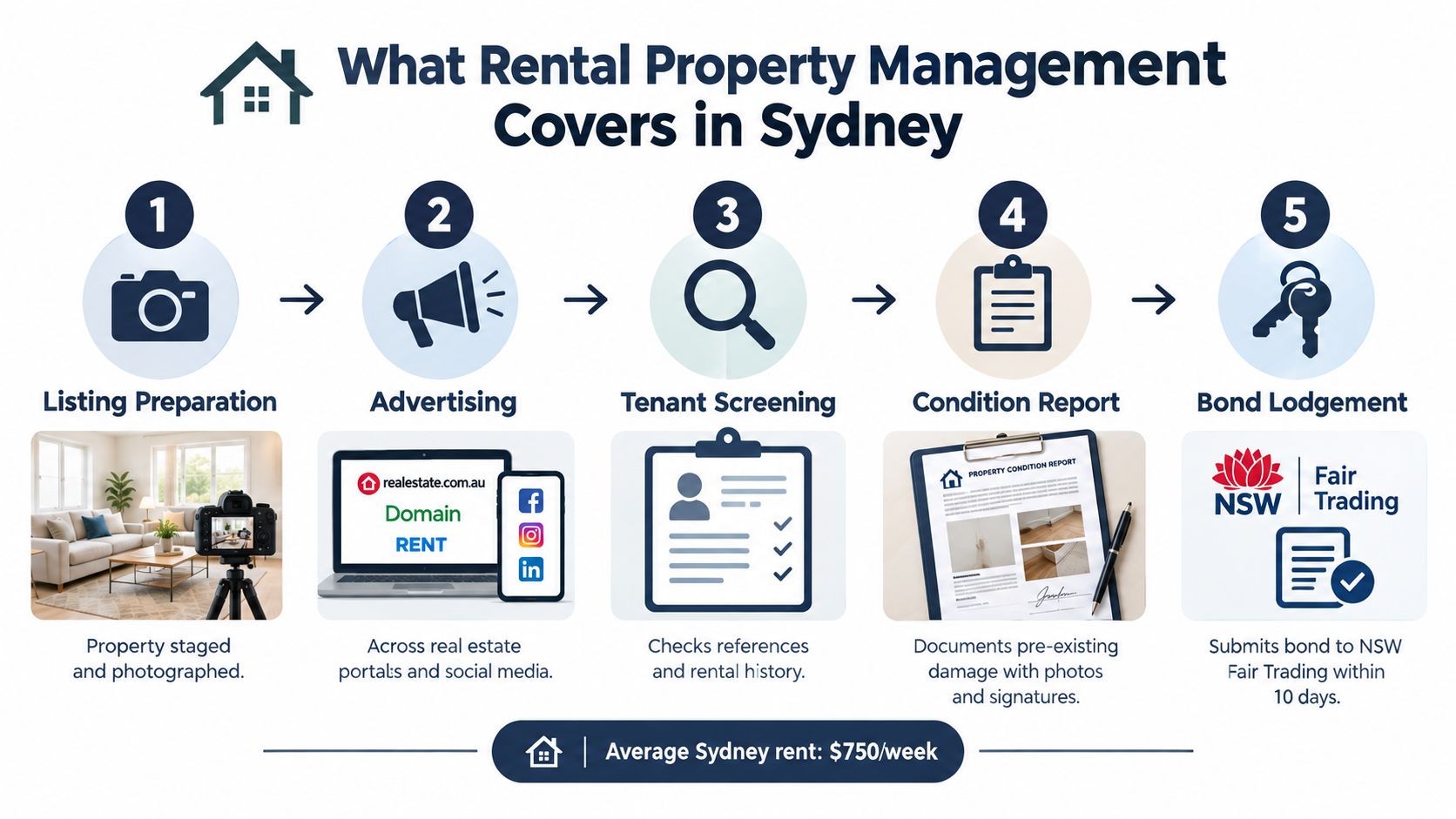
The first stage is property readiness. The manager checks presentation, photographs, inclusions, repair items and any known restrictions before preparing advertising for platforms such as realestate.com.au and Domain. They should also confirm whether strata by-laws, heritage considerations, smoke alarm obligations or pool requirements affect how the property can be marketed and occupied.
Applications may arrive through platforms such as 1Form or TApp. Screening should examine identity, income, employment, rental history and references consistently, without turning a rushed approval into a future arrears or damage problem. A property data tool can assist an owner or manager who needs to get property details from RealtyAPI.io, but no software replaces a documented human assessment.
The tenancy record
Once approved, the manager prepares the agreement under the Residential Tenancies Act 2010, completes the ingoing condition report, records photographs and coordinates signatures. Rent receipting must feed into the NSW trust-account process, with statements that allow the owner to reconcile income, fees and expenses.
During the tenancy, the manager schedules inspections, issues access notices, triages maintenance, coordinates licensed trades and follows up arrears. At the end, they conduct the exit inspection, compare the property against the ingoing report, resolve agreed issues and lodge the bond through Rental Bonds Online.
Owners should expect a clear answer to four questions at every stage: what happened, who approved it, when did it happen and where is the record? A detailed overview of residential property management services can help owners compare the actual workflow offered by different agencies.
Service Tiers Sydney Owners Can Choose From
Sydney owners usually choose between a full-service arrangement, a bundled set-and-forget model, or a boutique structure with direct access to a senior manager. The labels matter less than the operating details behind them.
| Tier | Typical Fee (% of rent) | Inspection Frequency | Reporting Depth | Avg Properties per Manager | Best For |
|---|---|---|---|---|---|
| Full-service | Varies by agency and agreement | Often scheduled inspections every six months | Detailed statements, arrears reporting and compliance records | Workload varies by agency | Owners wanting broad delegation |
| Set-and-forget | Varies by agency and package | Often quarterly | Standard owner portal and bundled reporting | Workload varies, often across larger portfolios | Owners prioritising convenience |
| Boutique or owner-portal | Varies by agency and agreement | Tailored to the property and tenancy | Custom reporting, direct communication and live approvals | Usually structured around a capped portfolio | Owners wanting visibility and personal accountability |
Full-service delegation
A full-service manager handles advertising, inspections, rent collection, arrears, maintenance, renewals, notices and NCAT preparation. The trade-off is cost and contract complexity. Owners need to read the schedule of additional charges, because tribunal attendance, lease renewals, project coordination and administration may sit outside the headline management percentage.
The bundled model
Set-and-forget packages can suit an owner who wants a standard process and minimal involvement. The risk is that a property can become one file among many. A portal may show the result of an inspection, but it won't necessarily tell you whether the manager identified a recurring moisture issue, challenged an incomplete repair or followed up an avoidable delay.
Boutique management
A boutique agency may give an owner a direct line to a senior manager, quicker approval requests, custom reporting and clearer fee separation. The service depends heavily on the people doing the work, so ask who will answer after hours, who attends difficult inspections and who prepares the file if a dispute reaches NCAT.
Lower fees can come with heavier individual workloads. In practice, ask for the manager's current portfolio size, escalation process and examples of the reports you'll receive. A cheap percentage isn't a saving if slow decisions create vacancy, arrears or preventable maintenance costs.
NSW Tenancy Law Changes That Rewrote the Manager's Job
The NSW reforms changed the manager's job from issuing familiar notices to maintaining a defensible reason-and-evidence process. The question is no longer solely whether an owner wants possession. The manager must identify the lawful pathway, communicate it correctly and preserve the supporting record.
From 19 May 2025, landlords need a valid reason to end both periodic and fixed-term tenancies. The manager must select the applicable reason, use the correct notice process and retain the evidence supporting that decision. An end-of-fixed-term notice can't be treated as an automatic administrative step.
The bond process also changed. From 1 July 2025, the reason for claiming or releasing a bond had to be recorded in Rental Bonds Online. That means the condition report, inspection photographs, invoices, tenant correspondence and owner instructions need to tell the same story. If the documents conflict, the dispute becomes harder to resolve.
Recent reforms also introduced fee-free rent payment options. Managers need to offer a payment method that doesn't impose a surcharge, record the tenant's selected method and make sure the ledger accurately reflects payments, reversals and arrears.
| Reform | Manager document required | Owner action |
|---|---|---|
| Valid reason required for ending periodic and fixed-term tenancies from 19 May 2025 | Notice showing the lawful reason, with supporting evidence retained | Provide accurate instructions and supporting facts promptly |
| Reason recorded for bond claims or releases from 1 July 2025 | Rental Bonds Online record matched to the exit file | Approve the documented reason before lodgement |
| Fee-free rent payment options | Record of the available method and tenant's chosen arrangement | Avoid directing the manager towards a surcharge-based process |
The paperwork isn't separate from the management service. It is the service.
The burden is particularly visible in mixed Sydney portfolios, where inner-city apartments, older South-West Sydney houses and strata properties generate different access, maintenance and communication issues. NSW Fair Trading's rental reform announcement provides the relevant reform context, but owners should still ask their manager how those rules appear in the daily file.
Compliance Documentation Owners Should Expect in 2026
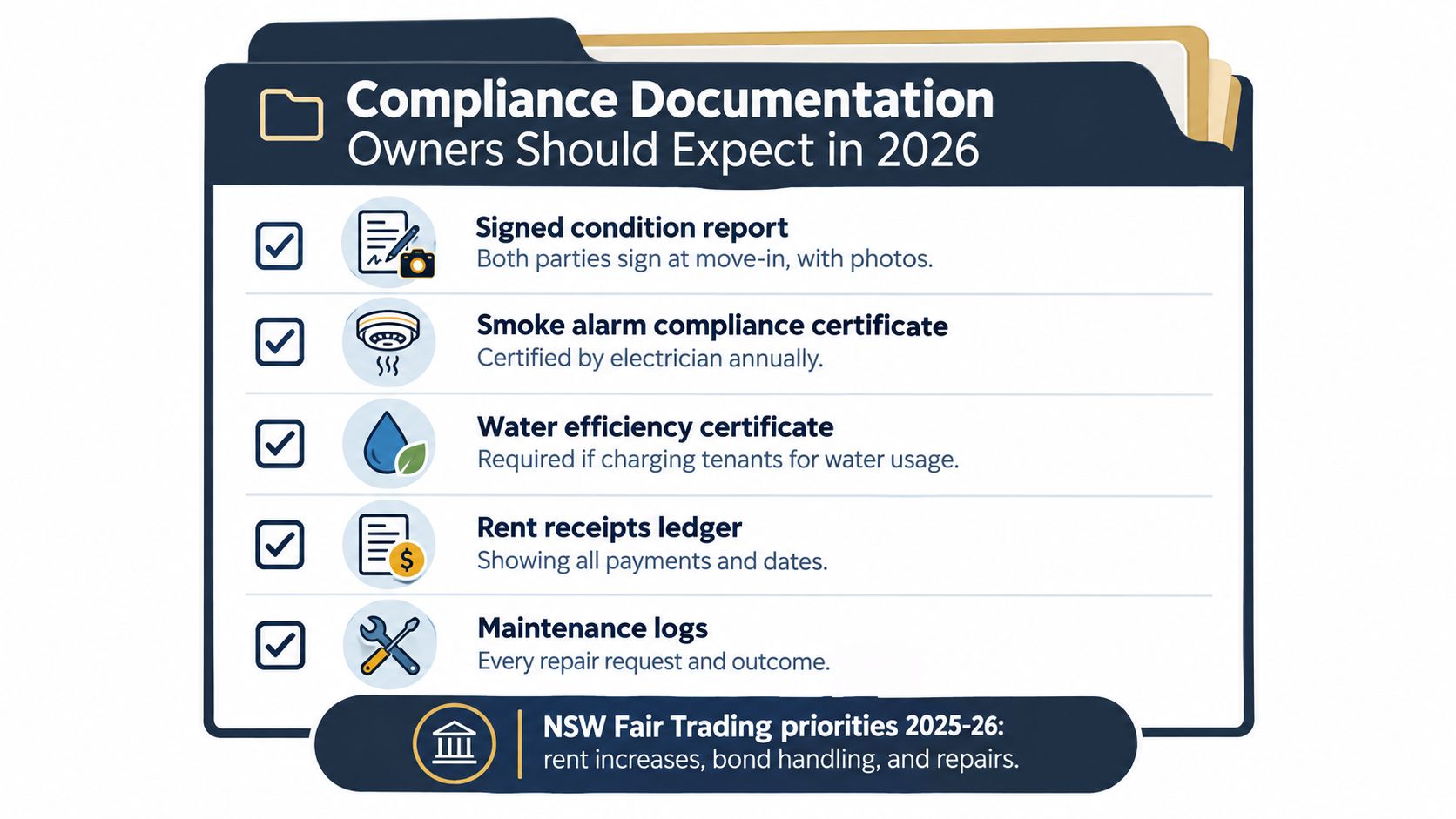
A compliant management file should allow another person to understand the tenancy without relying on memory. That matters because NSW Fair Trading's FY2025-26 priorities include unlawful residential tenancy terminations and illegal denial of access to tenants' homes. The agency's compliance and enforcement priorities make process-level evidence a practical requirement.
The running-file checklist
Expect the manager to retain:
- A signed condition report: Include dated photographs, signatures and a clear description of pre-existing damage.
- Safety and compliance records: Keep smoke alarm documentation, pool compliance material where relevant and any required certificates before keys are handed over.
- Access notices: Store the notice issued for every inspection, repair visit and other lawful entry, with the date, purpose and delivery record.
- A complete rent ledger: Show payments, dates, arrears progression, notices and communications about repayment or hardship.
- Maintenance records: Link each request to the triage decision, owner approval, trade invoice, attendance details and outcome.
- Bond evidence: Retain the Rental Bonds Online lodgement or release record and the documents supporting any claim.
Why timestamps matter
A message saying “the tenant was notified” isn't as useful as a dated notice attached to the inspection record. A maintenance entry saying “fixed” isn't enough if it doesn't identify the contractor, invoice or follow-up confirmation.
Older housing stock across parts of Liverpool, Fairfield and surrounding suburbs can produce recurring repairs rather than isolated jobs. Owners should therefore expect a property history, not a collection of disconnected emails. Guidance on NSW VIC QLD security rules can provide broader documentation context, although NSW owners still need NSW-specific advice.
Use a rental inspection checklist to audit whether each inspection record captures condition, access, tenant concerns, repairs and follow-up actions. If your manager can't produce these records promptly, the problem isn't presentation. It's control.
Performance Metrics That Matter in a Sub-2% Vacancy Market
Sydney owners shouldn't judge a manager only by how quickly they find the next tenant. REINSW reported Sydney's residential vacancy rate at 1.7% in June 2025, while noting that the city had exceeded 2% only once in the previous three years, and describing a healthy vacancy rate as roughly 3% to 3.5%. The market was therefore operating well below balanced conditions. (REINSW vacancy data)
SQM Research reported vacancy at 1.1% in March 2026, rising through 1.3% in April, 1.5% in May, 1.6% in June and 1.7% in July, with 12,782 vacant dwellings in July. (SQM Research property data) Those figures change the management question. The priority is protecting the income produced by an occupied property, not assuming every vacancy will be filled effortlessly.
Three numbers to request
Days on market reveals whether the manager's pricing advice, photography, copy and inspection process are converting demand. In a tight market, a property can still sit vacant if it's poorly presented, priced without evidence or difficult to inspect.
Arrears days are more useful than a simple arrears yes-or-no flag. Ask how quickly the manager identifies a missed payment, contacts the tenant, records the explanation and escalates when the agreed remedy doesn't occur. A clean ledger with weak follow-up isn't a control system.
Tenant retention shows whether the manager reduces avoidable turnover. Rent reviews should reflect the market while allowing for the cost and risk of replacing a functioning tenant. Domain reported Sydney house rents at a record $850 per week and unit rents at a record $780 per week in its June quarterly report, with quarterly increases of 6.3% for houses and 4% for units. (Domain rent report coverage)
Ask each prospective manager for their recent figures for these three measures, plus an explanation of how they calculate them. A polished proposal is less useful than a ledger, inspection report and vacancy analysis that show how the agency works.
Why Boutique and Local Managers Are Worth a Closer Look
A boutique local manager, a franchise office and an online-only service can all perform well. The difference appears when a tenant stops paying, a repair needs immediate authorisation or an owner needs evidence for a dispute.
Accountability at the point of failure
A local principal may know the property, the tenant history and the tradespeople serving Liverpool, Fairfield and nearby suburbs. That can shorten the distance between a maintenance request and a decision. It also makes accountability clearer, because the owner knows who reviews the file rather than dealing with a rotating account manager.
A franchise can offer strong marketing reach, established systems, branded portals and a call centre. Those advantages may suit high-end listings or owners who value a large corporate structure. The compromise can be handoffs, layered approvals and fee schedules that are harder to interpret.
Online-only management can work for a straightforward studio with predictable maintenance and an owner comfortable making decisions through an app. It becomes less convincing when the file involves hardship negotiations, complex repairs, tribunal preparation, repeated access issues or a contractor who needs someone on site.
| Dimension | Boutique / Local | Franchise | Online-Only |
|---|---|---|---|
| Accountability | Direct access to a senior manager or principal | May involve team handoffs | Usually centred on a remote support queue |
| Local knowledge | Strong suburb and trade familiarity where genuinely local | Varies between offices | Limited on-the-ground context |
| Technology | Often combines personal service with an owner portal | Established systems and portal infrastructure | App-led communication and reporting |
| Fee transparency | Can be tailored and separately itemised | Package structures may contain multiple charges | Often designed around standardised pricing |
| Complex tenancy issues | Personal escalation and local coordination | Formal escalation pathways | May require remote document handling |
The local advantage isn't a slogan. It's practical when someone can inspect the property personally, identify a recurring issue and authorise a sensible repair without waiting for a distant approval chain.
Ask who owns the difficult file. The answer tells you more than the agency's brand.
In a market running below balance, the differentiator is no longer access to applicants. It's the ability to retain suitable tenants, control arrears, coordinate work and document every material decision.
Choosing or Switching a Sydney Property Manager This Week
Start with evidence, not the management fee. Pull the last twelve months of statements, maintenance records, inspection reports and rent ledgers, then ask whether the current manager can explain the patterns.
A practical audit
- Review the statements. Compare the charges against the signed management agreement. Separate the management percentage from administration, advertising, inspection, renewal, tribunal and project fees.
- Measure the tenancy. Record days between tenants, arrears days and turnover. Don't accept a claim that the portfolio performs well without seeing how the agency defines each measure.
- Inspect the file. Ask shortlisted managers for a sample condition report, access notice, maintenance record and bond lodgement record that reflects the post-2025 process.
- Verify the agency. Check NSW Fair Trading registration details and ask whether the business maintains appropriate professional indemnity cover.
- Test the contract. Request the termination terms, notice period, authority limits and any trial or exit provision in writing.
The manager should also explain who handles urgent repairs, how owner approvals work outside business hours and what happens when a tenant raises hardship or disputes a charge. A portal is useful when it shows live rent status, statements, inspection documents, maintenance approvals and end-of-year reporting. It's not useful if it merely displays selected updates while the underlying file remains inaccessible.
Red flags worth taking seriously
Be cautious if the agency has no clear local contact, bundles every charge into one unexplained percentage, won't provide portal access or resists itemising compliance records. Reluctance to show how the manager checks tenant history is another warning sign. Owners can use a structured tenant history check as one reference point, but the agency should explain its broader screening and privacy process.
Set a one-week timetable. Review your file first, shortlist two managers, attend one appraisal, compare written service schedules and decide by Friday. If the current agency can't produce the records or metrics you need, switching is a business decision, not a personal criticism.
Gregory Property Agents provides residential management across Liverpool, Fairfield and South-West Sydney, with tenant screening, inspections, maintenance approvals, arrears control, compliance records and a 24/7 owner portal for statements and tenancy updates. Visit Gregory Property Agents to discuss your property, review the management workflow and arrange a practical appraisal.