

You've found an applicant who appears suitable, the references sound positive, and you're ready to approve the application. Months later, rent falls behind, damage appears, and you discover that the information supplied at the beginning didn't tell the full story. For a NSW landlord, the cost of a poor placement can extend well beyond a missed payment. It can affect the condition of the property, the time required to resolve disputes, and your confidence in the entire management process.
A structured approach to tenant screening services helps you assess an application using relevant evidence rather than instinct or a single online report. It also helps you meet NSW requirements around disclosure, consent, data collection and screening fees. The right process doesn't promise a risk-free tenancy. It creates a clearer, more consistent basis for making a decision and documenting why you made it.
Table of Contents
- Introduction to Tenant Screening Services
- Understanding Key Concepts in Tenant Screening
- Comparing In-House Screening and Third-Party Options
- Tenant Screening Checks Explained
- Pricing Considerations for Tenant Screening Services
- Pros and Cons for NSW Landlords
- Real-World Screening Scenarios and Outcomes
- Conclusion and Best Practice Recommendations
Introduction to Tenant Screening Services
Tenant screening is the point where a rental application becomes a reasoned risk assessment. You're not trying to find a flawless person. You're checking whether the applicant's identity, income, rental history and references form a consistent picture of someone who can meet the agreement and care for the property.
That distinction matters in South-West Sydney, where landlords may be comparing several applications at once. A quick online check can provide useful information, but it may not confirm whether documents are genuine, whether a previous tenancy ended well, or whether the person making the application is who they claim to be. Effective screening connects those separate questions.
The process should begin with clear, lawful criteria. Decide what evidence you need, tell applicants why you need it, obtain appropriate consent, and apply the same assessment method consistently. Avoid collecting information because a platform makes it available.
Professional tenant screening services can also reduce the practical burden of contacting employers, previous agents and referees. Gregory Property Agents' service information describes checks involving employment, income, tenancy history, references and identity or application consistency, giving landlords a more organised alternative to piecing together separate online searches.
The aim is simple: protect rental income and the asset while treating applicants fairly. Good screening is neither an informal internet search nor an opaque score. It's a documented process built around relevant evidence.
Understanding Key Concepts in Tenant Screening
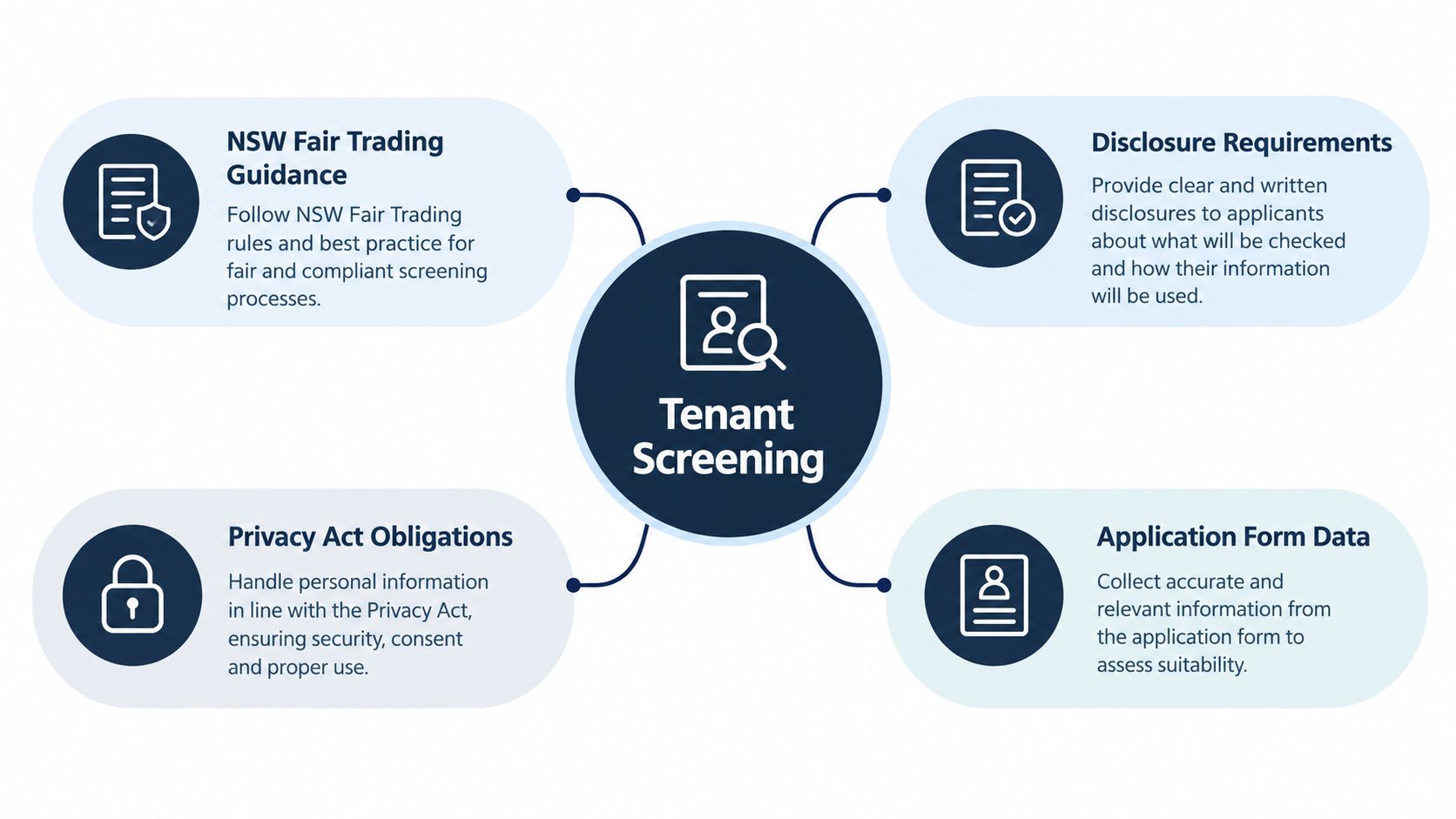
NSW screening begins with a purpose test. Collect information only when it helps verify identity, assess the ability to pay rent, or judge whether an applicant is likely to care for the property. NSW Fair Trading guidance says agencies should request only information reasonably necessary for those purposes, as explained in the NSW Fair Trading Commissioner's guidance.
A rental application resembles a job interview for a position involving a valuable asset. Questions should relate to that responsibility. Applicants should not have to provide unrelated personal details without knowing why they are requested or how they will be used. At the application stage, agents and screening platforms must explain the purpose of each item, how it will be collected, and how the application will be assessed, according to NSW application-stage guidance.
The four questions every request should answer
Before requesting a document or authorisation, make sure the process answers four questions:
- What is needed: State the decision-making purpose for the information.
- How it is collected: Explain whether the applicant uploads it, consents to a check, or supplies a referee's details.
- How it is assessed: Describe the relevant criteria without promising approval or hiding an unexplained formula.
- What happens to it: Explain its use, storage, confidentiality and sharing with third parties, consistently with NSW guidance on handling tenant personal information.
This disclosure is part of the process, not decorative wording. It helps applicants understand the assessment and helps agencies show that their requests are proportionate. It can also reveal unnecessary fields in an application form.
Fees require separate attention. NSW Government reported that some rental apps had charged renters $25 to $30 for background checks before the practice was banned, as described in its guidance for prospective tenants. NSW Fair Trading states that landlords and agents can't charge a prospective tenant for a background check. The Residential Tenancies Act 2010 allows penalties of up to 20 penalty units for breaches connected with those charges.
Practical rule: If a check forms part of your application process, treat it as a landlord or agent expense. Do not disguise it as an applicant administration charge.
Comparing In-House Screening and Third-Party Options
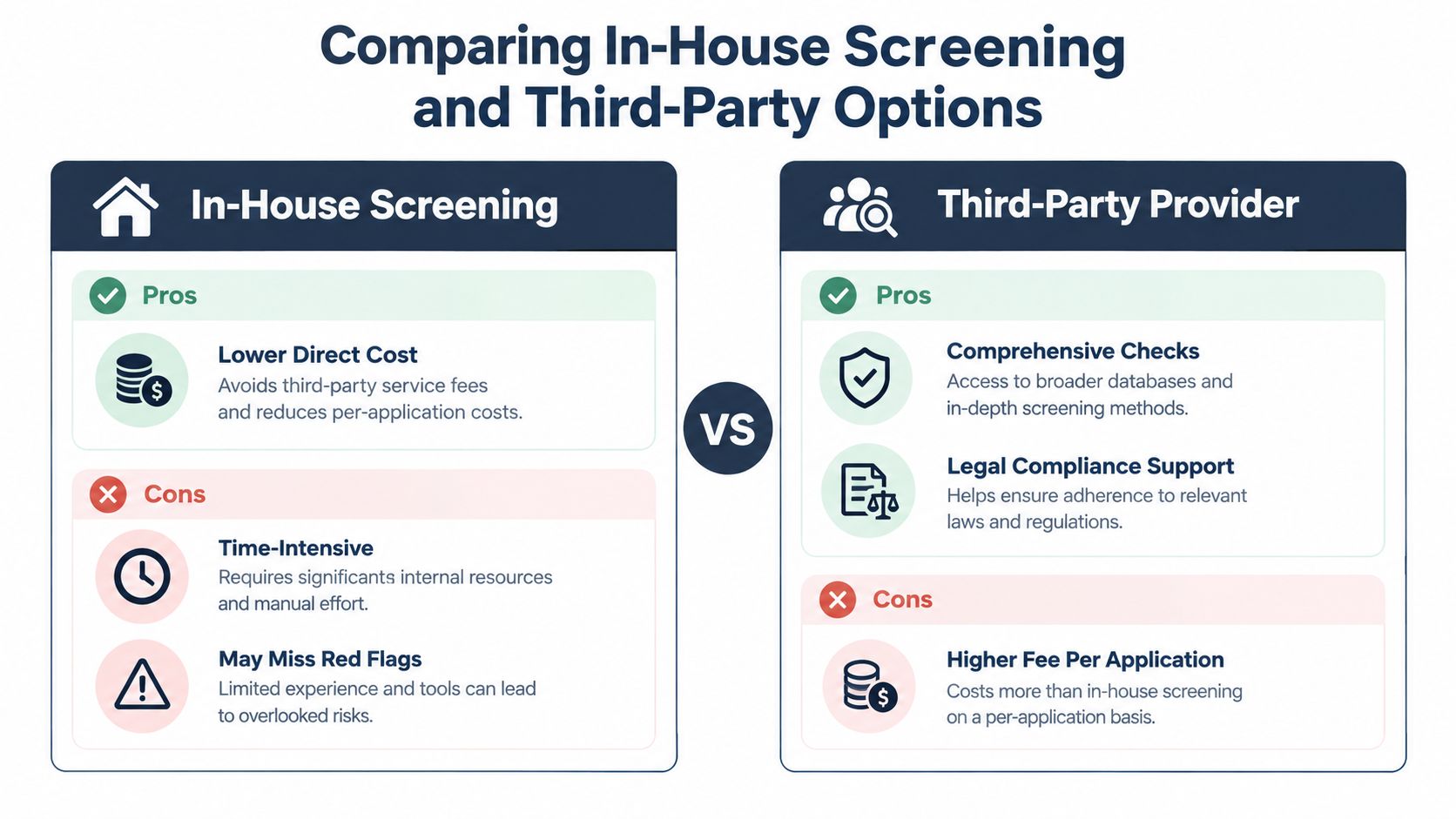
DIY screening gives you direct control, but it also makes you responsible for every step. You'll need to collect consent, verify identity, inspect documents, contact referees, interpret database results, record the decision and protect the information afterwards. A landlord with strong local knowledge and enough time may manage this effectively, provided the process is consistent and lawful.
A third-party service can bring together identity checks, income evidence, reference workflows and database searches in one system. The convenience is valuable, but outsourcing doesn't transfer every legal responsibility. You still need to understand what the provider collects, how the result is generated, what the report means and whether the information is relevant to the decision.
A practical comparison
| Consideration | In-house screening | Third-party option |
|---|---|---|
| Control | You set the workflow and speak directly with referees. | The provider supplies a structured process and reporting format. |
| Time | Staff or the landlord must complete each enquiry manually. | Automated requests and integrated reports can reduce administration. |
| Context | You can ask tailored questions about a specific tenancy. | Standardised checks may improve consistency but can miss local context. |
| Compliance | You must manage notices, consent, storage and disclosures yourself. | Some providers offer compliance support, but you remain responsible for oversight. |
| Cost structure | Labour, calls, software and staff time are the main inputs. | Fees may apply per application, through subscriptions or as part of management. |
| Risk of error | Results depend heavily on the operator's experience and record keeping. | Matching software can identify inconsistencies, but false positives still require review. |
Automated screening is developing faster than the rules governing it. Recent Australian research identifies growing concerns about data privacy, algorithmic bias and disclosure requirements as automated screening tools outpace regulatory frameworks, according to AHURI research on data-hungry PropTech.
That doesn't make technology unsuitable. It means you should treat a generated score as an input, not a final verdict. Ask whether the provider explains the information used, allows human review, supports consent capture and gives you enough context to challenge an apparent mismatch.
For landlords who want an agency to manage the wider process, residential property management services can combine applicant sourcing, screening, inspections, maintenance and compliance administration. The right choice depends on your portfolio, availability and comfort with NSW obligations.
Tenant Screening Checks Explained
A defensible application assessment uses several signals that test different aspects of tenancy risk. Identity checks confirm who is applying. Income evidence addresses serviceability. References provide behavioural context. A tenancy-database search may reveal a documented history, but it must be interpreted within NSW rules.
Identity verification comes first
Start by checking that the applicant's name and identifying details are consistent across the application, supporting documents and consent records. Look for unexplained differences in names, addresses, dates or document quality. A mismatch isn't proof of dishonesty, but it deserves clarification before you rely on the rest of the application.
Identity verification also protects applicants from being assessed against someone else's record. A database result attached to the wrong person can create an unfair outcome, so matching should be careful rather than automatic.
Income and employment evidence
Payslips, bank statements and employment contracts are common parts of real-world applications. A 2023 Tenants' Union of NSW survey found that 90.3% of renters provided payslips, 81.5% bank statements and 67.7% employment contracts, as reported in its rental privacy survey.
Don't assess one document in isolation. Compare the employment details, stated income, transaction pattern and application information. Bank statements can help you understand whether rent payments appear consistent, but they contain sensitive information and should be limited to what you reasonably need. If an applicant says rent is paid from another account, record the explanation and verify it through an appropriate reference rather than treating the statement alone as conclusive.
Previous landlord and agent references
A previous landlord or agent can help establish whether rent was paid as agreed, whether communication was reliable and whether the property was maintained. The same survey found that 83.1% of renters provided a previous landlord as a reference, confirming how central tenancy history is to Australian applications.
Ask focused questions instead of seeking a general character opinion. Confirm the tenancy dates, payment history, notices or disputes where relevant, property condition and whether the landlord would rent to the applicant again. Keep notes that distinguish verified facts from a referee's personal impression.
Tenancy databases and related records
AHURI describes tenancy databases as electronic systems that property managers and agents use to store and retrieve breach or default history. Commercial reports may also contain identity and tenancy-history information, along with records such as bankruptcy information, court judgments, writs and summonses, depending on the service and available data. Equifax describes its National Tenancy Database as an integrated background-check report for real estate agents and property managers through its National Tenancy Database service.
A database listing isn't automatically a reason to reject an applicant. NSW rules state that a tenant can only be listed after the tenancy has ended and only for specific grounds, such as money owed above the bond or an NCAT termination resulting from tenant wrongdoing. Check the record, confirm the identity match, understand the reason and allow the applicant to respond.
| Check type | Purpose | Source |
|---|---|---|
| Identity verification | Confirms the applicant matches the person named in the application and supporting records. | Application documents and authorised identity tools |
| Income and employment | Tests whether the applicant appears able to meet the rent. | Payslips, employment evidence, statements and employer confirmation |
| Rental references | Examines payment conduct, communication and property care. | Previous landlord or agent |
| Tenancy database | Identifies documented tenancy breaches or defaults subject to NSW rules. | Commercial database search and source records |
For a managed process, a tenant history check can bring these strands together. The strength of the assessment comes from cross-validation, not from giving one source more authority than all others.
Pricing Considerations for Tenant Screening Services
A landlord may choose a low-cost report, then spend extra time correcting an identity mismatch or chasing a referee. The price of screening includes the report, platform access, staff time, follow-up and record keeping. A higher fee can be reasonable when it covers organised administration and accountable verification.
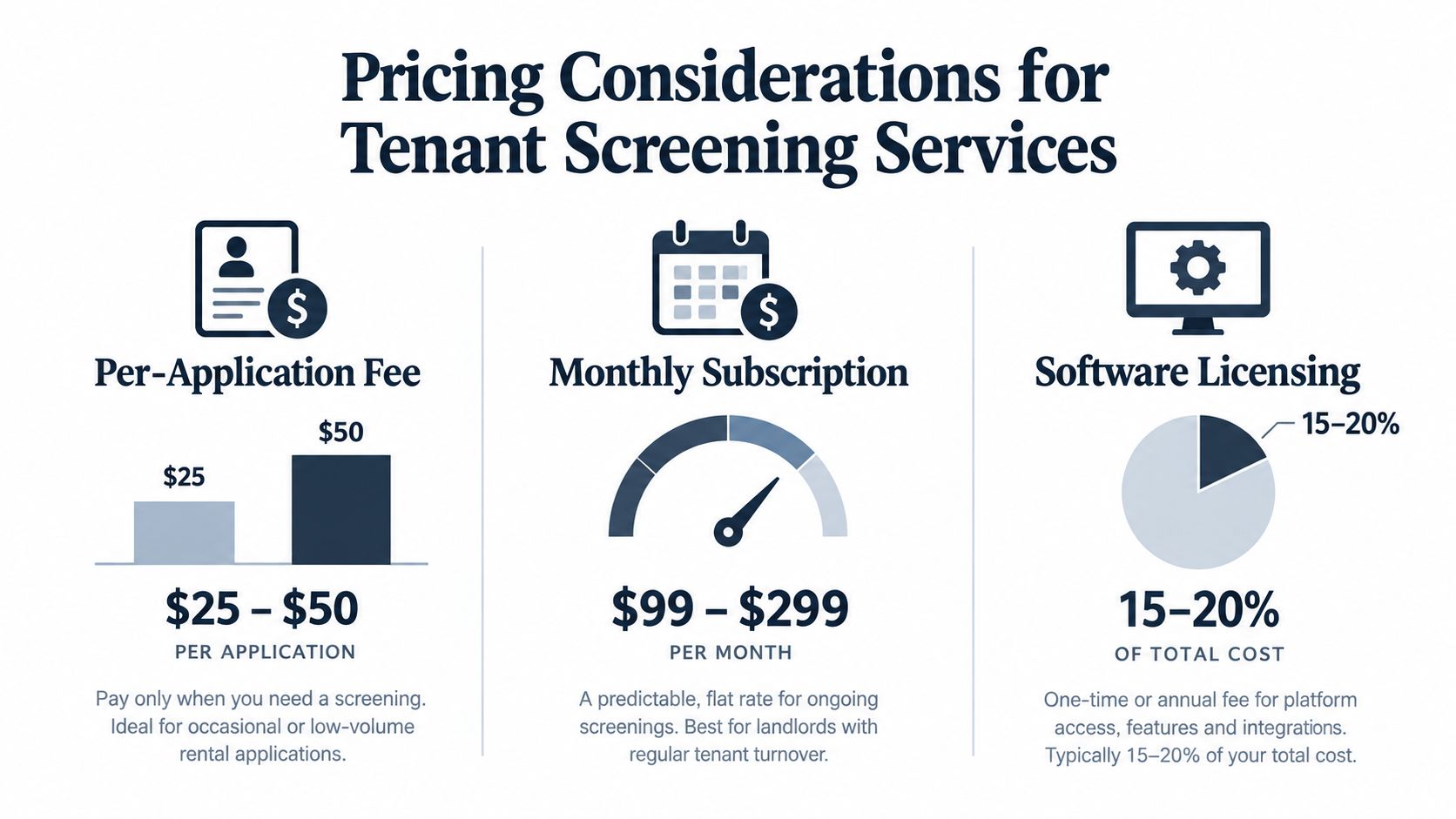
Common pricing models include:
- Per-application charges: You pay each time a report is ordered. This suits occasional vacancies, provided you confirm which checks and follow-up work are included.
- Subscriptions: A monthly platform fee may cover applications, reports or broader property-management functions. It may suit landlords who screen regularly.
- Agency service fees: A property manager may include screening within a wider leasing or management service. The fee can reflect staff time, verification and responsibility for maintaining the process.
- Internal labour: DIY screening has no separate report invoice, but calls, document checks, file management and compliance tasks still use time and resources.
The NSW fee rule changes the calculation. NSW Government reported that rental applications had charged renters $25 to $30 for background checks before that practice was banned. Current Fair Trading rules require the landlord or agent to pay for screening rather than passing that background-check charge to the applicant, as explained in the NSW Government application guidance cited above.
Budget for quality, not volume
Ask whether the quoted fee includes follow-up enquiries, identity matching and reference calls, or treats them as separate services. Before uploading applicant records, check the provider's retention and deletion arrangements. A transparent provider should state who pays, what the service covers, how long results usually take and what happens when an enquiry cannot be completed.
Privacy also belongs in the price assessment. A cheaper platform may provide less clarity about access, storage or deletion, leaving the landlord with more compliance work. Treat the service like a filing system for sensitive records: its value depends on both the information collected and how safely it is handled.
Gregory Property Agents advises that a full screening check can take up to 48 hours, although enquiries may take longer when employers or agents respond slowly. Allowing for that delay is more practical than choosing a service solely because it promises an instant result.
Pros and Cons for NSW Landlords
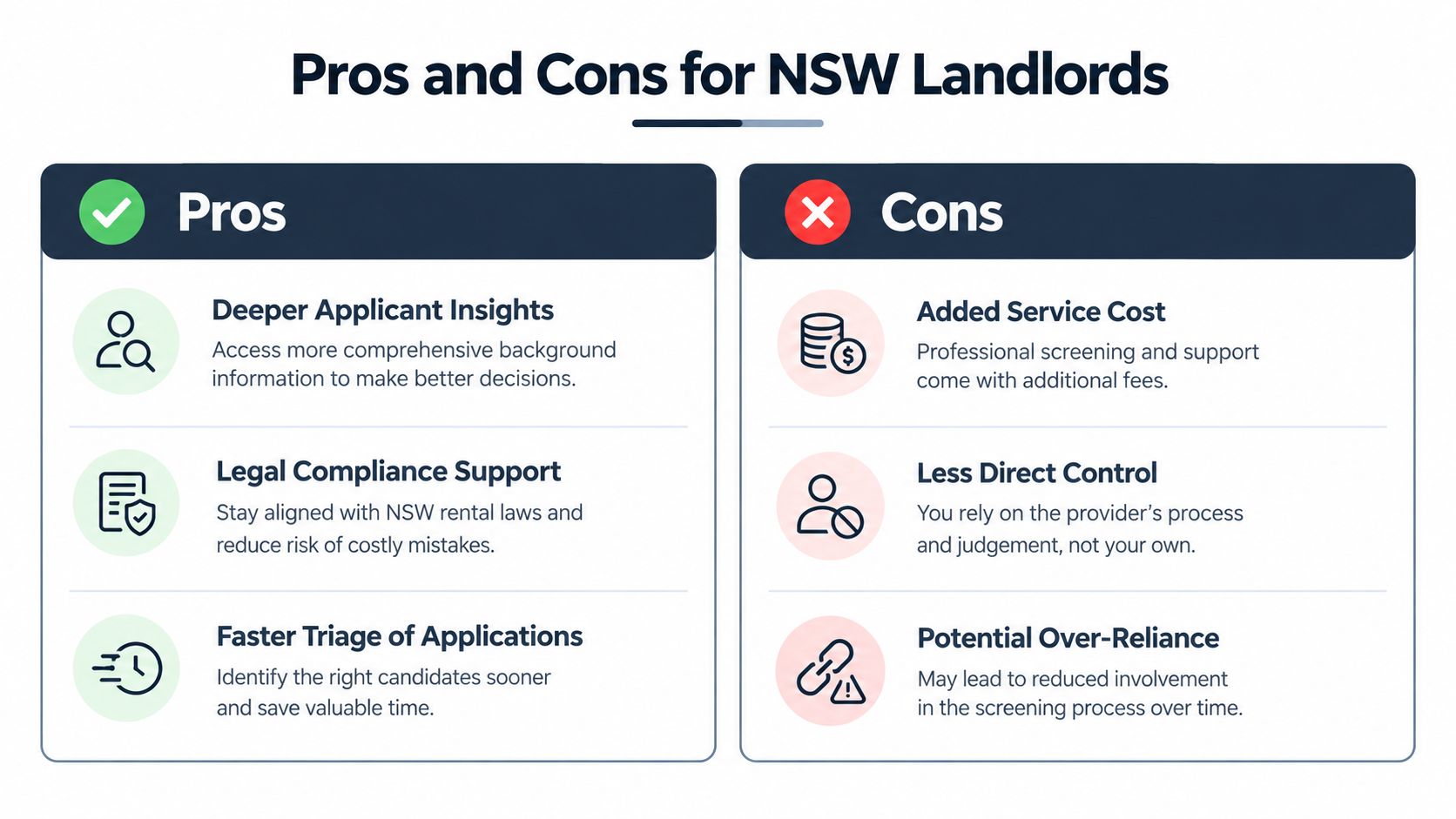
Professional screening can improve the quality of an application review, but it doesn't remove the need for judgement. The strongest process combines technology with human verification and clear documentation.
Where the benefits sit
Deeper applicant insight comes from comparing identity, income, employment and tenancy history instead of relying on a single document. A previous agent may identify a payment or maintenance issue that was never recorded in a commercial database.
More consistent administration helps you assess applicants against the same criteria and retain a clear record of the decision. This is particularly useful when multiple people review applications or when a landlord is not available to manage every enquiry.
Faster triage can help separate applications that need clarification from those ready for a full decision. Speed should never replace verification, but a structured workflow can reduce avoidable delays.
Australia's tenancy system gives landlords a strong reason to take screening seriously. Tenancy-database providers report that more than 127,000 cases are heard before tenancy tribunals each year, highlighting the wider context of arrears, damage and lease breaches described by Tenancy Database.
Where the risks sit
The service adds a cost, and you may have less direct control over how information is gathered. A rigid report can also encourage over-reliance on a score that doesn't explain the applicant's circumstances.
Privacy is another concern. AHURI research notes that digitised screening can collect income, rental history, lifestyle and housing-need information, while oversight of algorithmic decision-making remains limited. The report also raises concerns that some agencies and PropTech intermediaries may fall outside the Privacy Act because of the small business exemption.
A good property manager should still inspect the condition of the existing residence where appropriate, coordinate references and question inconsistencies. Landlords who need help connecting screening with inspections, arrears control and maintenance may consider rental property management in Sydney. For physical property risks unrelated to applicant suitability, landlords may also find a specialist resource such as FullScope Pest Control rental properties useful as part of broader asset care.
Real-World Screening Scenarios and Outcomes
Gregory Property Agents describes cases where a standard online application did not reveal the full risk picture. The agency's broader process includes employment verification, tenancy-history enquiries, physical observation of the applicant's current residence and matching software intended to assess payment reliability and responsibility.
One difficult case involved an applicant who supplied a driver licence and bank statements. Some details appeared plausible, but the transaction history didn't show expected rent payments. The applicant explained that rent was paid from another account. That explanation required verification rather than an immediate conclusion.
An on-site verification process then indicated that the applicant had fraudulently taken a neighbour's identity. The case demonstrates why document collection alone isn't enough. A professional check should compare the applicant's identity, stated history, financial explanation and physical circumstances.
Another warning concerns fraudulent documents. Bank statements and other records can be manipulated, while a person who understands the application process may present a convincing surface-level profile. That's why a landlord should treat a report as one piece of evidence and investigate contradictions before approving the tenancy.
Gregory Property Agents also notes that new ATF and AML requirements for real estate agents create opportunities for more in-depth enquiries into applicants. Those enquiries still need to remain relevant, explained and consistent with NSW privacy and tenancy requirements.
The practical lesson is not to reject every unusual application. It's to pause when the evidence doesn't align, ask a clear follow-up question and document how the issue was resolved.
Conclusion and Best Practice Recommendations
A reliable NSW screening process has four foundations: lawful data collection, verified identity, cross-checked financial and rental evidence, and consistent decision records. Tell applicants why you need each item, how you'll use it, how it will be stored and whether it will be shared. Don't charge applicants for background checks.
Use tenancy databases as supporting evidence, not automatic rejection tools. Give applicants a fair opportunity to clarify an apparent mismatch, and make sure any listing is permitted under NSW rules. If you're handling screening in-house, create a repeatable checklist. If the workload is growing, choose a provider or agency that can explain its checks rather than returning an unexplained score.
Allow realistic time for employers and previous agents to respond. A careful decision made with verified information is more valuable than an instant report that leaves obvious questions unanswered.
Gregory Property Agents provides tenant sourcing, identity and application checks, income and employment verification, tenancy-history enquiries, reference checks and ongoing property management across Liverpool, Fairfield and South-West Sydney. Visit Gregory Property Agents to discuss a screening process that protects your rental asset while meeting NSW requirements.