

A Hinchinbrook application recently looked flawless until a direct employer call revealed the applicant had been dismissed three weeks earlier. The application also omitted plans for adult children to move into the property.
That is why a tenant history check can't be treated as a database tick-box. In South-West Sydney, effective screening combines tenancy records, identity checks, employment verification, affordability analysis, references and a clear conversation with the landlord about what the evidence means.
Table of Contents
- When a Perfect Application Hides Serious Problems
- What a Tenant History Check Actually Covers
- NSW Legal Limits on Tenant Screening and Database Listings
- Why Database Hits Are Not Always Decisive
- Verification Steps Beyond Database Searches
- Assessing Affordability Against Household Composition
- How Landlords Receive and Interpret Screening Results
When a Perfect Application Hides Serious Problems
The Hinchinbrook application was, on paper, sensational. The documents were complete, the references appeared positive and the applicant presented as financially suitable. A less experienced reviewer could easily have recommended approval without further questions.
Our property manager, who has more than 15 years of experience, contacted the applicant's employer directly. The employer confirmed that the applicant's employment had ended three weeks earlier. Further checks also revealed that the applicant intended to have adult children living in the home, although that plan hadn't been properly disclosed in the application.
Those details changed the risk assessment. The issue wasn't that the applicant had lost employment. The larger concern was that the application no longer represented the household, income position or occupancy arrangement the landlord was being asked to approve.
Practical rule: Documents show what an applicant submitted. Due diligence tests whether those documents still describe reality.
Once tenants have the keys, the landlord's options become more complicated and the property manager is managing the consequences of decisions made at the application stage. Rent arrears, unapproved occupants, property-care concerns and tenancy disputes are harder to prevent after possession has been granted. Upfront verification is usually more effective than trying to repair a weak approval later.
A basic reference check might involve sending an automated request or calling a nominated contact. A tenant history check asks whether the contact is genuine, whether employment and income remain current, whether the proposed occupants match the application, and whether the rental history is supported by more than one source.
The same discipline applies when negotiating the wider leasing arrangement. Landlords who want clearer obligations and secure favorable lease terms with BoloSign can use a structured agreement process, but the document only works when the information behind it is accurate.
The Hinchinbrook example doesn't mean every applicant with a change in employment is unsuitable. It shows why a property manager should investigate material inconsistencies, record the findings and explain the implications before the owner makes a decision. Due diligence upfront is critical, particularly when a clean application creates a false sense of security.
What a Tenant History Check Actually Covers
A modern Australian tenant history check is broader than a phone call to a previous landlord. The process has developed from informal references and local memory into structured screening that can draw on tenancy databases, identity information, rental records, court information, financial information and direct verification.
Start with tenancy databases
At Gregory Property Agents, TICA and the National Tenancy Database can assist with application assessment. The National Tenancy Database is described by major Australian providers as the most extensive database of tenant information in Australia, and its records may include rental history, tenancy listings, court judgments and bankruptcy information. The National Tenancy Database also provides a pathway for private tenants to request a personal residential report free of charge, while paid self-check products are available through some channels.
A database search can identify a listing that deserves attention, but it can't explain the entire story. It may not show a current employment change, an undisclosed occupant, a forged document or a landlord who has provided an incomplete reference.
Confirm identity and authority
Identity verification connects the applicant to the records being reviewed. It helps reduce the risk of mistaken identity, inconsistent names or documents that don't belong to the person applying. The check should be handled consistently and with appropriate consent and privacy controls.
Verify the financial picture
Income and employment checks test whether the applicant can meet the proposed rent. Payslips, bank statements, employer contact and other supporting documents each reveal different information, although document-based evidence still needs sensible review because an uploaded document alone doesn't prove that employment continues.
Credit checks may reveal financial obligations and payment behaviour, but they don't replace rental references. An applicant can have a limited credit footprint, or a report that says little about how they cared for a property.
Speak to rental referees
Previous landlords and agents can comment on rent payment patterns, communication, property care and the way the tenancy ended. The quality of the call matters. A vague confirmation that someone rented a property isn't equivalent to a conversation about conduct throughout the tenancy.
Landlords comparing providers should also distinguish Australian requirements from overseas terminology. For teams reviewing international workflows, information about FCRA-compliant screening tools may be useful context, but NSW applications still need to be managed under NSW rules.
The practical conclusion is straightforward. Use the database as an early signal, then verify the applicant's current position through human checks and consistent documentation.
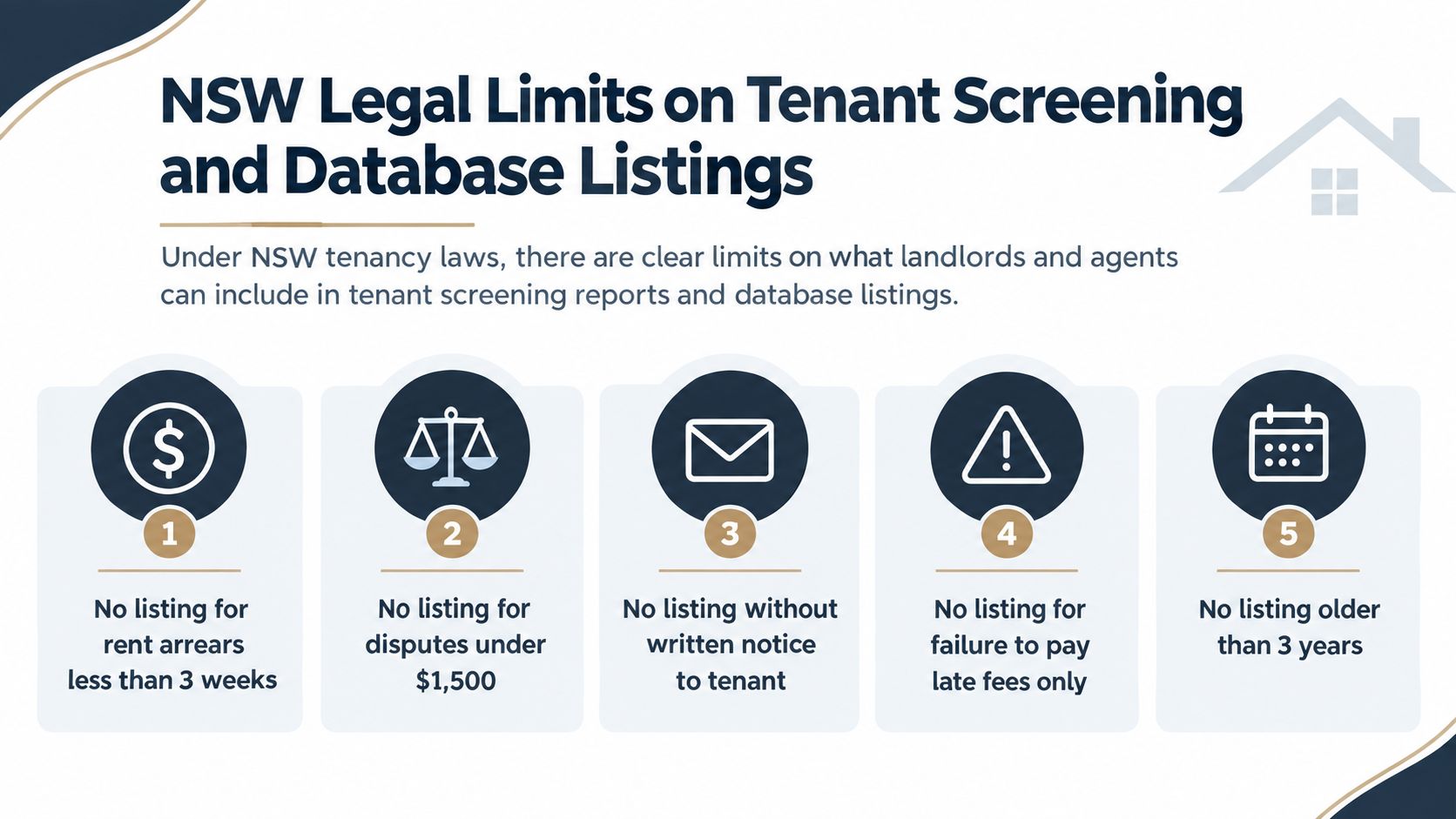
NSW Legal Limits on Tenant Screening and Database Listings
NSW landlords and agents need to understand both what screening can reveal and what the law prevents them from doing. A screening process that produces useful information but mishandles applicant rights can still expose the agency and owner to compliance problems.
Applicant fees are restricted
In NSW, a landlord or agent can't charge a prospective tenant for a background check. The NSW tenant history check guidance explains that the Residential Tenancies Act 2010 sets a maximum penalty of 20 penalty units for requiring or receiving that amount, and NSW Fair Trading identifies charging for a credit check or other background check as a breach of the Act.
The rule applies whether or not the person eventually applies for the tenancy or signs a lease. The Act also defines “tenant” to include a prospective tenant, so agencies operating across South-West Sydney need to build compliant fee handling into the application workflow from the beginning.
Database listings have narrow grounds
In NSW, a tenant can only be listed on a tenancy database after the tenancy has ended. The NSW Government tenancy database rules identify two valid reasons:
- Money owed: The tenant left owing money for a breach of the tenancy agreement, and the amount was above the bond.
- NCAT termination: The NSW Civil and Administrative Tribunal terminated the agreement because of something the tenant did wrong.
A listing also needs to be corrected or removed when the information is inaccurate, incomplete, unclear or out of date. That requirement matters for both sides. Landlords need reliable information, while renters need a practical opportunity to challenge a record that could affect future applications.
The workflow must support fairness
NSW Fair Trading notes that multiple tenancy databases operate in NSW. A renter may not know which provider holds information, what the record says or how long an access request will take. Consumer guidance from Equifax's tenancy check service highlights the importance of access and correction pathways, although fees, delays and request processes can vary between providers.
Compliance is part of risk management. The safest process considers the source, accuracy, notice, access rights and relevance of every result.
These restrictions explain why a database search cannot be the whole assessment. Some conduct won't be lawfully listable, some records may be disputed, and some risks only become visible when an agent checks current circumstances directly.
Why Database Hits Are Not Always Decisive
A database hit should trigger questions, not an automatic rejection. In a tight rental market, including many Sydney areas, applicants may have limited choices and landlords may feel pressure to decide quickly. That pressure makes consistent interpretation more important, not less.
The key distinction is between a verified, relevant record and a bare flag without context. A listing may be old, incomplete, unclear or no longer accurate. A tenant might have since demonstrated reliable rental conduct, resolved an amount owing or corrected an identity error. Treating every result as a permanent judgement can exclude an otherwise suitable applicant and can create an unfair process.
Read the result alongside current evidence
Experienced property managers compare the database information with:
- Recent rental conduct: Ask the current or previous agent about payment behaviour, property care, communication and the way the tenancy ended.
- Current employment: Confirm that the stated employer and role remain current rather than relying only on an old document.
- Household affordability: Test the proposed rent against the verified income of the actual household.
- Occupancy details: Check who will live at the property and whether the arrangement matches the application.
- Record accuracy: Give the applicant an opportunity to explain or challenge information that appears incomplete or incorrect.
This approach doesn't minimise serious conduct. A confirmed history of unresolved tenancy debt above the bond or an NCAT termination for tenant wrongdoing deserves careful consideration. It does recognise that a database record is one piece of evidence, and its weight depends on accuracy, recency, relevance and corroboration.
Avoid two common mistakes
The first mistake is treating the database as decisive. The second is ignoring it because a reference sounds reassuring. Both approaches are shortcuts.
South-West Sydney landlords need a process that can handle competing signals. A positive reference doesn't erase an unexplained listing, and a negative listing doesn't automatically outweigh strong, verified current evidence. The final decision should be based on written criteria applied consistently to applicants in comparable circumstances.
A database is a filter. It isn't a substitute for judgement.
That distinction protects landlords from approving an application without sufficient investigation, while also reducing the risk of unfairly rejecting a renter because of information that lacks context.
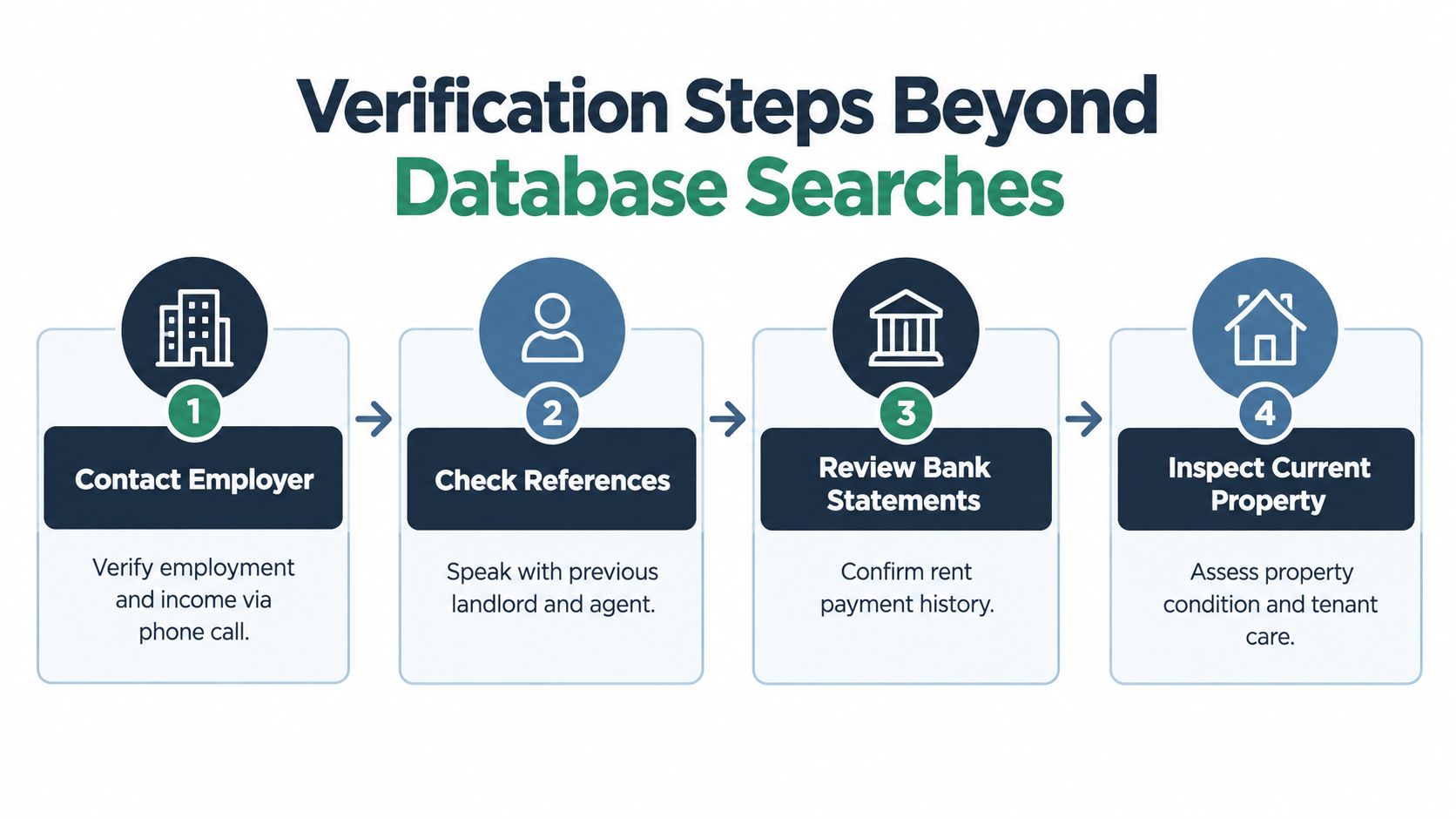
Verification Steps Beyond Database Searches
The practical work begins after the automated results arrive. A property manager should use those results to identify questions, then obtain evidence that confirms or challenges the application.
Contact the employer directly
Employer verification should test whether the applicant is currently employed, whether the contact details are genuine and whether the income information is consistent with the application. The Hinchinbrook matter illustrates why this step matters. The applicant supplied an apparently credible employment history, but a direct call established that employment had ended three weeks earlier.
The purpose isn't to demand irrelevant personal information. It is to verify the facts the applicant relies on to demonstrate affordability and continuity.
Check the household, not just the applicant
Occupancy affects the suitability of a property and the accuracy of the lease. Ask who intends to live at the premises, whether adult children or other occupants are expected, and whether the proposed arrangement has been disclosed. A tenant history check that ignores household composition can miss a material part of the risk.
Review financial evidence carefully
Income assessment may involve payslips, bank statements, employment information and other documents. Each source should be checked for consistency with the applicant's stated income, rent obligation and household circumstances. The purpose isn't to apply a vague rule of thumb. It is to decide whether the proposed tenancy appears sustainable before keys are handed over.
Speak with previous landlords and agents
Reference calls should be specific. Ask about payment regularity, property condition, maintenance reporting, communication and the tenancy's conclusion. A previous agent may also clarify whether information supplied by the applicant matches the agency's records.
The rental inspection process adds another useful perspective where access and timing make it appropriate. A structured rental inspection checklist helps property managers assess condition consistently rather than relying on a casual impression.
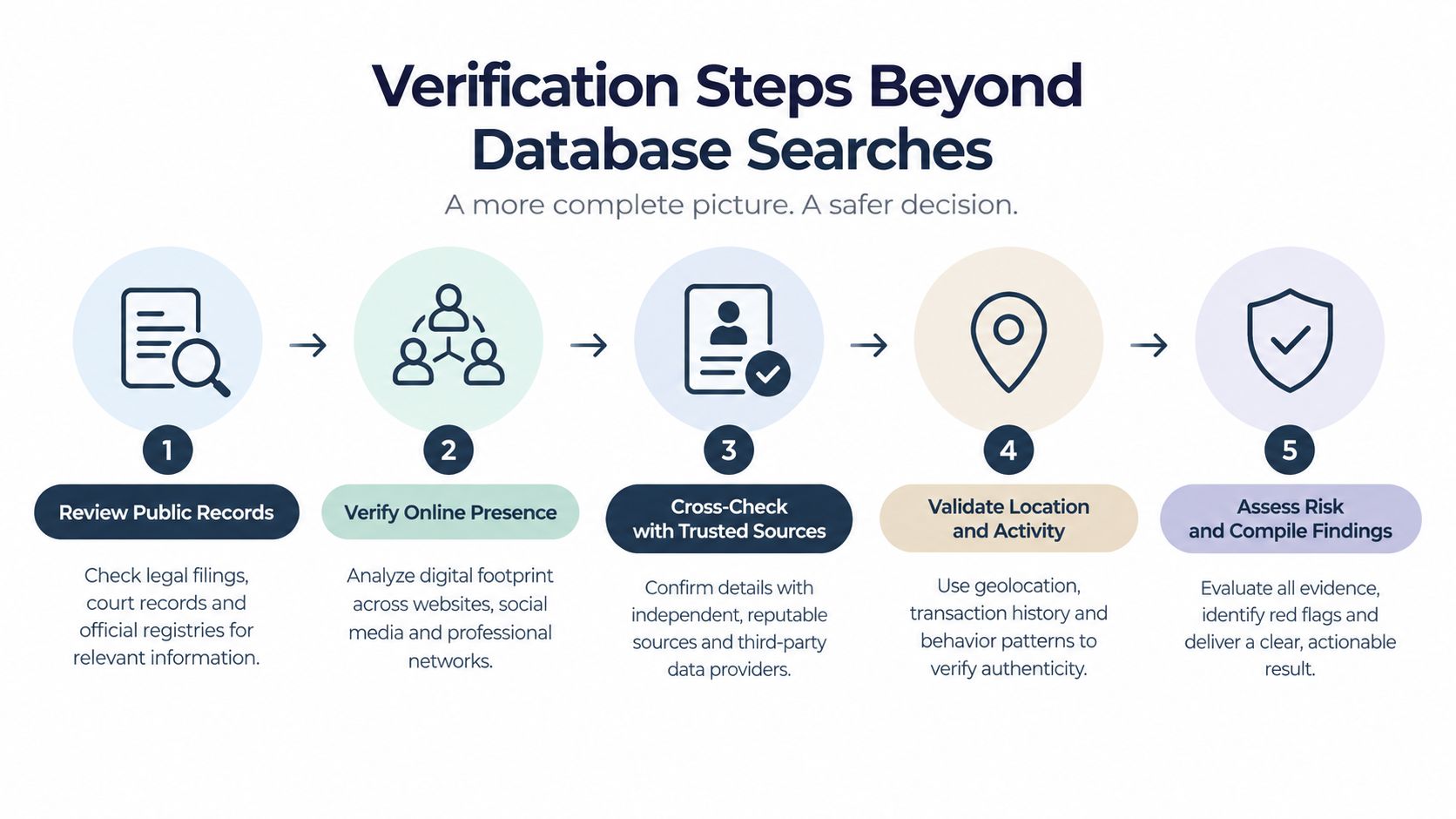
Good screening also means knowing where to stop. Personal information should be relevant to the tenancy decision, collected lawfully and handled securely. Property managers building broader trust and safety processes can consult this practical guide for trust and safety teams, while keeping the rental assessment focused on legitimate tenancy obligations.
The strongest process combines automation with professional curiosity. Software can flag a mismatch, but a trained property manager has to call, ask, compare and document the answer.
Assessing Affordability Against Household Composition
Affordability isn't only an income question. It is a relationship between household composition, verified gross income, rent and the obligations the household already carries. A single applicant, a couple and a family may present very different affordability profiles even when the headline income appears similar.
NSW Government affordable-housing thresholds provide a structured reference point by household type and region. For NSW outside Sydney in 2026–27, the published thresholds are:
| Household Type | Very Low Income | Low Income | Moderate Income |
|---|---|---|---|
| Single adult | $34,100 | $54,600 | $81,900 |
| Couple | $51,200 | $81,900 | $122,900 |
These figures come from the NSW Government affordable-rental income thresholds. They aren't a universal private-rental approval formula, but they demonstrate why household type belongs in the assessment rather than being treated as background information.
Match income to the actual household
If an applicant says they will live alone but intends to accommodate adult children, the affordability and occupancy picture changes. The agent needs to clarify who will reside at the property, whose income is being relied upon and whether the lease accurately reflects the proposed arrangement.
NSW also publishes separate rent-assistance-related income limits. For 2024–25, the maximum gross weekly income is $3,720 for a couple with four children and $2,190 for a single person with four children, according to the NSW Government income limits.
Numbers should inform judgement, not replace it. An applicant may have variable income, multiple earners or expenses that aren't visible in a simple payslip review. The property manager's job is to identify whether the rent appears compatible with the verified household circumstances and to explain any uncertainty to the owner.
Landlords can also use a clear rent calculation method to test the proposed obligation before approval. A practical resource on how to calculate monthly rent can help owners understand the conversion and compare the figure with the applicant's documented income.
The best affordability assessment happens before signing. It gives the landlord a clearer basis for approval and gives the tenant a fairer opportunity to disclose circumstances that could otherwise become a source of arrears or tenancy stress.
How Landlords Receive and Interpret Screening Results
A landlord shouldn't receive a pile of reports with no explanation. Screening information has value only when the owner understands what was checked, what remains uncertain and why the property manager recommends approval, further questions or rejection.
Gregory Property Agents provides owners with secure access to a 24/7 owner portal containing ledgers, reports and selected information relating to applications. The portal supports visibility for local and remote owners, but access to documents isn't the same as professional interpretation.
Look for a clear decision summary
A useful screening presentation should separate facts from judgement. The owner should be able to identify:
- Verified information: Employment, income, rental references, identity details and database results that were checked.
- Unresolved questions: Missing documents, inconsistent answers or information that needs clarification.
- Risk context: Whether a database result is accurate, relevant and supported by other evidence.
- Recommendation: The proposed next step, with reasons linked to the application criteria.
The property manager also needs to explain what a report doesn't show. A clean database result doesn't confirm current employment or future occupancy. A negative result doesn't necessarily establish that the applicant will fail a new tenancy, particularly if the information is outdated or disputed.
Use conversation for complex applications
At Gregory Property Agents, owners are often contacted personally about applicants, usually through a 15-minute Zoom conversation. That format gives the landlord an immediate opportunity to ask follow-up questions rather than trying to interpret a document in isolation.
The conversation should be candid. If an application has a strength and a weakness, both need to be stated. If a reference couldn't be independently verified, the owner should know. If an applicant's affordability depends on income that hasn't been confirmed, approval should not be presented as risk-free.
Landlords comparing agencies can review how a broader property management service handles screening, reporting, inspections, maintenance and arrears control. The important question isn't whether an agency orders a report. It is whether the agency combines the report with disciplined verification and communicates the conclusion clearly.
Gregory Property Agents combines rental-history checks, employment and income verification, references, affordability assessment and direct owner communication for properties across Liverpool, Fairfield and South-West Sydney. Visit Gregory Property Agents to discuss a screening process that gives you the evidence and context needed before approving your next tenant.
1 Comment